Guerrilla marketing is the discipline of putting your brand on the wall, on the sidewalk, on the pole, on the mural, and inside the venue where your audience already lives. Not on a billboard above the freeway. Not on an Instagram feed they scroll past. On the surface they walk past on their way to coffee at 8:42 a.m., on the corner they smoke outside at 11 p.m., on the door of the bar they meet their friends at on Friday. The street is the campaign. That is the entire premise.
Beyond Street Media has run more than 500 documented installs. Zero municipal removals on record. Across all 50 states, with active crews in 40 metros. The clients are named: Palantir, Sezane, Yonex, True Religion, Huda Beauty, Brooklyn Museum, OneRepublic, Momentous, Incrediwear, Relevance AI, FIFA World Cup 2026, Stripe, RYZE Coffee, ease2o. The campaigns are documented: three GPS-stamped photos per wall, daily install logs, geo-tagged install maps, final wrap decks. The brand managers who buy guerrilla marketing buy it because the photo proof reads as cultural credibility. Anyone can buy a billboard. Not everyone can show up where the audience already lives.
This guide covers the category in 2026. What guerrilla marketing actually is. The five disciplines BSM ships. Who buys it and why. The four strategic moments brands deploy it. Where it works geographically. How it gets priced. The legality question. How it gets measured. How it compares to other out-of-home formats. And how to brief us for one.
01. Defining guerrilla marketing
The phrase came from Jay Conrad Levinson in 1984. Guerrilla Marketing: Secrets for Making Big Profits from Your Small Business, published by Houghton Mifflin that year, argued that small businesses could outpunch larger competitors by trading capital spend for imagination, low-budget tactics that produced high-impact returns through unconventional placement. Spray-painted stencils. Sticker bombs. Sandwich-board operators. Street teams. The whole vocabulary of street-level brand presence got named under that single umbrella.
Forty-plus years later the category has changed register. Guerrilla marketing in 2026 is no longer about small businesses with no media budget. The buyers are Series C tech companies, fashion houses, record labels, cultural institutions, and consumer brands with $4,000 to $50,000-plus campaign budgets. They are not picking guerrilla over billboards because they cannot afford billboards. They are picking it because the photo proof reads differently. A billboard says the brand bought media. A documented wheatpaste in Bushwick says the brand showed up.
That distinction matters legally and operationally. The original Levinson formulation included tactics that ran on public infrastructure without permits. Spray-painted city walls. Sticker bombs on lampposts. Stencils on sidewalks the brand did not own. The 1984 version of guerrilla marketing was adversarial to municipal property. The 2026 version is not. Beyond Street Media’s entire operational thesis is that the premium end of the category has matured into consent-documented installs with documented property-owner consent. The aesthetic stays the same: paper on a brick wall, paint on a building side, vinyl on a pole, chalk on a sidewalk. The legal substrate is completely different. Every install carries paper.
What guerrilla marketing is not in this guide: random street art commissioned through aerosol crews. Illegal sticker bombing on public property. Sandwich-board stunts. Flash mobs. Brand “moments” in shopping centers. Pop-up activations that close in 48 hours. Those are adjacent categories with their own vendors. The five disciplines that follow are the physical-install layer of the brand-marketing stack, executed on permitted surfaces with photo documentation, sustained over weeks rather than seconds.
What it is: the one place outside the auction. Every other media channel in 2026 sits inside a programmatic bidding system. Display, video, search, paid social, connected TV, retail media, programmatic OOH. The walls do not. The mural in Wynwood does not get bid on at a Q3 upfront. The paste-up corridor in SoMa does not have a CPM benchmark inside The Trade Desk. The pole-sticker run in Pittsburgh does not appear in a DSP. That structural fact, not nostalgia, is why guerrilla marketing keeps showing up on the brand-budget allocation slide every year.
02. The 5 BSM disciplines
Beyond Street Media ships five core disciplines under the guerrilla marketing umbrella. Each has a different price floor, different lead time, different visibility window, and different ICP. The category is not monolithic. The brief should pick the discipline that matches the campaign objective, not the other way around.
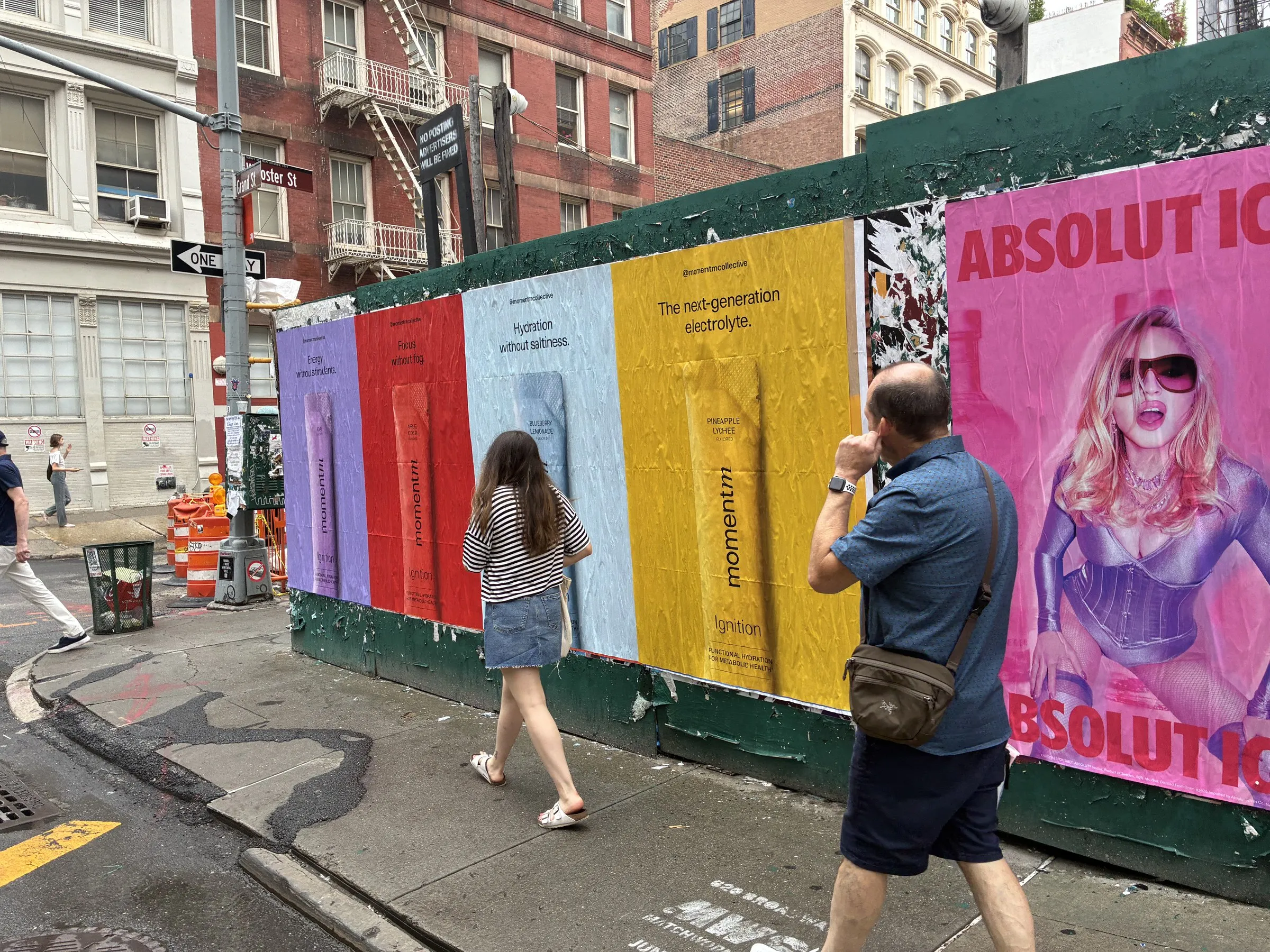
Wheatpasting. The original guerrilla format and still the highest-volume offering. Large-format paper posters adhered to permitted walls with water-based adhesive. Twenty-four by thirty-six inches standard. Forty-eight by seventy-two for hero installs. Print, paste, photograph, walk away. The visibility window is 14 to 60 days depending on weather, foot traffic, and surface prep. The format wins when the campaign needs velocity, fast turnaround, dense neighborhood saturation, organic social pickup. Real example: the Relevance AI “Agent #23” pixel-art posters that blanketed SoMa and the Mission last quarter. Starting at $3,500. Forward to the wheatpaste advertising service page and the Complete Guide to Wheatpasting pillar for the deep dive on this discipline.
Hand-painted murals. The flagship format. Skilled muralists spending 10 to 21 days on a single building side using exterior-grade acrylic with UV-protective topcoat. Forty by sixty feet typical for a building-side commission; twenty by thirty for an alley wall. The visibility window is 6 to 18 months. The format wins when the campaign needs prestige, sustained cultural presence in a mural district, earned photo amplification from neighborhood residents who post the wall to social. Wynwood, Bushwick, the Arts District in LA, the Mission in SF, East Austin, Old Fourth Ward in Atlanta are the active mural neighborhoods. From $18,000 for a 20-by-30 single-wall commission. See hand-painted murals for the format-level deep dive.
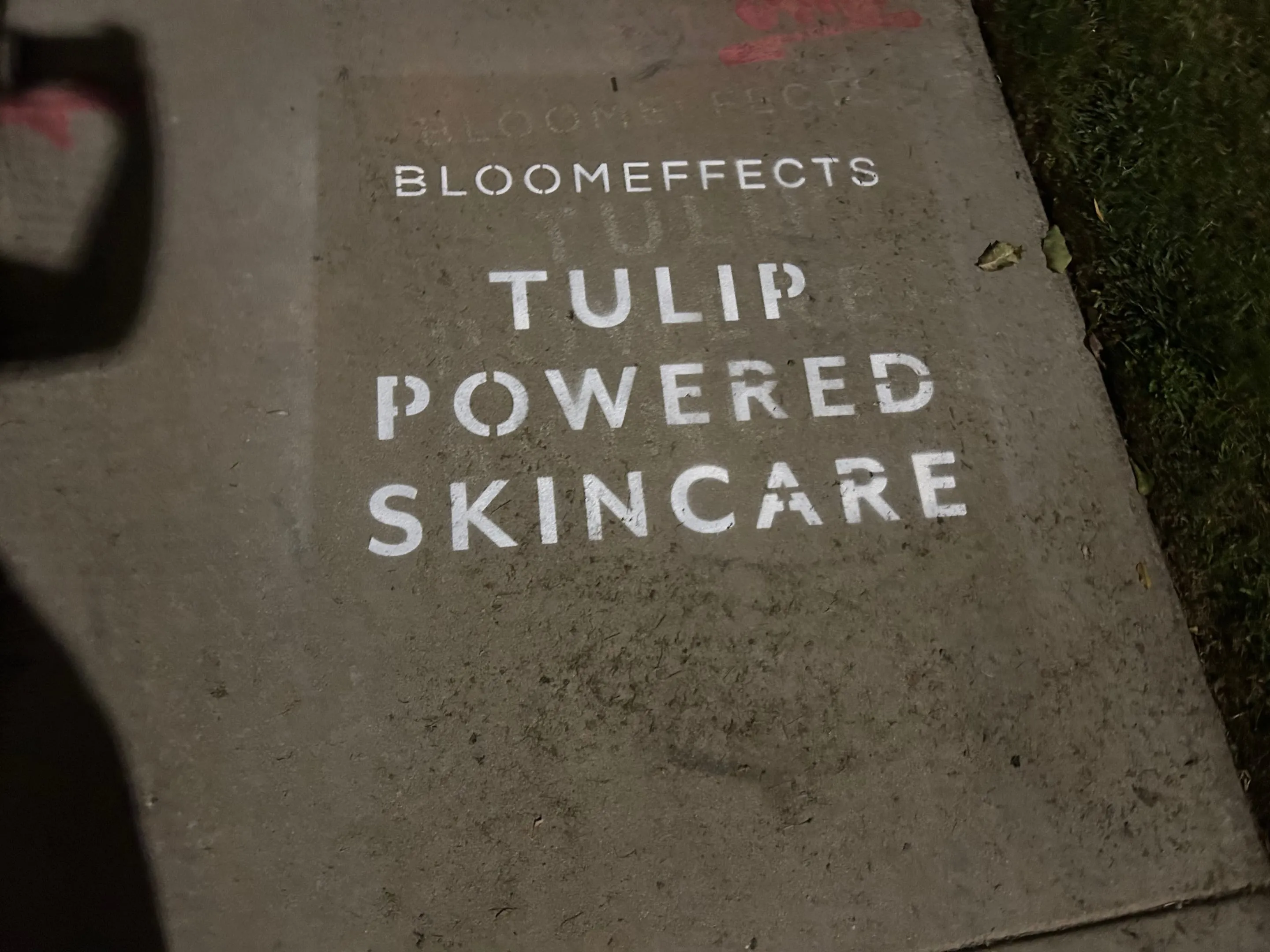
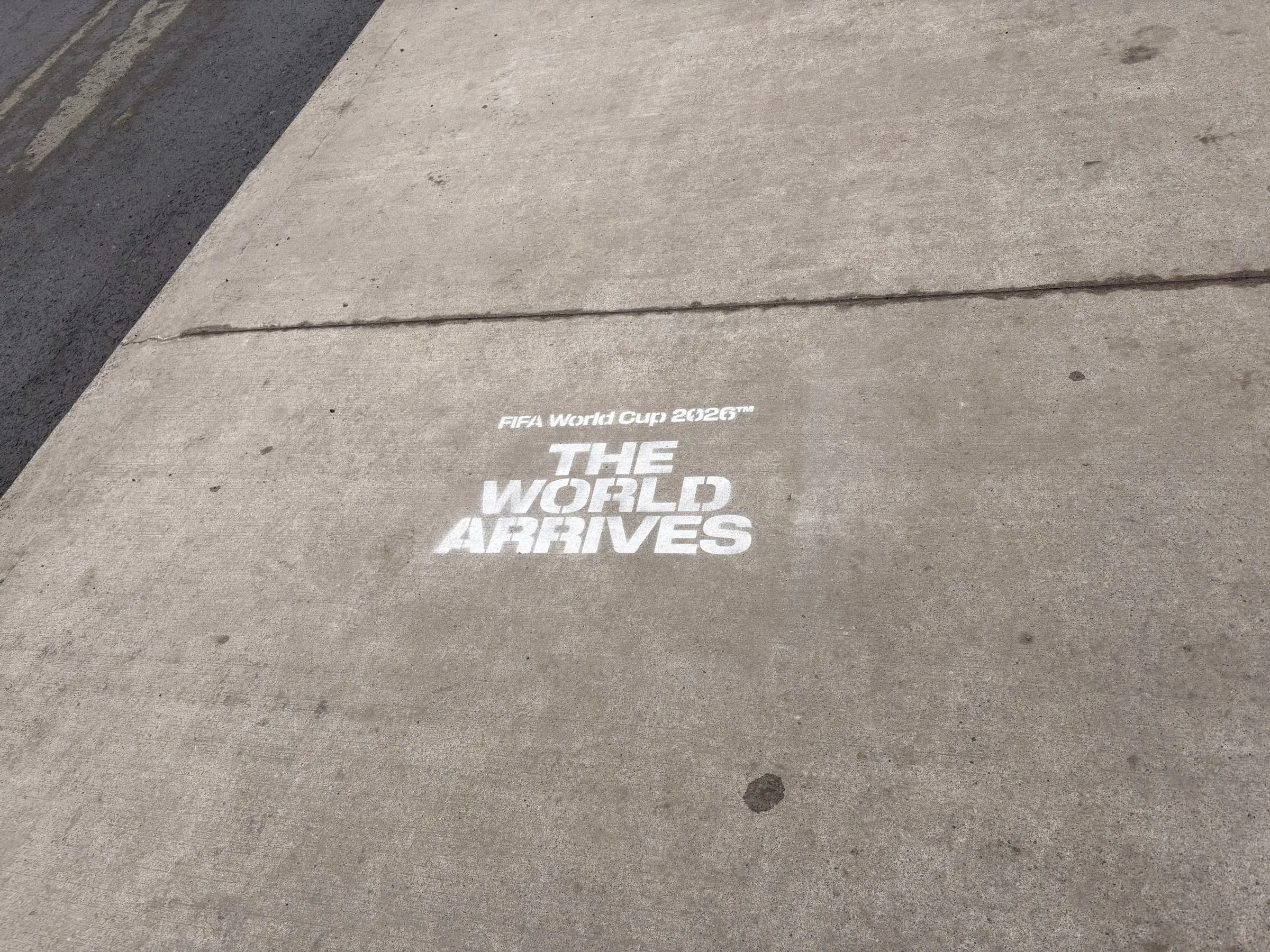
Sidewalk stencils. The ground-level layer of the stack. Brand mark, logo, message, or QR code stenciled onto sidewalk surfaces using chalk paint, biodegradable spray, or reverse-stencil clean-tag technique on dirty concrete. The visibility window ranges 2 to 7 days for chalk, 10 to 30 days for biodegradable spray, and 60-plus days for reverse-stencil clean tags. The format wins for wayfinding, directing foot traffic to a venue, activation, or polling place, and for hyperlocal brand presence outside the actual stores and venues the audience already visits. Bloom Effects ran sidewalk stencils outside Williamsburg retail corridors as a counterpoint to their wall-level wheatpaste. From $2,500 single-neighborhood. See sidewalk stencil advertising.
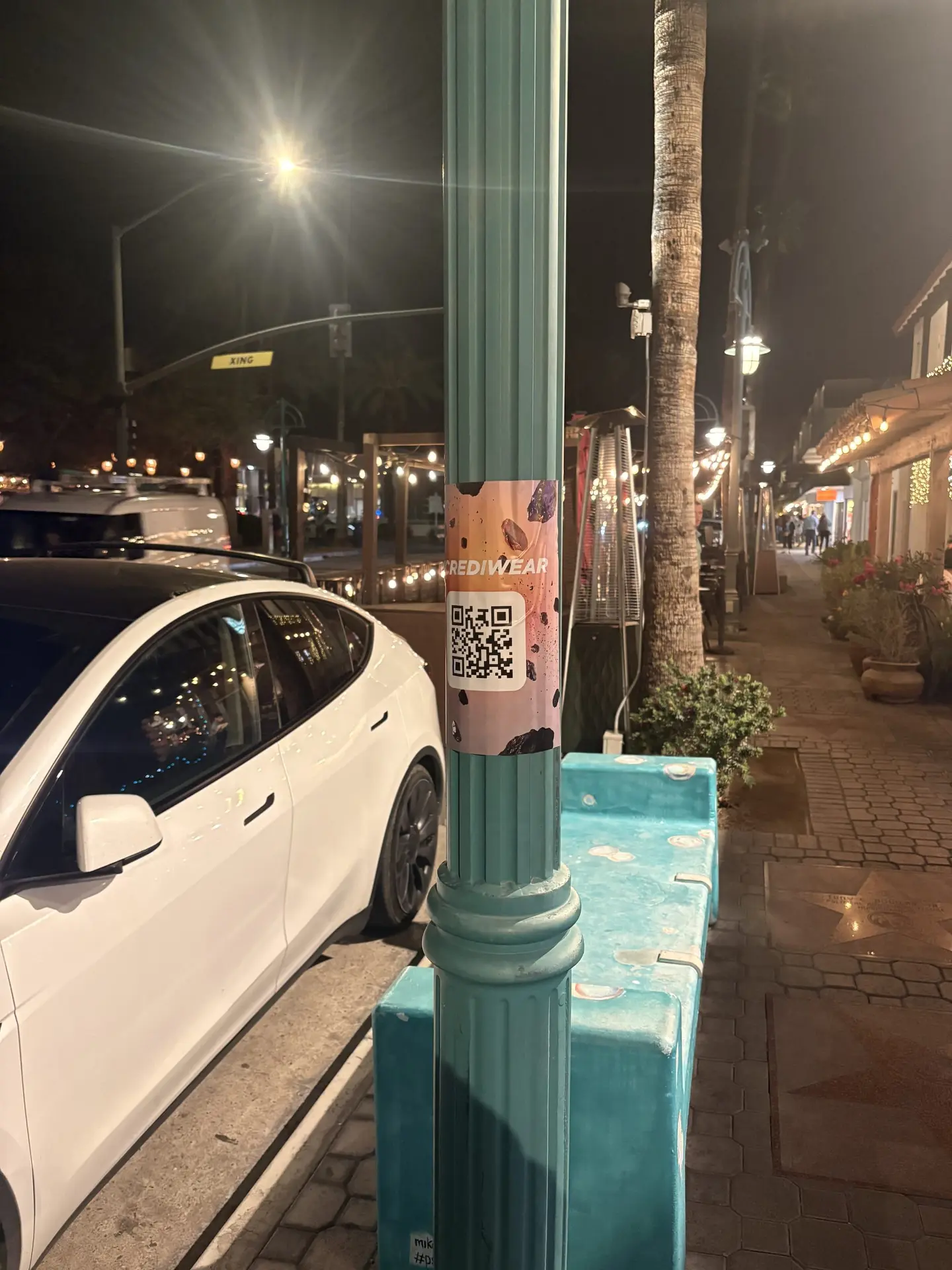
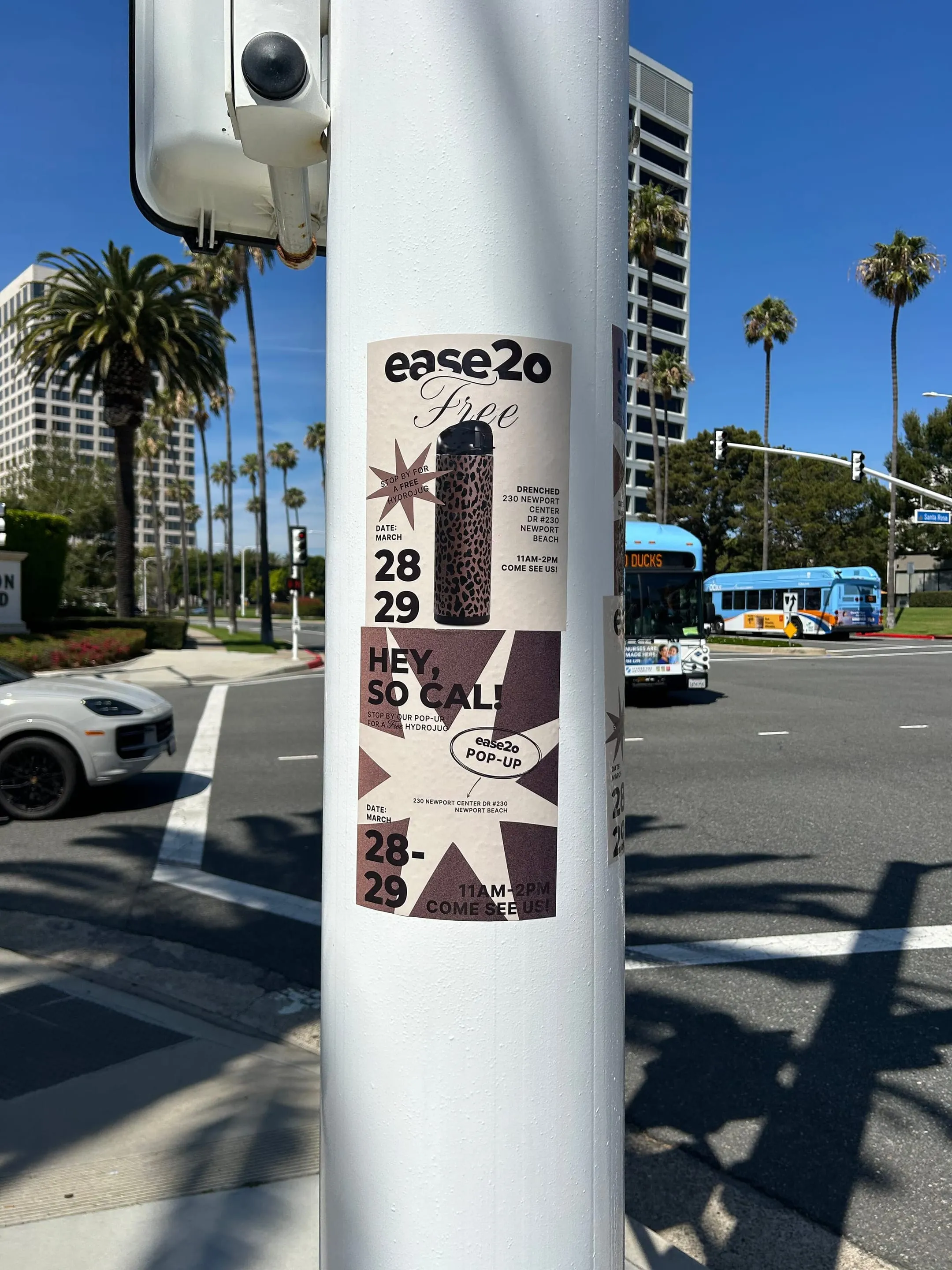
Pole stickers. Vinyl decals installed on legally permissioned street poles, light poles, signposts, scaffold uprights, and utility-box surfaces in dense urban corridors. The format scales differently from wheatpaste. A five-block run of pole stickers reads as a single campaign and creates rhythm at street-eye level that drivers, walkers, and commuters all register. Visibility runs 30 to 90 days depending on weather and city sanitation cycles. Real example: the Incrediwear pole-sticker corridor through Newport Beach and the Pittsburgh case study covering Lawrenceville and the Strip District. From $3,000 single-market. See pole sticker advertising.
Interior installs. The placement layer that lives inside curated host venues, bars, restaurants, coffee shops, gyms, salons, hotels, retail stores. Bathroom-mirror clings, stall-door posters, column wraps, window installs, full-room takeovers. The format wins on dwell time: the audience is already inside the venue for 20-plus minutes and the brand placement lands in a low-distraction environment. Brooks Run Club’s interior program in Seattle and Yonex’s SoHo pop-up activation are documented BSM examples. From $5,000 for a venue-curated multi-placement program. See interior installs.
The disciplines combine. A multi-city tour might pair wheatpaste in tier-1 neighborhoods with pole stickers as connective corridor presence and a single hand-painted mural as the anchor photo asset. That kind of mixed-format brief gets priced as a package, not as a sum of the parts. The combined deliverable carries more weight than any single discipline shipped alone.
03. Who buys guerrilla marketing
The buyer profile splits along vertical lines more than budget lines. The verticals matter because each one buys guerrilla for different reasons, with different photo expectations, and different success metrics. The audiences hub lists all 32 verticals BSM ships against. The five clusters below cover the dominant majority of the inbound.
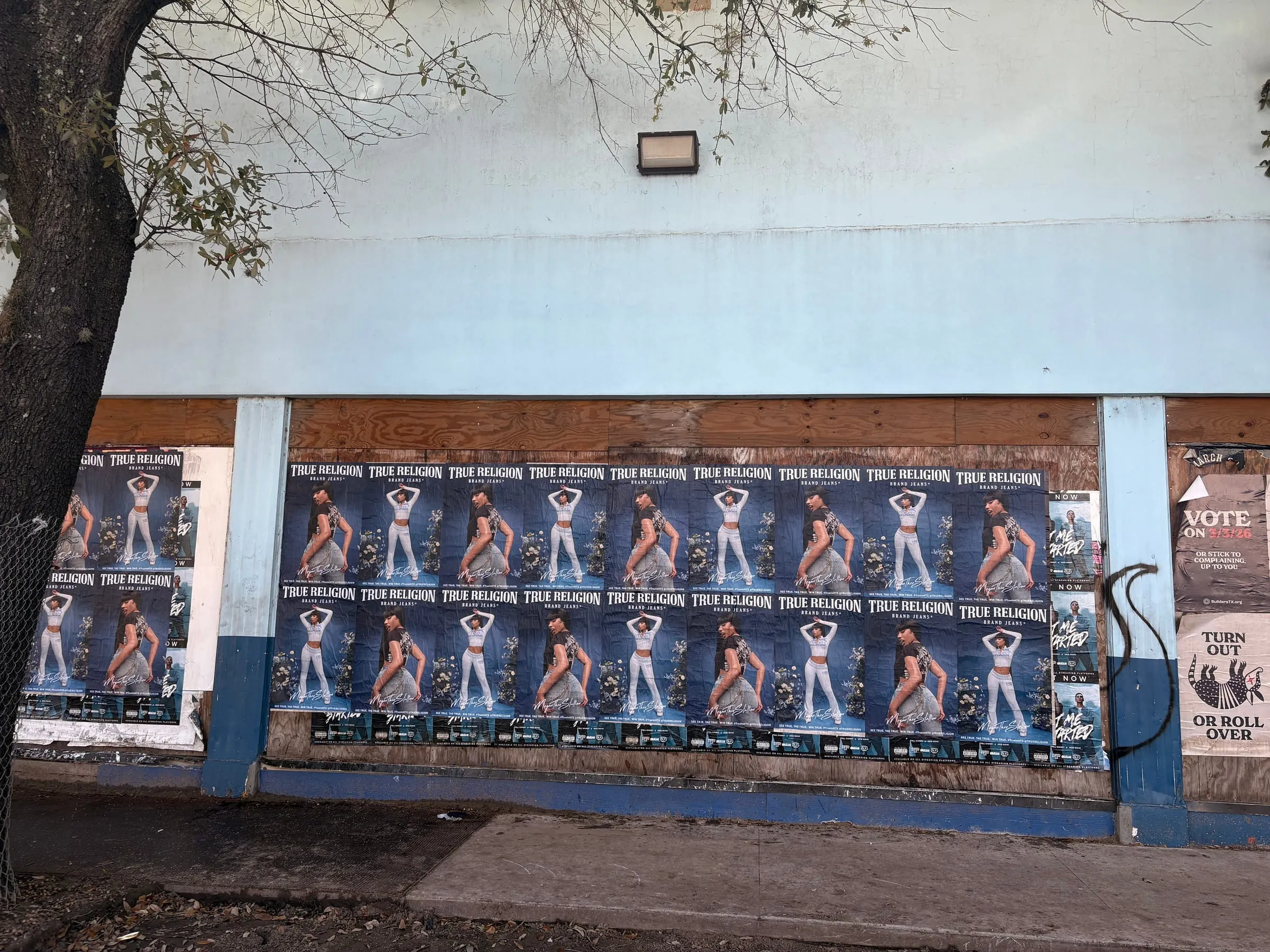
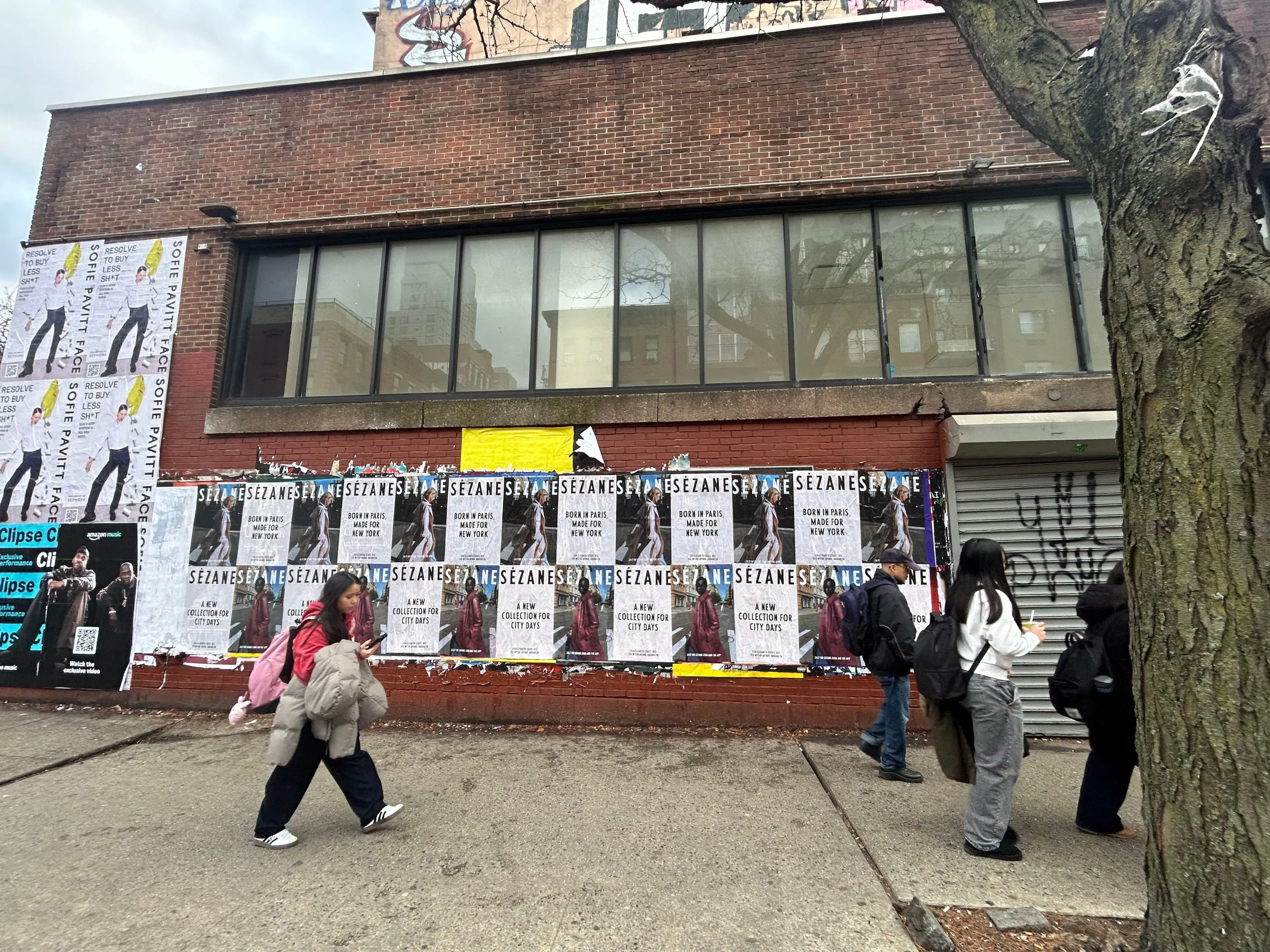
Fashion brands. Apparel houses launching collections, opening flagship stores, or claiming presence around fashion week and cultural calendars. Sezane ran a multi-city BSM campaign covering NYC, LA, and Miami around their flagship openings. True Religion ran a Houston wheatpaste blitz around the brand relaunch. Huda Beauty deployed wheatpaste in Soho and the Lower East Side around product drops. Fashion buyers want photogenic walls, named neighborhoods (SoHo, Williamsburg, Silver Lake, Wynwood), and social-ready imagery for press distribution. See fashion and apparel guerrilla marketing.
Tech launches. Series C-plus companies announcing product, platform, or category positioning. Palantir runs multi-city guerrilla activations covering San Diego, Honolulu, and adjacent markets. Relevance AI ran the Agent #23 SoMa campaign and the Agents Meatballs activation supporting their developer-platform launch. Stripe ran convergence-week presence in SF. Tech buyers want presence in operator neighborhoods (SoMa, the Mission, Hayes Valley in SF; Williamsburg and SoHo in NYC) and proof of cultural credibility outside the conference circuit. See tech and SaaS guerrilla marketing.
Music and entertainment. Labels supporting album drops, tours, festival appearances. OneRepublic ran the Artificial Paradise campaign across NYC corridors. Brooklyn Museum ran multi-exhibit guerrilla support covering Mugler, Pablo-Matic, and the Spike Lee retrospective. RYZE Coffee ran a 25-placement Brooklyn and Manhattan campaign around their mushroom-coffee product launch. Music and entertainment buyers want neighborhood density and earned-photo amplification from culture publications and social tagging. See music labels and artists guerrilla marketing.
Cultural institutions. Museums, galleries, nonprofits, advocacy coalitions. Nonprofits of NY ran a multi-org coalition campaign across Manhattan and Brooklyn. Brooklyn Museum’s exhibit-cycle program anchored three back-to-back shows. Cultural buyers want sustained neighborhood presence and grassroots-perception support. See nonprofits and advocacy guerrilla marketing and museums and cultural institutions.
Wellness and DTC. Direct-to-consumer health, beauty, fitness, and lifestyle brands building neighborhood density before paid digital scales. Momentous ran an LA wheatpaste program covering Silver Lake and Arts District. Incrediwear ran a Coachella Valley pole-sticker sweep around the BNP Paribas Open. ease2o ran a Newport Beach activation around their drinkware launch. Bloom Effects ran a Williamsburg and Soho program supporting beauty product drops. Wellness buyers want presence in the actual neighborhoods their target customer lives, eats, and works out in. See wellness and fitness guerrilla marketing and DTC, CPG and beauty brands.
What unifies the five clusters: every buyer above is an operator, not an enthusiast. They have been burned by vendors who disappear post-PO. They want photos, GPS coordinates, dates, names, walls, prices. They do not want vendor jargon. The brief intake form reflects that. The deliverables reflect that. The whole BSM operational thesis reflects that.
04. The 4 strategic moments brands buy guerrilla marketing
Inbound briefs to BSM cluster around four strategic moments. Knowing which moment your campaign sits in determines the format mix, the geography, and the budget envelope.
Launch. Product launches, store openings, album drops, brand relaunches, platform announcements. The campaign window is short (5 to 14 days), the photo demand is high (the brand needs press-ready imagery the day of launch), and the geography focuses on the launch city or the top three target metros. Wheatpaste and pole-sticker formats dominate launch briefs because they ship inside the launch-window calendar. The RYZE Coffee Brooklyn launch and the Relevance AI SoMa platform announcement are template examples. Budget envelope: from the $3,500 wheatpaste floor for single-city briefs through $30,000+ for multi-city programs.
Activation. Festivals, conventions, sporting events, fashion weeks, peak retail seasons (back-to-school, Black Friday, holiday). The campaign window aligns to the calendar event, geography clusters near the event neighborhoods or transit corridors feeding the venue, and the format mix favors high-density visual presence over sustained dwell time. The FIFA World Cup 2026 multi-city program covering Atlanta, Seattle, Toronto, and the multi-city aggregate is the template at the upper end. Yonex’s multi-city pre-Olympics activation is a tier-2 template. Budget envelope: $15,000 multi-market through $50,000-plus multi-city festival saturation.
Defense. A competitor has moved into the brand’s category and gained share. The brand needs a cultural rebuttal that runs in the same neighborhoods the competitor is buying media in. Guerrilla wins on defense because the response can ship inside 7 days and the photo proof creates a visible counter-presence. Defensive campaigns favor wheatpaste and hand-painted murals for the credibility signal. Budget envelope: $8,000 multi-neighborhood through $30,000 multi-city, often with mural anchor in the highest-pressure market.
Authority-building. Sustained brand presence in core neighborhoods, not tied to a launch or event. The brand is choosing to own certain corridors over multi-quarter horizons through rotating campaigns. Hand-painted murals dominate this brief because the visibility window matches the strategic horizon. Pole stickers serve as the connective tissue between mural anchors. The Palantir multi-city program is the template: sustained presence across San Diego, Honolulu, and tier-1 markets, with creative refreshing on a quarterly cycle. Budget envelope: $18,000 single-mural floor through $50,000-plus building-side mural plus rotating supporting campaigns.
Real briefs sometimes hit two of the four moments at once: a launch campaign that doubles as authority-building, or an activation campaign that runs as a defensive response to a competitor’s festival sponsorship. The brief intake captures which moment dominates, and the format mix and timeline get scoped accordingly.
05. Where guerrilla marketing works geographically
Beyond Street Media covers all 50 US states and Canada. 110-plus cities have documented BSM activity. The geographic question is not “where can we ship,” it is “which markets carry permanent crew” versus “which require dispatch from the nearest hub.”
Twelve anchor markets. Permanent crew, 5-7 day lead time, full format range, dense neighborhood specificity. These are the cities BSM ships the most volume in and where the deepest neighborhood-corridor knowledge lives.
- guerrilla marketing in New York City, the highest-volume market. SoHo, Williamsburg, Bushwick, the Lower East Side, Tribeca, Bed-Stuy. Brooklyn HQ.
- Los Angeles, the second-highest-volume market. Silver Lake, Echo Park, Arts District DTLA, Venice, Highland Park.
- guerrilla marketing in Miami, the Brooklyn HQ city. Wynwood (the global mural capital), Brickell, Design District, Little Havana.
- Chicago, Wicker Park, Logan Square, West Loop, Pilsen.
- San Francisco, SoMa, Mission District, Hayes Valley.
- Austin, East Austin, South Congress, Domain corridor.
- Atlanta, Old Fourth Ward, West Midtown, East Atlanta Village.
- Nashville, Lower Broadway, East Nashville, the Gulch.
- Boston, Allston, South End, Cambridgeport, the Seaport.
- Philadelphia, Fishtown, Northern Liberties, South Philly.
- Seattle, Capitol Hill, Ballard, Pioneer Square, Georgetown.
- Washington DC, Shaw, H Street, U Street, Georgetown.
Tier-2 dispatch markets. Active crews, 7-10 day lead time, full format range. Phoenix, Denver, Portland, Dallas, Houston, New Orleans, Charlotte, Pittsburgh, Detroit, San Diego, Sacramento, Tampa, Saint Petersburg, Salt Lake City, Las Vegas, Minneapolis, Orlando.
Tier-3 dispatch markets. Crew dispatch from the nearest hub, 10-14 day lead time, single-format briefs strongly preferred. The remaining 60-plus cities in the BSM coverage map, including state capitals and tertiary metros across the South, Mountain West, and Midwest.
The 50-state legal framework is documented in the Wheatpaste Laws by State pillar. Every state has a defacement or unauthorized-posting statute that applies to public infrastructure. Every state has a permitted-surface pathway through private-owner consent. The compliance framework holds in all 50. The differences live in city-level sign codes and enforcement intensity. The full coverage map lives at the coverage hub.
06. Pricing the campaign
Beyond Street Media publishes per-discipline pricing floors. No discovery-call gatekeeping. No RFP-builder chatbot. The full rate card lives at the pricing page and the cost-driver breakdown lives at the wheatpaste campaign cost insight. The published floors in 2026:
| Discipline | Floor | Notes |
|---|---|---|
| Wheatpaste posters | Starting at $3,500 | Single-market brief. 5 to 7 day lead time. |
| Sidewalk stencils | Starting at $2,500 | Permit class varies by city. 5 to 7 day lead time. |
| Snipes + stickers | Starting at $3,000 | Cheapest path to neighborhood saturation. 5 to 10 day lead. |
| Floor graphics | Starting at $4,000 | Outdoor and partner-venue surfaces. |
| Hand-painted mural | $18,000-$28,000 | Single 20-by-30 wall, skilled muralist. 10 to 21 day lead. |
| Building-side mural | $30,000-$65,000+ | 40-by-60 feet plus, full artist commission. 3 week lead. |
| Expedited Campaigns | +80% to +150%+ over standard | 24 to 72 hour brief-to-documented-install. Premium typically doubles standard rate. |
We publish floors, not single fixed numbers, because the brief specifics move the final quote. Final number depends on turnaround, size, location count, and combined service mix. Final quote returns inside 24 to 48 hours of brief intake.
The published floor reflects four real cost centers: print production (outdoor-grade paper, soy ink, press run sized to placement count plus overage), crew dispatch and install labor (two-person crew, 5 to 7 hours per neighborhood, paste, brushes, ladders, vehicle), documentation (photography, GPS tagging, daily logs, wrap deck), and compliance (property-owner consent, BID coordination, GC authorization on hoardings).
Four variables move a quote across the range: turnaround (the Expedited Campaigns tier typically doubles standard rate for 24-72hr windows), size (larger campaigns earn a better per-unit rate as crew cost amortizes), location count (single-market briefs price differently than multi-city programs), and service mix (combining wheatpaste + stencil + snipes prices as one program, not stacked invoices).
Volume efficiency applies at scale. Larger campaigns earn a better rate as crew cost amortizes across more density per dispatch. Multi-city tours layer a tour-coordination efficiency on top. The final number returns inside the quote based on the brief’s specifics. Range varies by turnaround, size, location count, and combined service mix. Final quote returns inside 24 to 48 hours.
How this compares: a single-market wheatpaste run in NYC starting at $3,500 delivers 14 to 21 days of foot-traffic visibility in named neighborhoods. The equivalent classic billboard buy in NYC starts at $25,000 to $40,000 per month for one high-traffic location with zero neighborhood granularity. Paid social CPC in fashion or tech verticals runs $1.80 to $4.20 per click; a comparable wheatpaste campaign generates an organic photo-amplification lift that translates to 200-plus tagged Instagram posts inside the 30-day window with no incremental CPC.
Forward to the pricing page for the full rate card. Send the brief at /contact/ for a custom quote in 24 to 48 hours.
07. Legality and the “guerrilla” misconception
The most-asked question on inbound briefs: is guerrilla marketing legal?
Short answer: yes, when the surface is permitted and the property owner has given written consent. Illegal when it lives on public infrastructure. The medium is not the issue. The surface is. New York Penal Law § 145.30 states the test plainly: the offense is posting on the property of another with no right to do so and no reasonable ground to believe you have one. Authorization is the whole difference between a campaign and a violation.
The misconception lives in the word “guerrilla.” Levinson’s 1984 framing borrowed the term from asymmetric warfare, and the original tactics included unauthorized public-property installs. The premium end of the category has moved away from that posture. Every Beyond Street Media install has sat on one of three permitted lanes.
Lane 1: Private property with written owner consent. The dominant pathway, accounting for the majority of paste-up, sticker, and mural volume. A property owner, leaseholder, or authorized agent signs a consent form before any install lands. The consent specifies the surface, the install window, and the removal terms. The paper trail lives in the campaign file.
Lane 2: GC-authorized construction hoardings. The general contractor controls the hoarding during the build cycle. A signed authorization from the GC or developer covers the hoarding panels. This is one of the cleanest pathways for large-format paste-ups and a meaningful share of BSM’s volume in NYC, Chicago, and Miami.
Lane 3: BID-cleared corridors and sanctioned signage programs. A Business Improvement District is, in the City of New York’s own definition, a geographic area where local stakeholders oversee and fund the upkeep, improvement, and promotion of their commercial district. Those districts and city signage programs run authorized pathways for member businesses. Wynwood BID in Miami, Times Square Alliance and Downtown Brooklyn Partnership in NYC, Downtown LA Alliance, Yerba Buena in SF, West Town BID in Chicago all coordinate sanctioned poster and mural programs.
No install lands on public infrastructure. No utility pole, no traffic sign, no mailbox, no transit property, no public bench. States draw that line the same way we do: California Penal Code § 556 makes it a misdemeanor to place an advertising sign on state, city, or county property without lawful permission. The legal lane is wide enough to run a national campaign. The campaigns that get pulled by sanitation are the ones that skipped the consent step. We do not skip it.
That is the operational explanation for the zero municipal removals on record claim across 500-plus documented installs. The state-by-state legal framework is published in the 50-state Wheatpaste Laws pillar. Practical city-level walkthroughs live in the NYC posting legality piece and the LA sidewalk stenciling legality piece. Nothing in this section is legal advice. Specific campaign exposure gets reviewed with counsel familiar with the target jurisdiction before any crew dispatches.
08. Measuring guerrilla marketing
Guerrilla marketing measures differently than digital. There is no impression-bidding console. There is no click-attribution model. There is a permitted wall, a documented install, and the audience that walked past it. That structural fact shapes what gets reported.
Impressions. Modeled from foot traffic data times install duration. A 20-wall wheatpaste run in SoHo with average corridor foot traffic of 12,000 to 18,000 pedestrians per day over a 21-day install window produces a modeled impression count in the 5 to 7 million range. The model is conservative. It excludes vehicular pass-by and counts each pedestrian as a single impression per day, not per pass. Brand teams who want a tighter impression number commission third-party foot-traffic measurement (Placer.ai, Near, Bluedot) and BSM coordinates the data handoff.
Brand recall lift. Measured through pre-and-post survey in the campaign neighborhood. Standard methodology: an n-of-200 intercept survey before install and a matched n-of-200 after the campaign window closes. Brands running this measurement layer typically see 18 to 35 percent recall lift in the neighborhood-specific audience versus the citywide baseline. The lift correlates to campaign saturation rather than total impression count.
Social pickup. Tracked through hashtag and geo-tag monitoring on Instagram, TikTok, and Twitter. Documented BSM campaigns generate 80 to 500 organic user-generated posts per campaign, depending on creative quality and neighborhood density. The Sezane multi-city run produced more than 280 tagged Instagram posts across the three target cities inside the 30-day window. The Brooklyn Museum exhibit cycle generated more than 700 tagged photos across the three back-to-back shows.
Earned press mentions. Local culture publications, trade press (Adweek, AdAge, OOH Today, The Drum), and neighborhood blogs cover guerrilla campaigns when the creative is photogenic and the brand is recognizable. BSM tracks press mentions through standard media-monitoring (Critical Mention, Meltwater, Cision) when the brand has the subscription. Campaigns that produce strong creative typically generate 3 to 12 earned press mentions inside the campaign window.
Photo proof archive. The single deliverable that does not exist on any other channel. Every install gets three GPS-stamped photos: wide context shot, mid-distance composition shot, detail shot. The complete archive ships in the final wrap deck inside 48 hours of campaign close. The archive is the brand’s asset to keep. It feeds social posting, internal reporting, sales-deck imagery, and case-study development for multi-quarter horizons.
What guerrilla marketing does not measure: direct conversion attribution. A wheatpaste poster does not click through to a checkout page. Buyers expecting a CAC line on the dashboard will be disappointed. Buyers expecting cultural credibility, neighborhood-density signal, and earned photo amplification will see exactly what the channel produces. The two value frames are different, and the brief intake captures which one is the campaign objective.
Deeper read on the documentation discipline: Photo Proof and GPS Documentation in Guerrilla Marketing.
09. Guerrilla marketing vs other out-of-home
Guerrilla marketing sits inside the broader out-of-home category, which the Out of Home Advertising Association of America sorts into billboards, street furniture, transit, and place-based media. The category has four other major formats brand teams evaluate it against.
Versus billboards. Billboards buy impressions at scale through one high-traffic surface. Guerrilla buys neighborhood density at fractional cost. A single NYC billboard runs $25,000 to $80,000 per month for one location. A multi-neighborhood wheatpaste in the same city starts at $3,500 and reaches multiple distinct foot-traffic corridors. The audience overlap is partial. Billboards reach drivers and transit riders; guerrilla reaches walkers. Brand teams running both channels report that the formats compound rather than cannibalize. Billboards land impressions, guerrilla lands cultural-credibility signal.
Versus transit advertising. Transit (subway car interior cards, station dominations, bus wraps, taxi tops) sells dwell-time impressions during commute windows. Guerrilla sells photogenic neighborhood presence outside the transit system. Transit wins on raw impression count in dense transit cities (NYC, DC, Boston). Guerrilla wins on photo-proof asset value and earned amplification. Transit campaigns also rarely get photographed by riders; guerrilla campaigns get photographed constantly. The photogenic quality is the entire point of the channel for most BSM clients.
Versus Wild Posting®. Wild Posting® is Dash Two’s registered trademark for one craft tradition in paste-up advertising. The craft itself is the same physical practice as wheatpasting: paper posters adhered to permitted walls with water-based adhesive. Beyond Street Media ships that craft under the wheatpasting and paste-up labels rather than the trademarked phrase, because we are not licensed by Dash Two. The execution discipline is the same: permitted surfaces, property-owner consent, photo proof, geo-tagged install record. For a brand team specifically evaluating the trademarked vendor versus alternatives, the Wild Posting® alternative guide walks the comparison through.
Versus experiential and event marketing. Experiential agencies build pop-ups, brand activations, and event installations that run 48 hours to 5 days in a fixed location. Guerrilla marketing is the always-on physical layer that lives 14 to 60 days in a neighborhood corridor. Experiential is the event spike; guerrilla is the sustained presence. Brand teams running both channels typically pair them: a guerrilla campaign builds neighborhood density in the weeks leading up to an experiential activation, then continues during and after the event for sustained recall.
Versus programmatic OOH (pDOOH). Programmatic OOH buys digital screen inventory through automated bidding. The channel scales impression delivery but cannot reach the surfaces guerrilla marketing operates on. pDOOH and guerrilla do not compete. They sit in different inventory pools. A modern OOH plan often includes both.
The honest competitive answer: guerrilla marketing wins on neighborhood density, photo proof, cultural credibility, and earned amplification. It loses on raw impression scale, click-attribution, and inventory automation. Brand teams who buy guerrilla are not optimizing for the same metrics digital teams optimize for. The two frames coexist. The brief should pick the one that matches the campaign objective.
10. How to brief BSM for guerrilla marketing
The brief intake at Beyond Street Media is deliberately short. Five fields, sent to info@beyondstreetmedia.com, produce a real line-item quote inside 48 business hours.
Field 1: Brand and campaign objective. What brand, what is the campaign, what does success look like. Launch a product? Open a store? Defend a category position? Build sustained authority? The objective shapes the format mix.
Field 2: Target cities or neighborhoods. Which markets need coverage. If the answer is “wherever makes sense,” BSM proposes a geography in the return brief based on the audience profile. If the brand has specific corridors in mind (SoHo, Bushwick, Silver Lake, Wynwood, SoMa) name them.
Field 3: Install window. Start date, end date, any hard constraints (a launch day, an event tie-in, a press embargo). If the window is open, BSM proposes the optimal install timing in the return brief.
Field 4: Budget range. A range, not a ceiling. $4,000 to $10,000 unlocks a different conversation than $30,000 to $50,000. Buyers who want price floors before committing to a range can pull the published rate card from the pricing page.
Field 5: Creative and compliance constraints. Any specific creative requirements (size, format, finish), any compliance constraints (political-attribution lines, regulatory disclaimers, brand-safety zones to avoid). Print-ready files are appreciated but not required at intake.
What BSM returns inside 48 business hours:
- A proposed neighborhood map with named corridors and surface types
- A format mix recommendation (wheatpaste, mural, stencil, sticker, interior, or combinations)
- A line-item quote with print, crew, documentation, and compliance broken out
- An install window with start and complete dates
- Any permit pass-throughs or BID coordination flagged explicitly
No discovery calls. No “let’s hop on a quick 30-minute kickoff.” The quote is the conversation. Most briefs lock inside 5 business days of intake. The detailed brief template lives here for buyers who want a structured form to fill against. The BSM process page walks the full intake-to-wrap workflow.
When the brief comes back and the brand approves, the campaign moves into surface scouting (BSM scouts target neighborhoods and confirms legal posting surfaces), print or paint production, crew dispatch, install, daily reporting, and final wrap. The end state: photo proof on the wall, the photo archive in the wrap deck, and the brand on the record.
11. Single-format pricing floors, in full
Section 06 covers the headline disciplines. For brand teams pricing a narrow single-format brief, the full published floor list runs deeper. Every floor below covers creative, execution, documentation, and compliance inside one number. Range varies by turnaround, size, location count, and combined service mix. Final quote returns inside 24 to 48 hours of brief intake.
| Format | Floor |
|---|---|
| A-frame signs | from $2,400 |
| Sidewalk stencils | from $2,500 |
| Yard signs | from $2,800 |
| Pole stickers | from $3,000 |
| Snipes | from $3,000 |
| Sticker bombing | from $3,000 |
| Street-furniture wraps | from $3,200 |
| Reverse stencil | from $3,500 |
| Wheatpaste posters | from $3,500 |
| Sidewalk decals / floor graphics | from $4,000 |
| Utility-box stickers | from $4,000 |
| Street-pole takeover | from $8,500 |
| Scaffold wrap | from $12,000 |
| Hand-painted murals | from $18,000 (building-side from $30,000) |
The full rate card lives at the pricing page and the cost-driver breakdown at the wheatpaste campaign cost insight.
12. Calculating ROI on a guerrilla campaign
Section 08 covers what guerrilla marketing measures. This section covers how to turn those measurements into a return number when the campaign has a trackable endpoint (a retail location, an app, an event, a promo code).
The formula is the standard one:
ROI = (Revenue − Cost) ÷ Cost × 100
Worked example. A wheatpaste campaign costs $12,000 and drives 300 attributed store visits, each generating an average $50 in incremental revenue ($15,000 total):
ROI = ($15,000 − $12,000) ÷ $12,000 × 100 = 25 percent
Layer in earned value. If the same campaign also generates 5,000 organic social impressions and two press mentions, with a conservative earned-media-equivalent value of $8,000, total attributed value climbs to $23,000:
ROI = ($23,000 − $12,000) ÷ $12,000 × 100 = 92 percent
Well-executed campaigns with a trackable endpoint typically land in the 50 to 150 percent range. Campaigns that go viral or generate heavy press clear 300 percent. Awareness-only campaigns with no trackable endpoint are measured on press pickup and social volume instead, which is harder to convert to a clean ROI line. The brief intake captures which frame applies before the quote returns.
13. The format-to-objective matrix
Most successful campaigns blend two or three formats, but the lead format should track the primary objective. Match the goal to the format:
| Objective | Best format | Why |
|---|---|---|
| Brand awareness | Wheatpaste | High-visibility, Instagram-native, press-friendly |
| Direct response (promo code, QR) | Stencil or pole sticker | High legibility, high frequency, clear CTA |
| High-volume saturation | Pole sticker | Cheap per unit, high frequency, neighborhood saturation |
| Event promotion | Wheatpaste + stencil | Large creative + clear event date + QR link |
| Landmark / heritage moment | Mural | Semi-permanent, scale, foot-traffic destination |
| Retail traffic driver | Interior install + geofencing | Guaranteed foot traffic, demographic precision, tracking |
| Rapid-response campaign | Snipe or pole sticker | Fast turnaround, cheap, deployed quickly |
| Cause / advocacy | Wheatpaste + mural | High visibility, shareable, press pickup |
Layer the formats: a large-format anchor (wheatpaste or mural) for awareness and press, a stencil or snipe for direct response, and pole stickers for saturation and frequency.
14. How to vet a guerrilla agency: the 7-step framework
Most guerrilla agencies are small (5 to 15 people) and city-based, covering one primary market and a handful of secondary cities through partnerships. Before signing, assess these seven dimensions.
Step 1 - Scope clarity. Does the agency ask what cities, what neighborhoods, what audience, what foot-traffic profile, what creative format, and what your trackable endpoint is? Good agencies define the objective before quoting. Bad agencies pitch a generic “brand activation” without digging into specifics.
Step 2 - Proof standards. Do they GPS-tag every install, photograph pre and post, and deliver a timestamped proof deck? Demand proof that every placement was installed, photographed, and is standing on a specific wall on a specific date. “Estimated reach” is not proof.
Step 3 - Permit handling. Do they file permits where required, maintain property-owner agreements in writing, and carry liability insurance? “Permits slow things down, so we skip them” is not efficiency. It is risk that lands on the client.
Step 4 - Pricing transparency. Do they publish floors (wheatpaste from $3,500, stencils from $2,500) and explain the total? “Pricing is confidential until we know more” is consultant-speak. You are buying poster installations, not a six-month engagement. The price should be straightforward.
Step 5 - Timeline reality. What is the real lead time from brief to first install? An honest answer is 2 to 3 weeks for a scouted single-market campaign: roughly a week for design and scouting, 3 to 5 days for print, 2 to 3 days for install. “We can launch in 2 days” is unrealistic unless the campaign is already designed and scouted.
Step 6 - Deliverables checklist. What ships in the final wrap package? Expect a pre-launch scouting report, timestamped proof-of-placement photos with GPS coordinates for every wall, a social-tracking report, a final wrap report (placement count, lifespan, foot-stops, attribution), and brand-safe creative files. Vague “a photo gallery” is not enough.
Step 7 - Contract terms. What does the contract say about cancellation, IP, and indemnification? Good agencies offer a clear cancellation clause, client ownership of the creative, and indemnification against defacement claims tied to installs. Walk away if they will not clarify terms.
Red flags: when to walk away
- “Estimated reach of 500,000 people.” Reach is unverifiable. Demand foot-stops or social pickup instead.
- “We can’t disclose our pricing.” Pricing secrecy means they are either overcharging or do not know their own cost. Both are bad.
- “We partner with crews who keep their names confidential.” Crews should be named and trained. Anonymity signals no quality or compliance management.
- “Permits slow things down, so we skip them.” That is risk transfer, not efficiency. You are liable when they get fined.
- “Our reach estimate is conservative: 250,000 impressions.” Still unverifiable. Stop asking for estimates; start asking for proof.
- “We have 20 years of experience.” Maybe. But can they show a current GPS-tagged wrap report? Old experience does not redeem sloppy current work.
- “We’ll email you weekly updates.” Updates are fine, but demand photo proof and GPS coordinates, not email summaries.
- “Cancellation is not allowed, it’s a commitment.” Demand a cancellation clause. A refusal usually means they do not want you seeing mid-campaign quality.
The Beyond Street Media answer to all seven steps is published, not pitched: floors on the pricing page, the documentation discipline at Photo Proof and GPS Documentation, and the consent-documented legal model in section 07 above.
FAQ
The 12 most-asked questions from inbound briefs.
What is guerrilla marketing in 2026?
Guerrilla marketing is the discipline of installing brand presence in physical neighborhoods through consent-documented only methods: wheatpasting, murals, sidewalk stencils, pole stickers, and interior installs. The 1984 Levinson framing emphasized low-budget and unauthorized tactics. The 2026 premium end of the category runs permitted surfaces, documented owner consent, and photo proof.
Is guerrilla marketing legal?
Yes, when the surface is permitted and the property owner has given written consent. Illegal when it lives on public infrastructure (utility poles, traffic signs, mailboxes, transit property). BSM has documented 500-plus installs with zero municipal removals on record because every campaign sits on private property with consent, on GC-authorized hoardings, or in BID-cleared corridors.
How much does a campaign cost?
Wheatpaste campaigns start at $3,500. Sidewalk stencils start at $2,500. Snipes and stickers start at $3,000. Floor graphics start at $4,000. Multi-city tours $15,000 to $35,000-plus per week for coordinated multi-market programs. Hand-painted murals $18,000 to $28,000 on a single wall and $30,000 to $65,000-plus for building-side commissions. Expedited Campaigns typically double the standard rate (+80% to +150%+) for 24-to-72 hour brief-to-wall. Full rate card lives at the pricing page.
Which brands buy guerrilla marketing?
Fashion (Sezane, True Religion, Huda Beauty), tech (Palantir, Relevance AI, Stripe), music and entertainment (OneRepublic, Brooklyn Museum, RYZE Coffee), cultural institutions (Nonprofits of NY), and wellness or DTC (Momentous, Incrediwear, ease2o, Bloom Effects). The work archive lists 27-plus documented case studies.
What is the lead time?
5 to 7 business days from approved creative to first install in tier-1 cities. 7 to 10 days in tier-2 markets. 14 to 21 days for multi-city tours. 10 to 21 days for hand-painted murals plus 3 to 5 days of wall prep. 48-hour rush is available in NYC and LA for time-sensitive drops.
Where does BSM ship campaigns?
All 50 US states and Canada. 12 anchor markets with permanent crew. 17 tier-2 markets with active dispatch. 60-plus tier-3 markets reachable through crew dispatch from the nearest hub. The coverage hub lists every state and city in the network.
How is the campaign measured?
Modeled impressions (foot traffic times install duration), brand recall lift (pre/post survey), social pickup (hashtag and geo-tag monitoring), earned press mentions (media-monitoring tools), and the photo proof archive (three GPS-stamped photos per wall). Deeper read at the photo proof and GPS documentation insight.
How does BSM compare to AGM?
American Guerrilla Marketing is a large-volume agency with broad geographic coverage on indexed search. BSM is a premium operator agency with published per-wall pricing, photo proof on every install, and a documented client roster including Palantir, Sezane, Yonex, FIFA World Cup 2026, and Brooklyn Museum. The full side-by-side lives at the BSM vs AGM comparison page.
How does BSM compare to Wild Posting®?
Wild Posting® is Dash Two’s registered trademark for one paste-up craft tradition. BSM ships the same underlying craft under the wheatpasting and paste-up labels. The execution discipline is identical: permitted surfaces, property-owner consent, photo proof, geo-tagged install record. See the BSM vs Wild Posting® comparison page.
Can formats combine?
Yes, and most multi-city campaigns combine two or three. A typical tour pairs wheatpaste in tier-1 neighborhoods with pole stickers as corridor connective tissue and a single hand-painted mural as the anchor photo asset. Mixed-format briefs price as a package, not as a sum of the parts.
Is exclusivity available in a neighborhood?
BSM does not contractually exclude other brands from corridors. The placement-map deliverable shows the specific walls and surfaces in the campaign so the brand knows what is locked. If a competitor brand briefs an adjacent campaign during your install window, the BSM ops team flags the conflict and the brand can choose to extend, adjust, or proceed.
What is the refresh policy?
Standard 30-day refresh on paste-up campaigns is included in the base price. A second install pass at day 14, 21, or 30 covers any walls that weathered, posted-over, or otherwise lost finish. Pole stickers get refresh coverage at 45-day intervals on multi-cycle programs. Murals carry a 6-month touch-up guarantee. Contract terms run campaign-by-campaign; no retainer commitment.
Brief us
The brand showed up where the audience already lives. That is the campaign.
Send a brief to info@beyondstreetmedia.com. Pull the published rate card for the ranges, or hit /contact/ for a custom quote returned in 24 to 48 hours. See the coverage map for every market in the network. See the work archive for 27-plus documented campaigns with named clients and photo proof. Got a wall? We’ve got the paste.