A street campaign quote does not need a discovery call. It needs five specific inputs in a single email, and it comes back inside 24 to 48 hours with a neighborhood-mapped install plan and real start-and-complete dates.
Industry guidance assumes the long version of this. The ANA and the 4As tell marketers to allow two to three months for a US agency review and to put an anticipated budget range in the brief itself (10 Principles of Pitching). The budget-range advice holds for a poster run, though the two-month calendar does not, because what you are buying here is an install rather than an agency relationship.
This piece is the template for those five inputs, plus the three brief mistakes that slow every quote down.
The five inputs that get you a quote
1. City or cities
Name the cities. A brief that says “the East Coast” or “major metros” comes back as a question instead of a number.
The Census Bureau counts 387 metro areas in the US, from the 19.9 million people in New York-Newark-Jersey City on down (Vintage 2024 population estimates). We keep resident crews in nine of them: New York, Los Angeles, Chicago, Miami, San Francisco, Atlanta, Houston, Seattle, Pittsburgh. Those briefs run 5 to 7 days from approved creative to the first wall. Outside them, crews fly, and the quote carries a travel and per-diem line itemized at cost plus dispatch days on the front of the calendar.
If you want to run in multiple cities, list them. A 4-city tour and a 6-city tour are different price points, and the routing between them is most of the work: Palantir’s 300-poster recruitment run put 250 posters across San Diego in 48 hours and 50 across Honolulu over 72, one brief at two market tempos. See the coverage map for every market where we have active crew.
2. Format
Out-of-home closed 2025 at a record $9.46 billion, up 3.6 percent and its nineteenth consecutive quarter of growth, with digital formats taking 36.3 percent of the total (OAAA). Most of that money buys billboards and transit screens. The formats below buy the sidewalk.
Pick one or more:
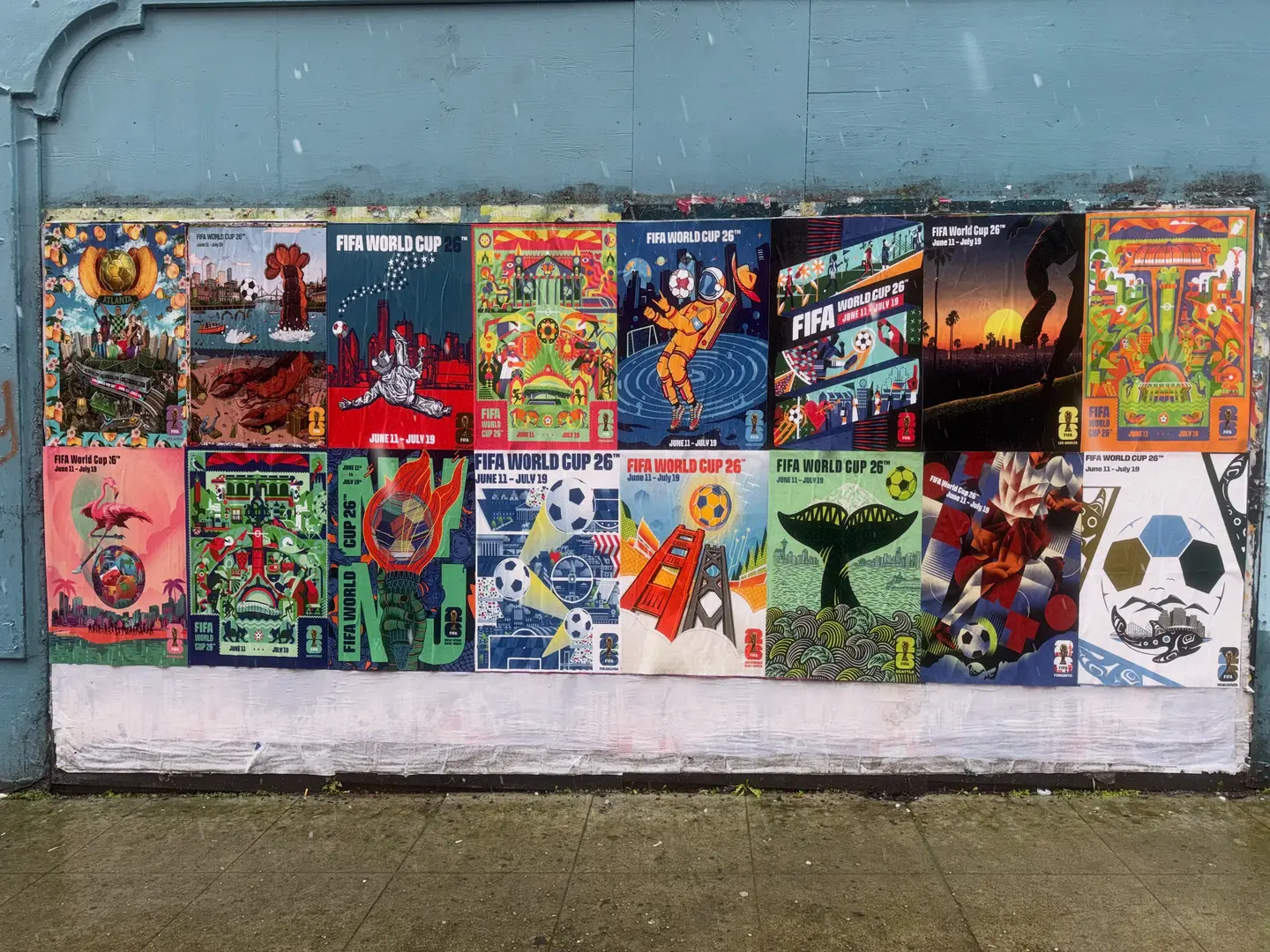
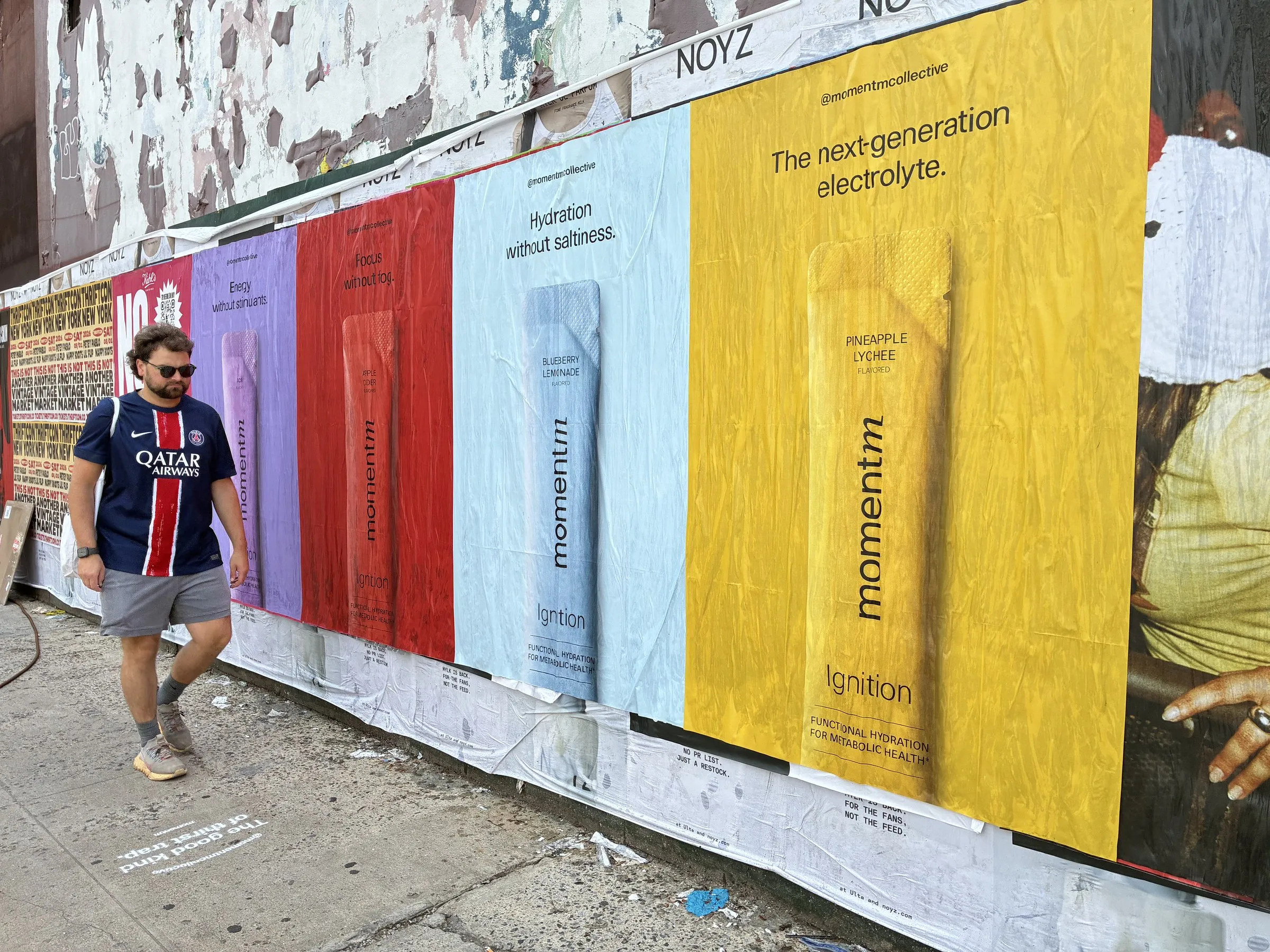
- Wheatpaste for large-format poster takeover on walls and construction hoarding. Highest visual real estate per placement.
- Pole stickers for high-volume sticker saturation on utility poles and street furniture. Smaller real estate, faster scale.
- Sidewalk stencils for a repeating mark at street level. In a mobile eye-tracking study of people walking outdoors, the path itself was one of the things they looked at often, along with other pedestrians (Foulsham, Walker and Kingstone, Vision Research).
- Interior installs for paste, poster, and signage placement inside venues (bars, coffee shops, fitness studios, retail).
- Mixed format if you want saturation across surfaces. We package it.
Surface choice is a legal question too, and the answer is written city by city. New York’s environmental control board penalty schedule lists separate fines for illegal posting of handbills and for placing stickers or decals on public or private property (NYC penalty schedule). If your brand needs owner-permissioned surfaces only, say so in the brief and we scope to that.
A naming note: if your brief says “wild posting,” write wheatpaste. Wild Posting® is a registered trademark of Dash Two, Inc. The work you are describing is wheatpasting, and that is how we quote it.
If you do not know which format fits the goal, say “format-agnostic, recommend.” We pick from the audience and the dwell pattern in the neighborhoods you are after.
3. Install dates or install window
Two acceptable formats:
- Specific dates, e.g., “live by June 12, complete by June 19.”
- A window, e.g., “anywhere in early-to-mid June, 7-day install.”
What is not acceptable: “soon,” “ASAP,” or “TBD.” Those force a quote against an assumed timeline that may not match yours.
Rush work is real, and it is priced as rush. Expedited 24-to-72-hour brief-to-install adds 80 to 150 percent over the standard rate, quoted case by case. The anchor case is True Religion: the brand locked a Megan Thee Stallion creative three days before launch, the shoot wrapped on a Friday, and the posters were on Houston walls 36 hours after signing. Same-week installs are standard. Two to three weeks out is the sweet spot for clean planning.
4. Creative status
Three states, all acceptable:
- Print-ready files in hand. Send the specs (dimensions, stock, ink) and we confirm and quote.
- Files in production with a delivery date. Tell us when they land, and we quote against the spec and hold the crew slot.
- Artwork not started. Say so in the brief. Printing is ours, on blueback outdoor stock from 24x36 up to 48x72, and a press run takes 3 to 5 days, so that half of the timeline is one we control. The design calendar is still yours.
Print runs need lead time, which is why creative status changes the schedule. A 14-day campaign with files arriving on day 12 is a different campaign than one with files arriving on day 2.
5. Budget ceiling
This is the one most briefs skip. It should not be skipped.
Telling us “we are working with $8,000” or “we have budget up to $30,000” lets us:
- Shape the scope to fit the budget instead of quoting a $25,000 program against an $8,000 wallet.
- Tell you immediately if the math does not work. (“Your $4,000 cannot do a 5-city tour. It can do a 2-neighborhood NYC run. Want that quote?”)
- Optimize within the ceiling. (“At $30,000 we can either do 3 cities saturated or 6 cities lightly. Which is your KPI?”)
An advocacy coalition came to us with a grassroots-tight number for a New York campaign. The ceiling bought three walls in SoHo and Downtown Manhattan, aimed at the corridors where city officials and political press walk every morning, rather than twenty sheets spread thin across neighborhoods that audience never walks. That trade only gets made if the ceiling is on the table.
We use the ceiling to build a campaign that runs, never to price up to it.
The sample brief
Here is what a good brief looks like in 8 lines:
Subject: Brief for [brand], [city/format/window]

City: Brooklyn (Williamsburg, Bushwick, Greenpoint)
Format: Wheatpaste, ~300 sheets
Window: Live by June 12, complete by June 19
Creative: Print-ready, 24 x 36 in blueback, sending today
Budget ceiling: $10K
Goal: Drive awareness for product launch on June 15
Key dates: Launch event June 15 at Brooklyn Steel
Contact: [name], [email], [phone]
That is the entire brief. Send it and the quote comes back inside 24 to 48 hours.
The three brief mistakes that slow every quote
1. “Tell us what’s possible”
A no-constraint brief is a request to design your campaign for you. We can do that, and it is consulting work rather than a quote. If you want a real number back in a day or two, give us the city, the rough format, and the budget ceiling.
2. “We’ll figure out the budget once we see the options”
This burns days. We quote three options, you review with finance, finance pushes back on all three, we re-quote, you push back again. By the time the number lands somewhere you can actually fund, the install window has slipped two weeks and the crew calendar has filled behind you. Give us the ceiling in the first email and the first quote is the useful one.
3. “Send us your typical pricing”
We do publish pricing tiers, and you can read the full cost breakdown article. A typical-pricing answer stays generic, though, and a brief-specific quote is what gets your campaign on the wall. The whole point of the five inputs is that they replace generic with specific.
Where to send the brief
Or use the contact form. Either way works. The form is faster for the first message; the email is faster for the follow-ups.
Standard turnaround on a scoped quote: 24 to 48 hours, the same number published on the pricing page. Multi-city tours use the full window.
Bonus: the brief checklist
Copy-paste before you hit send. If you can answer yes to all five, the quote comes back scoped instead of hedged:
- Named at least one specific city
- Named a format, or said “format-agnostic, recommend”
- Gave install dates or a specific window
- Stated creative status (in-hand, in production, not started)
- Stated budget ceiling
That is the entire bar.
For more on what individual services cost, see the wheatpaste campaign pricing breakdown. For the legality framework on NYC campaigns specifically, see is wheatpasting legal in NYC.
Ready to send the brief? Five inputs to info@beyondstreetmedia.com and a real number comes back inside 24 to 48 hours.