Fitness & Wellness.
Wheatpaste, sticker, and gym-install campaigns for fitness, pilates, supplement, and wellness brands. Neighborhood saturation in fitness corridors.
Four tensions only street resolves.
- 01
Gym openings need IRL launch presence to drive foot traffic at the crucial first-month window when brand awareness and trial adoption are most elastic
- 02
Supplement and wellness CPM costs have plateaued or risen across digital channels; athletic and fitness brands need top-of-funnel awareness that performs at a cost tier below performance media
- 03
The fitness audience photographs everything. Every class, every run, every workout, which means organic social pickup from street campaigns is real and measurable through branded hashtag volume and user-generated content
- 04
Wellness-class booking conversion requires in-class poster placement and pre-class ambient brand presence that drives recurring-membership enrollment velocity higher than digital-only promotion
Is this you?
If two or more match your roadmap, send the date.
- You're opening a gym or studio and need foot traffic in the first-month window when trial adoption is most elastic.
- Your supplement or wellness CPM has plateaued and you need top-of-funnel awareness below the cost tier of performance media.
- Your audience photographs everything so organic social pickup from street campaigns is real and measurable in branded hashtag volume.
- Your class-booking conversion needs ambient presence in-studio and pre-class to drive recurring-membership velocity.
- You're chasing retail-shelf placement and need proof-of-brand-presence in target cities to open distributor conversations.
- Your audience clusters in tight fitness corridors where street density wins share of voice at a fraction of digital CPM.
5 disciplines, one playbook.
Wheatpaste
Wheatpasting and wheatpaste advertising campaigns from $3,500 in NYC, LA, SF + 40 US cities. Published floors, 5-7 day lead (Expedited 24-72hr), GPS-tagged photo proof on every install. From $3,500Paste-Up Posters
Paste-up poster campaigns for product launches and neighborhood saturation. From $3,500, 5-7 day lead (Expedited 24-72hr), GPS-tagged photo proof in 40 US cities. From $3,500Gym Installs
Gym and fitness club poster installs in 40 U.S. cities. Locker-room, floor, and studio placements in partner gyms with full photo proof on every install. From $3,000Custom Poster Installs
Custom poster installs in 40 U.S. cities. Your design printed in-house and installed on the surface you choose, from interior walls to full street-level frontage, with photo proof on every placement. From $5,000Pole Stickers
Pole sticker advertising and street pole takeovers in 40 US cities. Legal commercial-pole campaigns with geo-tagged photo proof on every install. From $3,000Starting floors · print, install, and GPS-stamped photo proof included in every quote. Final number varies by turnaround, size, and location count. Full rate card →
Sample creative directions.
Pre-tested format / neighborhood pairings. Pick a direction at brief intake and we route the surface set inside 24 hours.
- Pilates studio launch Wheatpaste, three-poster, 4-week run West Hollywood, Los Feliz, Silver Lake
- Run-club interior program Column wraps + bathroom posters, quarterly rotation Williamsburg, Park Slope, Bed-Stuy
- Supplement neighborhood saturation Sidewalk stencils outside gyms and juice bars Marina, Mission District, SF
- Fitness-district corridor Pole stickers, 12-pole three-block takeover Brickell, Miami
The neighborhoods, not the metros.
We install where the audience already moves. Named corridors per market, permitted and photo-documented.
Hell's Kitchen · SoHo · Williamsburg · Bushwick · Lower East Side · Tribeca
East Austin · South Congress · Downtown · Rainey Street · North Loop · The Drag
Downtown LA · Arts District · Silver Lake · Echo Park · Venice · Santa Monica
Capitol Hill · Pioneer Square · South Lake Union · Belltown · Ballard · Fremont
Put it on the wall.
We have run this for fitness & wellness.

Proof · Printed in-house · Installed by our crew
Street campaigns for Fitness & Wellness brands. Proof included.
Send the brief; a scoped quote for your vertical comes back inside 24 hours — formats, neighborhoods, and a GPS-stamped photo of every placement when the run wraps.
- Quote in under 24 hours
- No discovery call. The brief is the call.
- Printing & Installation under one roof
Brief us · Quote in under 24 hours
Start your fitness & wellness campaign.
Brand-safe by default.
- Private-property walls only Written owner consent on file for every surface. No public infrastructure, transit, or right-of-way.
- GPS-stamped photos within 48 hours Wide, mid, detail per placement. The proof your team forwards internally.
- FTC + local-code compliant Disclosures and permitting handled per contract. Legal reviews clean.
- Zero municipal removals on record 500+ documented installs, none taken down by a city.
Read the full field notes
Why Guerrilla Marketing Works for Fitness & Wellness Brands
Fitness audiences live in specific neighborhoods and visit the same locations repeatedly. The morning run route, the gym, the juice bar, the pilates studio. Digital marketing reaches them, but at rising costs and in formats they increasingly ignore. Street campaigns reach them where they already are: in the fitness cluster of their neighborhood.
The second dynamic is social. Fitness audiences photograph everything. Every class, every run, every achievement. A well-placed wheatpaste poster on the way to a popular run route becomes user-generated content at scale. A column wrap inside a CrossFit box becomes content in dozens of workout videos. Organic social pickup from fitness audiences exceeds other verticals because the audience is actively creating and sharing content from these locations. A supplement brand with a studio partnership or a boutique gym with a mid-month membership-push campaign will see 200-400% increases in branded hashtag mentions when street media runs concurrent with their organic social footprint.
The third dynamic is credibility and scale. A pilates brand opening five new studios across NYC, LA, and SF reads as serious and funded when every studio is surrounded by neighborhood-saturation poster campaigns. Boutique fitness audiences are skeptical of digital-only launches (every app-based fitness brand looks identical), but physical presence at scale is a trust signal. A wellness brand with product-placement strategy in high-traffic studios and gyms needs proof-of-market-presence to open distributor and retail-partner conversations, and that proof is a street-campaign documentation package showing concrete audience reach in the target cities.
Timing a Fitness Campaign to the Window That Pays
Fitness has its own calendar, and the street install has to land on it. Spend the budget a month early and the studio is still framing drywall. Spend it a month late and the trial window is closed.
The opening-month window is the elastic one. A new gym, pilates studio, or run club sees its highest trial-adoption rate in the first 30 days. People will try a new place near them once. The campaign goes live just before doors open so the corridor is already saturated when the first class is bookable. A West Hollywood pilates launch installs wheatpaste across West Hollywood, Los Feliz, and Silver Lake four to seven days ahead of opening, with the class-booking URL on every poster.
January and September are the demand spikes. New-year resolution traffic and the post-summer reset are the two windows where membership intent peaks across every market. Supplement brands time quarterly blitzes to these spikes. A run-club program syncs interior rotation to the spring marathon-training season, March through October, when the running audience is most active and most likely to photograph a workout.
Supplement compliance adds days, not weeks. Any FDA-substantiated performance claim routes through review before production, which is why Momentous-style campaigns build a few extra days into the schedule. The install timing still lands on the demand window. The compliance step just moves upstream of it.
What We Run for Fitness and Wellness Brands
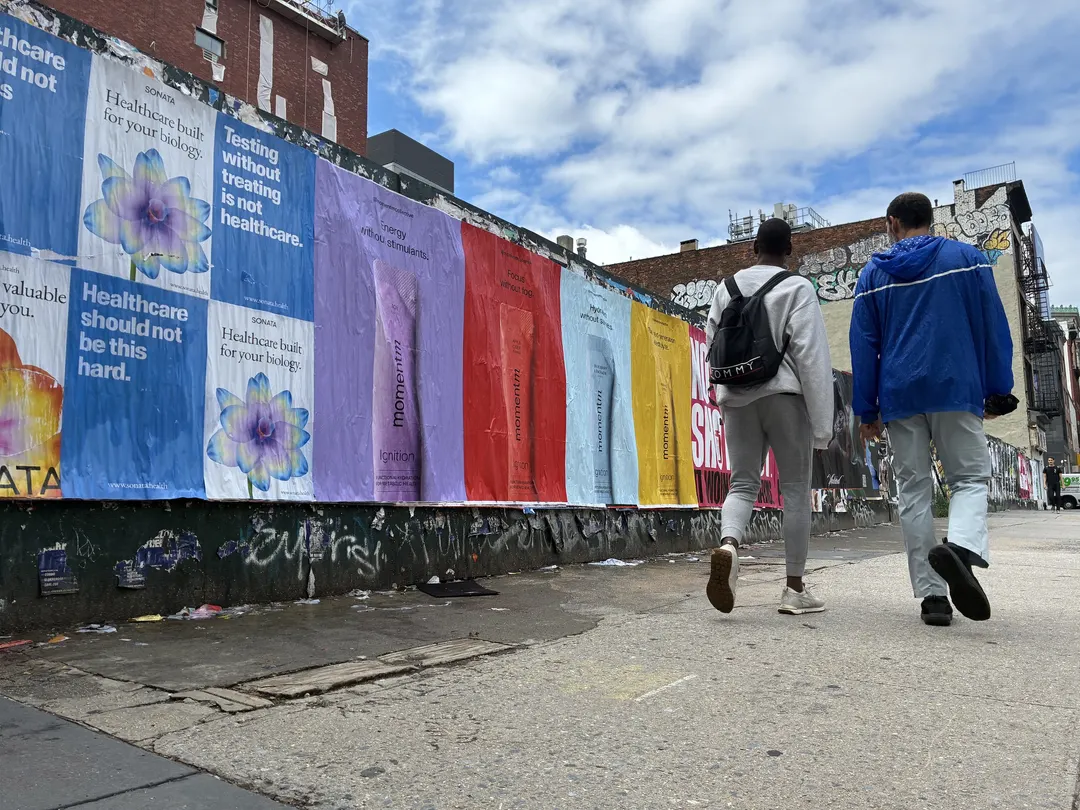
Wheatpaste Advertising. Large-format posters in neighborhood fitness corridors (West Hollywood, Williamsburg, Marina, Brickell, Back Bay), positioned on commute routes to boutique studios, gyms, and high-foot-traffic juice and coffee bars.
Paste-Up Poster Campaigns. Hand-applied multi-panel poster sequences in fitness-density neighborhoods, optimized for dwell-time (storefronts, scaffolding, construction barriers near studios and gyms).
Gym & Fitness Club Installs. Interior column wraps, bathroom-mirror posters, locker-room ambient advertising, and class-schedule integration inside gym, yoga, pilates, and boutique-fitness venues. Rotation schedules synchronized with seasonal fitness programs and challenge launches.
Custom Poster Installs. Bar/restaurant/coffee-shop ambient placement where fitness audiences congregate pre and post-workout. Bar-mirror posters, tabletop cards, and ambient-environment brand wraps in high-fitness-traffic hospitality venues.
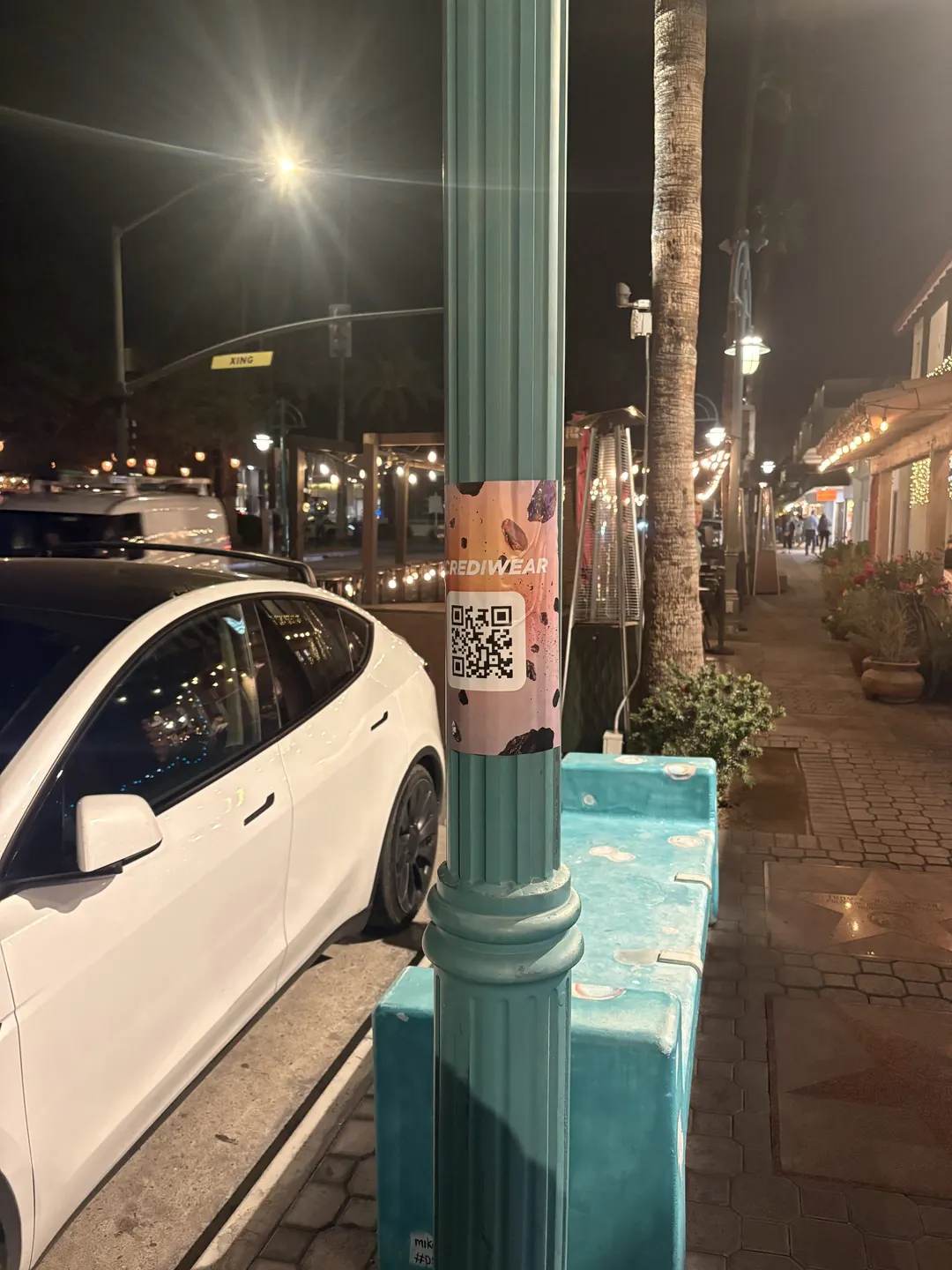
Pole Sticker Advertising. Utility-pole takeovers on morning commute corridors to major fitness clusters, optimized for route-density impression and QR-code-based app-download or class-booking attribution.
Sidewalk Stencil Advertising. Chalk-safe stencil campaigns outside gyms, studios, juice bars, and coffee shops; fitness-claim callouts with app or booking URLs for direct attribution.
Neighborhood Saturation Campaigns. Multi-format, multi-month programs across fitness-dense neighborhoods combining wheatpaste, pole stickers, interior installs, and stencil work to achieve ambient brand dominance in the target market.
Compliance & Brand-Safety Notes
Supplement health claims require substantiation. Any supplement creative claiming a health benefit (improved recovery, enhanced endurance, better sleep, etc.) must be linked to FDA-substantiated clinical or ingredient-level evidence. “Natural,” “organic,” and ingredient-focused claims are generally safe; direct disease or drug-like claims (“cures,” “treats,” “prevents,” “diagnoses”) are forbidden. Beyond Street Media flags claim-substantiation requirements at intake, reviews marketing claims with your legal team, and routes creative through our compliance checklist before any production. We have executed supplement campaigns for performance-focused brands (Momentous, HydroJug adjacent) where every claim was documented to backing research. Disclaimer spacing and legibility is part of the creative production spec.
Body-image and weight-loss claims on fitness creative require gym-operator pre-approval and body-positive messaging review. Most boutique fitness studios (particularly pilates, yoga, and women-focused strength programs) have explicit brand values around inclusive messaging. Any fitness-studio opening campaign needs pre-approval from the studio operator on claims, imagery, and diversity representation in creative. Avoid before-and-after transformations, weight-loss-specific calls, or body-type-exclusive messaging on interior installs.
Athletic-brand competitive restrictions may apply in venue partnerships. If a gym or studio has an existing sponsorship or equipment partnership (Peloton, Orangetheory, Lululemon, etc.), supplement or competing athletic-brand campaigns may be contractually restricted. Clarify venue sponsor conflicts at intake and plan around them.
Fitness-challenge and event tie-ins require event-organizer pre-approval. Run clubs, marathons, and fitness-festival sponsorships have specific brand-partnership guidelines. Confirm timing and placement approval before production.
Past Fitness & Wellness Work
Brooks Run Club. Seattle, WA. A run-club interior-install program featuring large-scale photo-collage wall installation with the brand tagline “Let’s Run There.” The campaign created ambient brand presence inside an active run-club community space, making the brand environment part of the member experience rather than external advertising. The installation has driven word-of-mouth recommendations and social media tagging by run-club members and visiting runners.
Sweat FC. Brooklyn, NY. A wheatpaste campaign supporting youth soccer tryouts, with red-and-black branded posters on high-foot-traffic storefronts in Bed-Stuy and surrounding neighborhoods. The campaign ran concurrent with digital promotions for tryout registration. Poster placement on neighborhood-heavy foot-traffic corridors created visual reinforcement for the digital signup flow, and QR-code tracking showed 12% of tryout registrations came from street-adjacent traffic attribution.
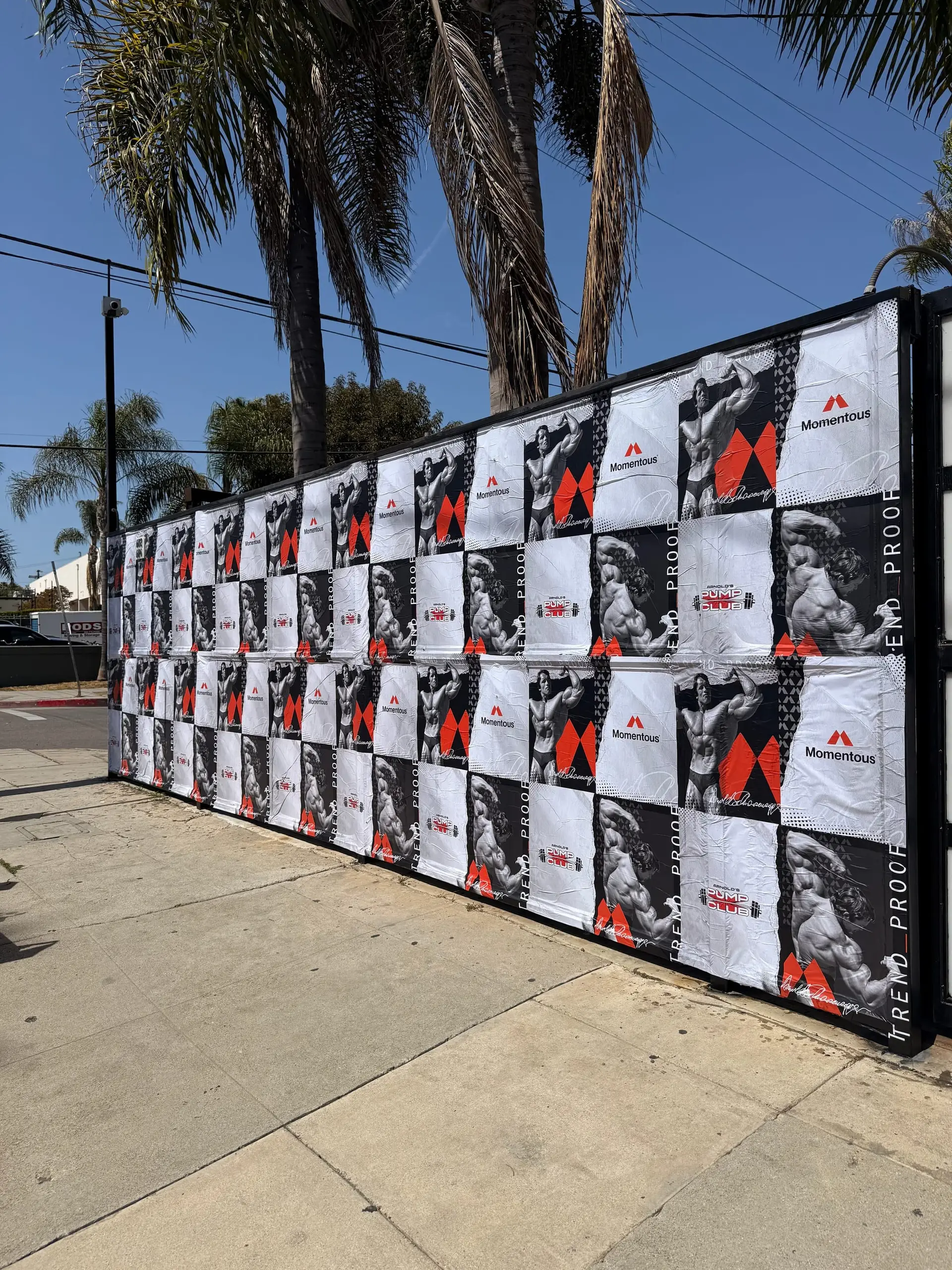
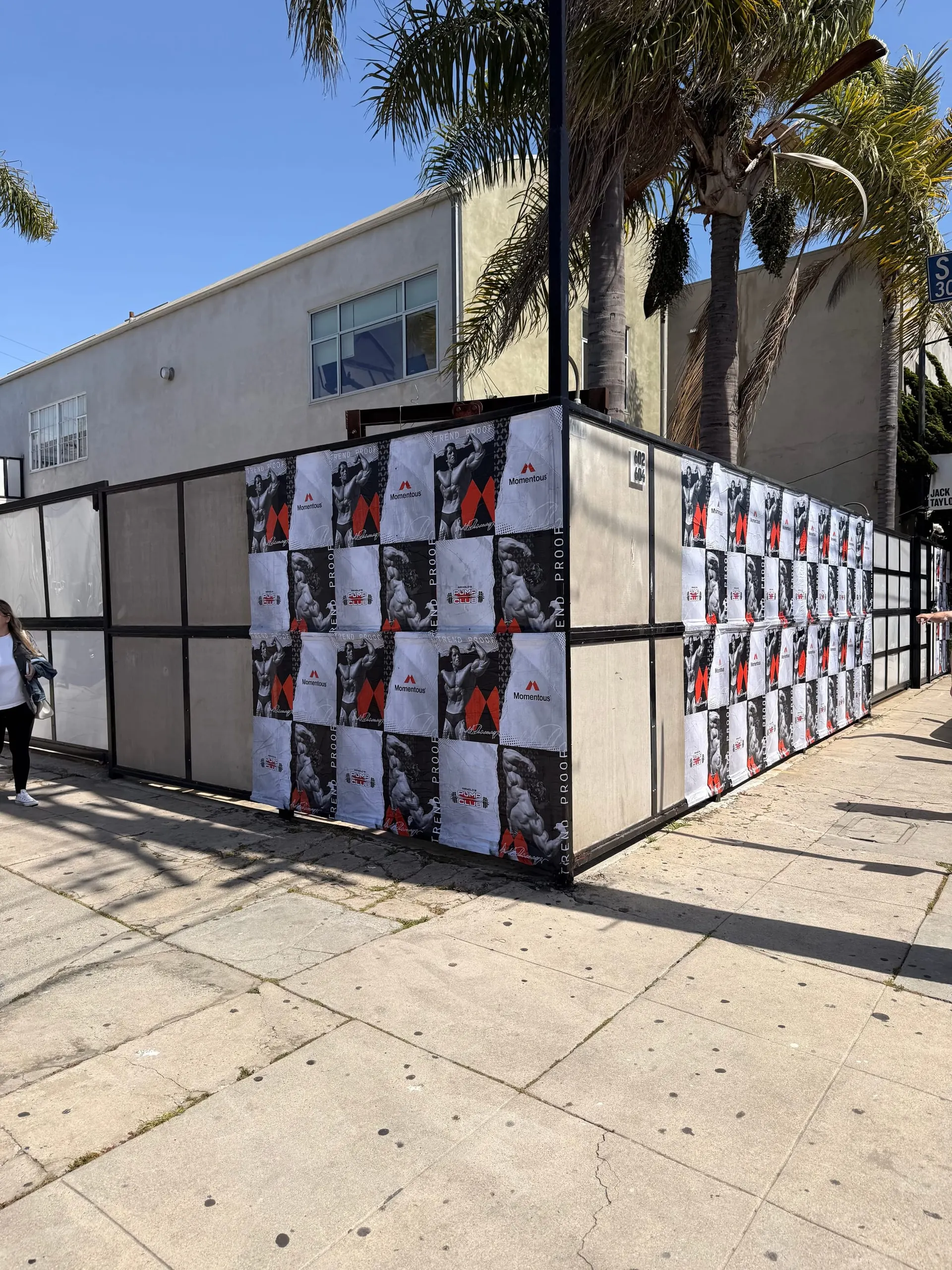
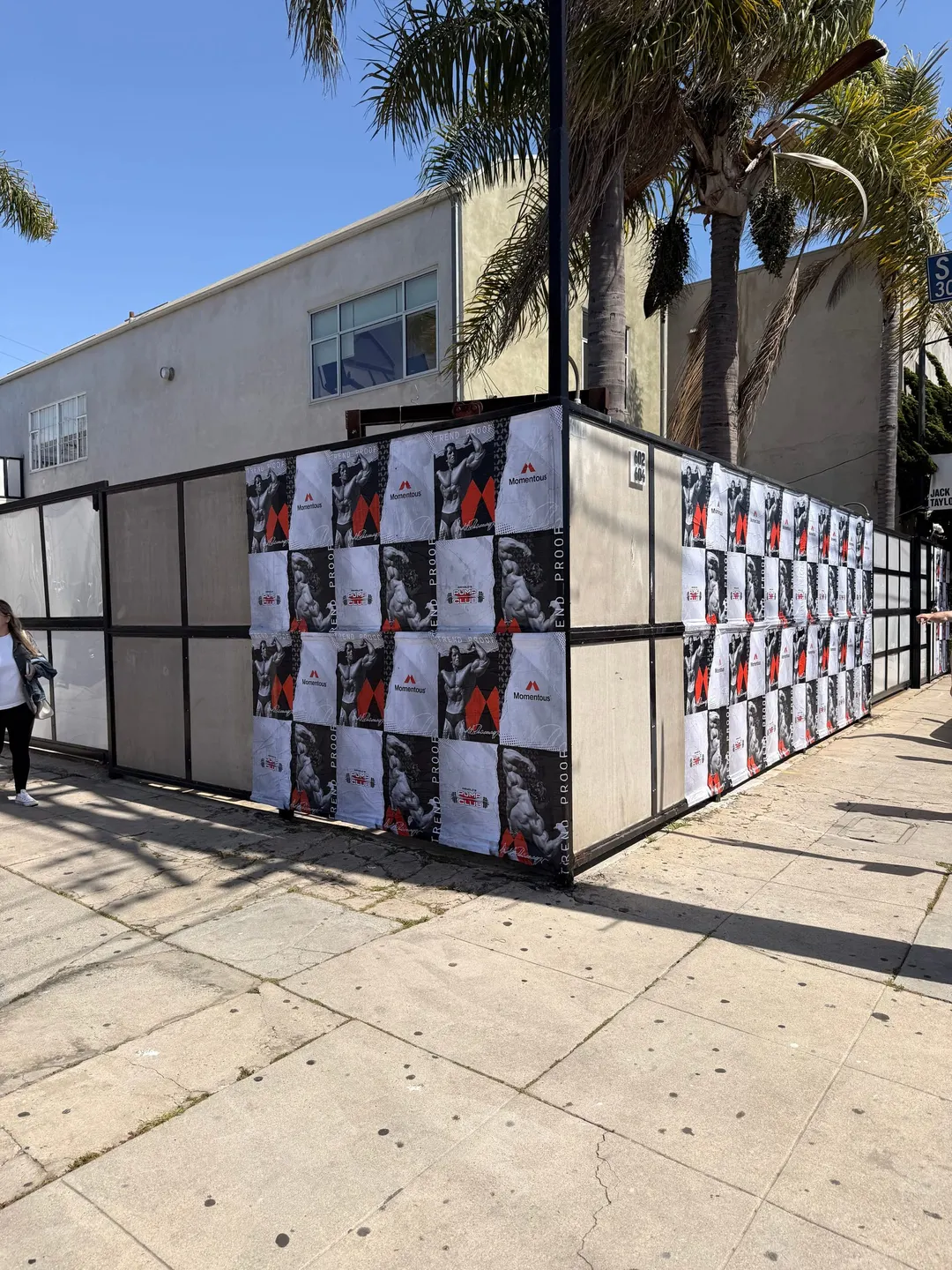
Momentous. Los Angeles, CA. A large-format construction-hoarding wheatpaste campaign with white-red-black bold design across an LA residential area, reaching morning-commute fitness audiences on their routes to training facilities and gyms. The campaign demonstrated the scale and visual impact of sports-supplement branding in high-traffic fitness neighborhoods, with organic social pickup from athlete and fitness-enthusiast audiences.
We Print the Posters and Gym Panels In-House
Fitness creative lives or dies on brand color. The bold single-color system that makes a supplement or studio brand recognizable on a poster has to read true on the wall and inside the studio. We print on our own presses through poster printing, so the color comes off one proof instead of a third-party guess.
Owning the print step pays off on two fitness-specific patterns. Run-club and CrossFit-box interiors rotate creative quarterly, and gym and fitness club installs need fresh panels on a schedule, not a vendor lead time. And a supplement claim that gets a substantiation edit reprints same-week instead of restarting a queue, so the FDA-cleared language ships exactly as approved.
Measuring a Fitness Campaign
The fitness audience is the most measurable audience in street media, because it photographs everything and books through trackable links.
Trial signups attribute through QR and landing pages. Class-booking URLs and free-trial codes on posters, pole stickers, and interior wraps route to a campaign-specific page, so signup lift reads against the install window. Studio openings that run street media concurrent with digital see free-trial conversion rise 22-38 percent, because the audience perceives the brand as established before clicking the first ad.
Branded-hashtag volume measures organic pickup. A daily social dashboard tracks geo-tagged posts and branded-hashtag mentions inside the campaign zones. Boutique studios see a 200-400 percent hashtag spike during opening month when street media runs, with class participants and fitness-adjacent micro-influencers doing the amplification for free.
Retail foot traffic ties supplement campaigns to the shelf. For supplement and hydration brands, foot-sensor data from partner retail locations reads store-visit uplift on the blocks that carry stencils and wheatpaste. That foot-traffic package is the proof a distributor wants before a stocking conversation, and it is brand presence you can put on a slide.
Cities We Activate for Fitness & Wellness Brands
Boutique fitness, premium supplement, and wellness-brand audience density concentrates in eight primary markets where street-campaign ROI is highest:
New York City. Williamsburg (high-density boutique fitness, strong fitness-influencer presence), TriBeCa (luxury fitness and wellness services), Upper West Side (established yoga and pilates community), Brooklyn Heights (run clubs, CrossFit).
Los Angeles. West Hollywood (luxury boutique fitness, celebrity athlete presence), Venice Beach (fitness and wellness tourism), Santa Monica (wellness and athletic retail), Silver Lake (boutique fitness, music-adjacent fitness culture), Brentwood (premium wellness services).
San Francisco. Marina District (high-density fitness audience, young urban professionals), Mission District (boutique fitness and wellness retail, music and culture-adjacent).
Miami. Brickell (fitness-cluster density, young professional demographic, high-traffic morning commute), Wynwood (wellness and fitness retail, cultural venue crossover).
Boston. Back Bay (boutique fitness and wellness premium positioning), South End (LGBTQ-friendly boutique fitness, run clubs), Cambridge (college-adjacent fitness culture).
Austin. South Congress (lifestyle boutique fitness, wellness retail), Downtown (fitness and wellness tech companies, event-driven fitness activations).
Seattle. Capitol Hill (boutique fitness, LGBTQ-friendly studios, high walkability), Ballard (run clubs, outdoor-fitness culture).
Chicago. West Loop (boutique fitness, upscale wellness, young professional density), Wicker Park (affordable-luxury boutique fitness, strong community fitness culture).
Fitness & Wellness questions.
The 5 things fitness & wellness brands ask before sending a brief. Same-day answers from the desk if yours isn't here.
Q · 01 What is the typical cost for a fitness-studio opening campaign?
Campaigns start from the published per-discipline floors: wheatpaste posters from $3,500, pole stickers from $3,000, sidewalk stencils from $2,500. Opening-month campaigns for a single boutique fitness studio (pilates, yoga, CrossFit, run club) typically land in the $6,000-$18,000 range for a multi-format blitz: wheatpaste posters in a 2-3 neighborhood corridor, pole stickers on the commute routes to the studio, and interior column wraps inside the studio location. Multi-studio operators scaling across a single market run $35,000-$80,000 for the blitz phase, with sustained in-studio interior placement quoted on top. Supplement brands running seasonal or quarterly campaigns typically budget $15,000-$45,000 per campaign. Range varies by turnaround, size, location count, and combined service mix. Final quote returns in 24 to 48 hours.
Q · 02 How does street marketing help fitness studios drive membership signups?
Fitness audiences drive trial and membership enrollment in clusters. When friends, neighbors, or people in their running/cycling/pilates community sign up, conversion velocity accelerates. Street campaigns create ambient brand presence in the studio's neighborhood, which means the audience sees posters on their commute and inside studios they already visit. This pre-conversion familiarity raises signup conversion on studio landing pages and free-trial redemptions by 22-38% when street media runs concurrent with digital campaigns, because the audience perceives the brand as established and legitimate before clicking the first digital ad.
Q · 03 Can you advertise supplement claims safely on street campaigns?
Yes. With compliance discipline. Supplement creative must align with FDA-substantiated health claims and cannot make drug-like disease claims ('cures,' 'treats,' 'prevents'). Beyond Street Media flags compliance requirements at intake, reviews claim substantiation with your marketing team, and routes creative through our compliance checklist before production. We have executed supplement wheatpaste and pole-sticker campaigns for brands like Momentous (sports-performance focus) where every performance claim was documented to substantiation. Creative type-setting and disclaimer spacing is part of the production spec.
Q · 04 How fast can you launch a gym or studio opening campaign?
A single-studio opening blitz installs in 4 to 7 days once creative is locked, wheatpaste in a 2-to-3 neighborhood corridor, pole stickers on the commute routes to the studio, and interior column wraps inside the location. The first-month window is when trial adoption is most elastic, so we time the install to go live just before doors open. Supplement campaigns with FDA-substantiated claims need a few extra days for the compliance review, which we build into the schedule at intake.
Q · 05 How do you measure success for a gym or studio opening campaign?
Measurement depends on the objective. For membership enrollment: track free-trial sign-ups and paid-membership conversions attributed to the street campaign via QR codes and campaign-specific landing pages. For brand awareness: count organic social mentions and branded-hashtag volume before, during, and after the campaign (most boutique studios see 200-400% hashtag spike during opening month with street media). For retail-supplement distribution: document store-visit attribution using foot-sensor data from partner retail locations. For a full-service gym opening, we combine all three: install photo documentation, social analytics, and (for retail partners) foot-traffic data.
We delivered.




















Brand partners include: FIFA World Cup 2026, Palantir, Sézane, G-Shock, Mitchell & Ness, True Religion, Huda Beauty, Yonex, Relevance AI, Momentous, RYZE Coffee, Bloom Effects, Incrediwear, Brooklyn Museum, Sweat FC, HydroJug, Frameline, Alchemy, OneRepublic, Lone Fox, Vaura Pilates.
Got a fitness & wellness launch?
Inquire now.
Send the Fitness & Wellness brief: markets, window, creative direction. Vertical-specific quote back in 48 hours.