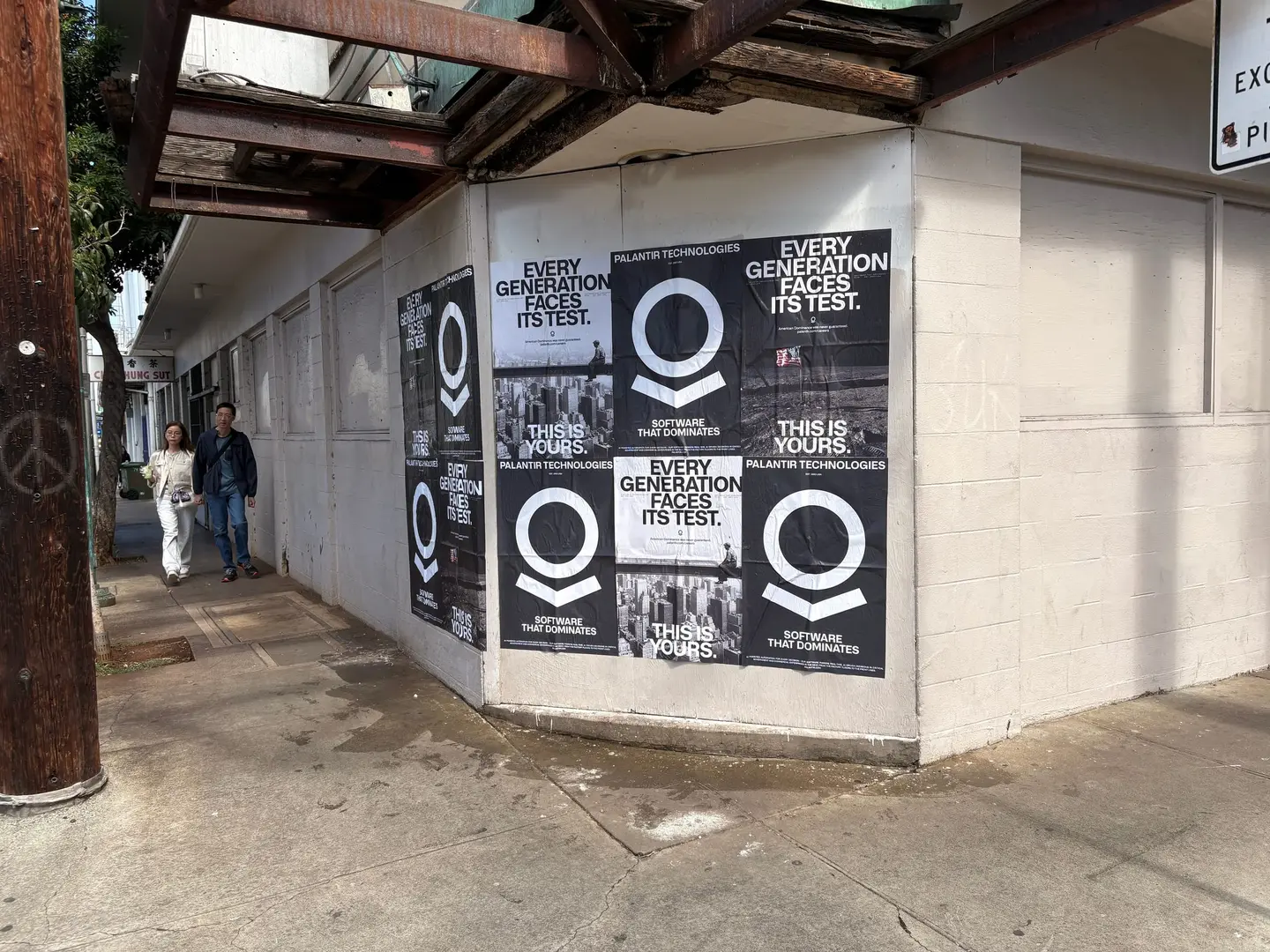
Fashion Week compresses the people who decide what gets bought and covered into a handful of blocks. In New York, the CFDA’s preliminary September 2026 schedule lists 70 runway shows and designer presentations, opening Thursday September 10 and closing Tuesday September 15, with Ralph Lauren showing on the 9th ahead of that. Six days of programming, and a much longer tail of showroom appointments on either side of it. A street campaign timed against that window puts the brand in front of buyers and editors while they are already walking.
The install is the straightforward part. Property access and owner consent set the calendar, and the creative approval cycle has to close before either one starts. This playbook covers neighborhood targeting in both cities, format mix, the T-7 install window, and how to pace social against the post-show editorial cycle.
Why Fashion Brands Run Street During Fashion Week
Official fashion week spend goes to venues and show-day presence, and every brand on the calendar is buying some version of it. A wall in the neighborhood reaches a different moment in the same person’s day. The buyer walking from a Broadway showroom to a Crosby Street appointment is between scheduled obligations, and that is when a placement registers.
Street presence works alongside official presence rather than replacing it. The campaigns at the bottom of this piece are apparel and fashion brands, and each one bought neighborhood coverage inside a compressed attention window.
NYFW Timeline and Window Structure
The official calendar is the anchor, and the campaign window extends well past it. For placement, the window breaks into phases:
T-7 to T-0 (the week before shows): Showrooms open, venue crews build out, first-wave buyers and press start their corridor walks. Fewer people than show week, and a higher share of them cleared a calendar to be in New York.
T+0 to T+5 (show days): The busiest stretch, concentrated at venues and the blocks immediately around them. Corridor traffic rises too, with a wider mix of people who are not working the week.
T+6 to T+21 (post-show tail): One-on-one appointments, editor follow-ups, extended showroom hours. Thinner traffic, higher proportion of decision-makers.
We do not count footfall, so read those phases as shape rather than as numbers. If a vendor quotes you a fashion week footfall figure, ask where it came from.
Installation timing depends on the objective:
Pre-show install (T-7 to T-4): Maximum cure time, installation happens during setup week when the blocks are still quiet, campaign is settled by T+0. Reaches the first-wave audience. Our default recommendation.
Show-day install (T-1 to T+3): Surface is at peak freshness during peak traffic, but crews are working around venue logistics and street closures, which usually means night work and a slower per-wall pace.
Post-show install (T+6 to T+14): No show-day constraints, daytime installation possible, reaches the one-on-one buyer conversations after the runway noise clears. Suits a brand launching something specific in the weeks after the shows.
For September 2026 NYFW, a pre-show install runs September 3 to 6, a show-day install runs September 9 to 13, and a post-show install runs September 16 to 24.
LAFW Timing and Neighborhood Clustering
Los Angeles has no single centralized fashion week the way New York does. The October 2026 edition, produced by The Bureau, runs October 16 to 18 at The Lot Studios on North Formosa Avenue in West Hollywood, which puts the official venue miles from the downtown Fashion District. Plan Los Angeles around neighborhoods rather than around a venue cluster.
Melrose Avenue (Fairfax to Highland): The retail spine. The City of Los Angeles maps a Melrose business improvement district across that run, alongside separate districts for the Arts District and the Fashion District. Boutique density is highest here, and a wall on Melrose gets repeat passes from the same people across several days.
Arts District (east of downtown): Bounded by Alameda Street, the 101, the LA River and 7th Street. Emerging-designer scouts and gallery-adjacent retail. Less show traffic, more of the people looking for what is next.
Fashion District (downtown): The LA Fashion District BID covers 107 blocks, from 7th Street south to the 10 and from Broadway east to Essex. Wholesale and trade territory. Worth placements if the brand is selling into retail, secondary otherwise.
West Hollywood (Sunset to Santa Monica Boulevard): Retail-adjacent, and with the October shows at The Lot Studios it is the closest neighborhood to the official venue. Useful for broad-appeal brands that want proximity to the calendar.
A 14 to 18 wall LA campaign clusters as eight to ten walls on Melrose, four to six in the Arts District, and two to three downtown or in West Hollywood depending on whether the brand is positioning at wholesale or at the shows. That spread covers the scouting loop without over-saturating one block.
LA also runs longer than New York’s compressed week. T-7 to T+14 is the practical visibility window, which gives a campaign presence across multiple showroom cycles.
The 6-Week Pre-Install Window
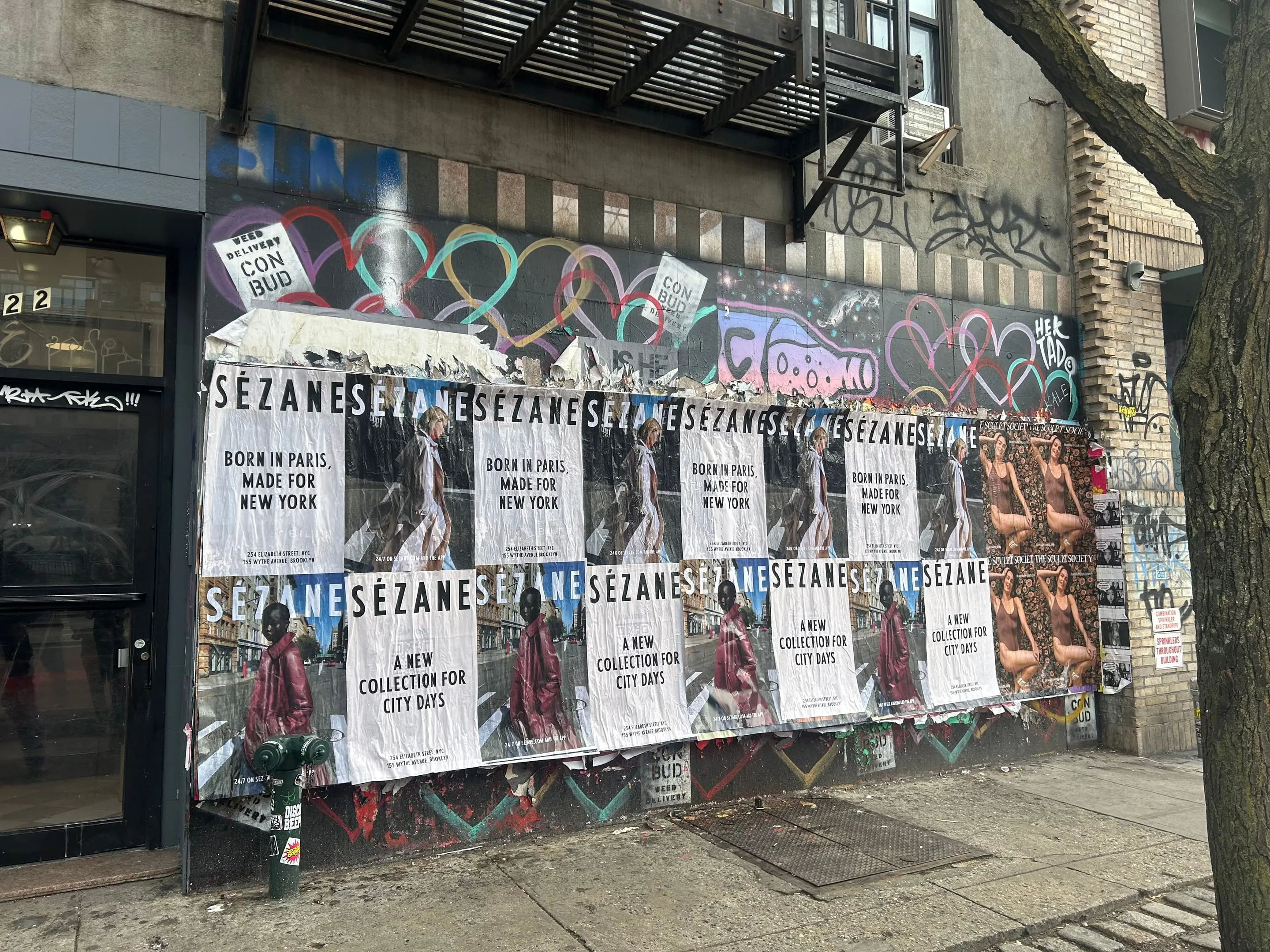
Scouting is the constraint that locks every other date. A 12 to 15 wall fashion week campaign takes six weeks of lead time.
Weeks 1-2: Surface identification and preliminary mapping
Identify 25 to 30 candidate surfaces in target neighborhoods. For NYFW: Tribeca (Hudson to Broadway), SoHo (Spring, Mercer, Lafayette), Lower East Side (Orchard to Essex, Houston to Delancey), Williamsburg (Bedford Avenue). For LA: Melrose between Fairfax and Highland, the Arts District, and the Fashion District if wholesale is the target.
Map surfaces on a neighborhood grid and photograph each candidate from street level. Document surface size, exposure, adjacent retail, and loading logistics. Rule out city-managed surfaces and transit infrastructure.
We plan on roughly half of approached owners saying yes, which is why the candidate list starts at 25 to 30 surfaces to land 12 to 15 walls. That ratio is our own planning assumption from running these programs, not an industry benchmark.
Week 3: Initial property-owner outreach
Identifying the owner comes first. In New York, the Department of Finance’s ACRIS system pulls up the recorded deeds for any address. The deed usually names an LLC or a managing agent rather than a person, and that entity is who has to sign.
Send preliminary consent emails to 20 to 25 owners or management companies. The email covers campaign concept, install window with specific dates, format, how long the campaign stays up, and who removes it.
Owners rarely consent on the first ask. Expect two or three rounds of questions about liability and timing. Our own turnaround experience is 5 to 7 business days for a first reply in New York, where management company layers slow things down, and 3 to 5 in Los Angeles.
District staff help where a district exists. New York lists 78 business improvement districts, and the ones covering our NYFW corridors are the Lower East Side BID and SoHo Broadway, which runs both sides of Broadway from East Houston to Canal. Tribeca has no BID, so every Tribeca approach goes direct to the owner or the managing agent. Build the extra week into the Tribeca line of the schedule.
Week 4: Consent turnaround and revision negotiation
Most owners who will consent do so by Week 4. Lock finalized consent from 8 to 10 properties. A binding consent letter specifies the surface address, exact dimensions (for example, north-facing wall, 4 feet by 6 feet), the install window, how long the work stays visible, and removal responsibility.
Mark properties that delay or require additional review as secondary. Do not hold Weeks 5 and 6 waiting on one signature.
Week 5: Physical logistics inspection
Visit each consented property in person. Document surface condition and paint type, ladder access, adjacent obstacles like power lines and HVAC equipment, retail neighbor hours, and any local notification requirement for work.
Take high-resolution photos of each surface at the exact angle the campaign will appear from. Those become the crew briefing reference and the pre-install baseline for documentation.
Week 6: Final property list and logistics plan
Confirm the final 12 to 15 properties. Prepare a crew briefing with addresses, dimensions, access instructions, constraints, and on-site contacts. That document goes out a week before install starts.
Scouting failures after Week 6 get expensive. A property that fails consent in Week 5 needs a replacement plus a repeat logistics inspection, which the remaining calendar rarely allows. A property that fails inspection in Week 6 means a crew arrives with nowhere to work.
Format Mix Strategy: Wheatpaste, Snipes, Stencils
A fashion week campaign built on one format reads thin. Formats with a hierarchy between them read as a plan.
Wheatpaste carries the hero placements, five or six walls per market at 4’ x 6’ or 3’ x 4’, on corner walls and mid-block stretches with the longest sightlines. These hold the premium creative, and they anchor the campaign. Wheatpaste campaigns start at $3,500.
Snipes cover the secondary hits, four or five per market at 2’ x 3’ or 1.5’ x 2.5’, positioned between the heroes or in feeder corridors. They carry simplified creative and give the corridor rhythm without saturating it. Snipe campaigns start at $3,000.
Sidewalk stencils handle wayfinding, one or two per market near venues or major intersections. Minimal content, usually a mark and a direction, helping press find their way while reinforcing brand presence. Sidewalk stencil campaigns start at $2,500.
We do not publish an impact split across the three formats, because we photograph placements rather than measure them. What the hierarchy buys is a sequence on the street. The hero placement lands first, and the snipes carry the brand along the walk toward wherever the stencil is pointing.
Roughly half the budget goes to the wheatpaste anchors, about a third to snipes, and the balance to stencils. A mixed-format fashion week program starts at $3,500 and scales with market count and placement density. Range varies by turnaround, size, location count, and combined service mix. Final quote returns inside 24 to 48 hours.
Install Timing and the T-7 Window
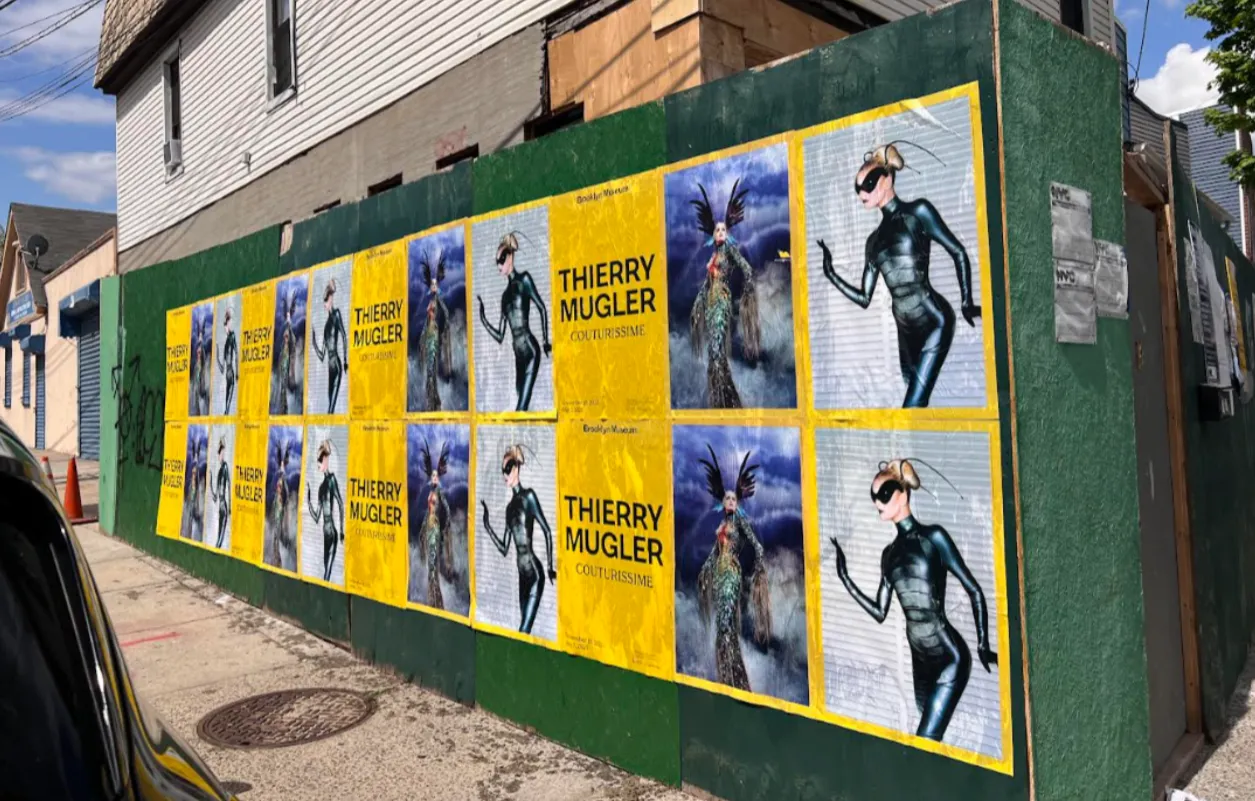
Fashion week campaigns install inside a tight window, and T-7 is where we start every schedule.
On a pre-show install, crews work the overnight window on consecutive nights. A 12-wall campaign (6 wheatpaste, 4 snipes, 2 stencils) installs over two or three nights with a two-person crew. Surface prep starts at 6 PM, install completes by about 10 PM, and the paste cures overnight.
Timeline for September 2026 NYFW, shows September 10 to 15:
- T-7: Thursday September 3, 6 PM start, overnight into Friday
- T-6: Friday September 4, 6 PM start, overnight into Saturday
- T-5: Saturday September 5, held as the weather buffer night
- T-4 to T-1: September 6 to 9, cure and monitor
- T+0: September 10, shows open, campaign fully cured
- T+1 to T+5: September 11 to 15, show days
- T+6 onward: post-show tail, appointments and editor follow-ups
For LA, the install window widens to T-10 to T-3. Spreading placements across Melrose, the Arts District and downtown means crews cover more ground per night, and fewer blocks require night-only work. A 14-wall LA campaign installs over three or four nights.
Always hold one or two buffer nights for rain or humidity. If the forecast turns between T-5 and T-2, spend the buffer night or move the whole install to the post-show window, where there is no calendar pressure on the paste.
Social Amplification: The T+1 to T+7 Curve
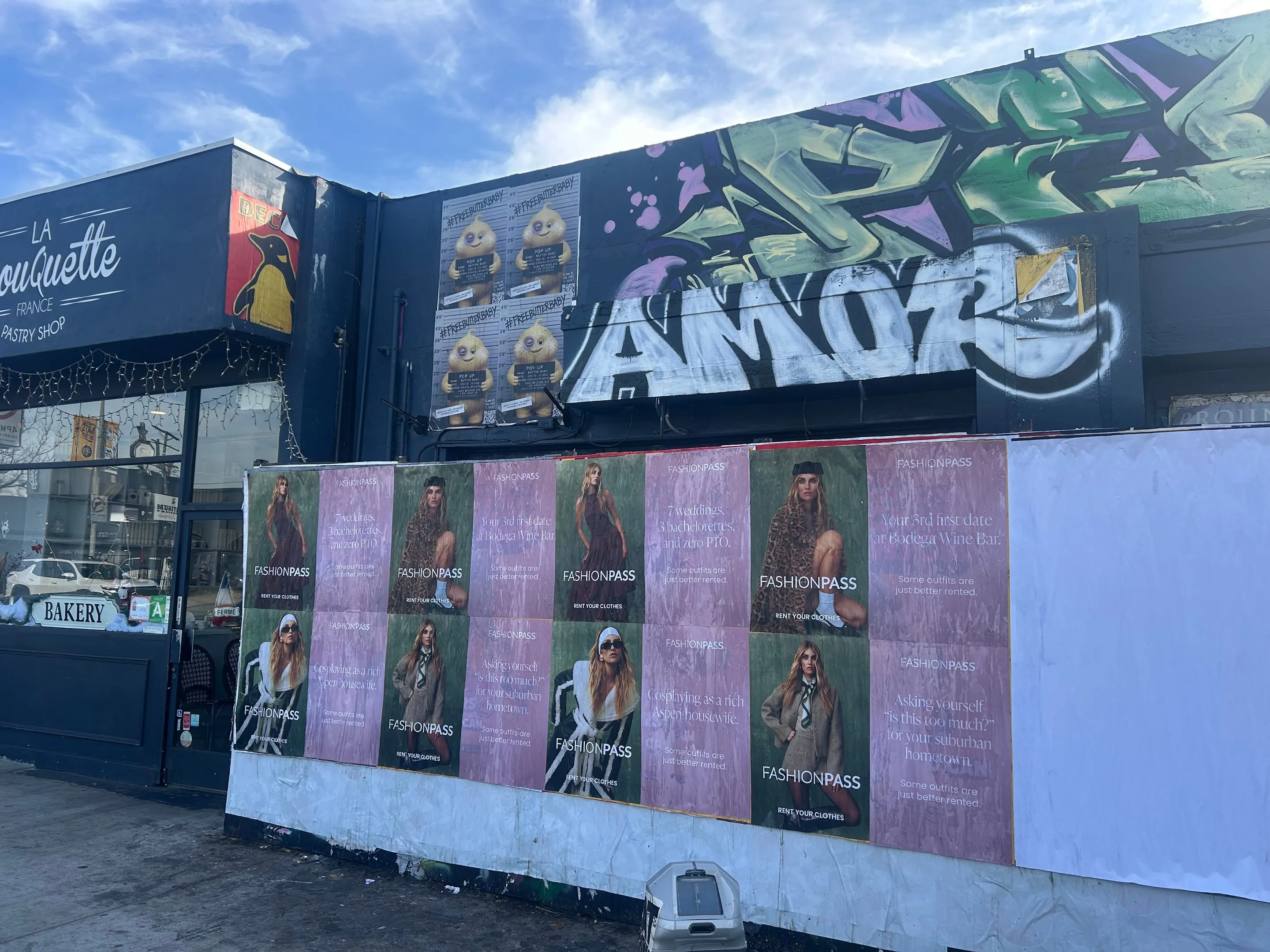
A campaign is not finished at install. What follows is a posting sequence, and the recommendation below is a plan rather than a measured outcome.
At T+1, the day after the last wall cures, the brand social team posts the announcement: install behind-the-scenes, crew photography, a line about being live on the street during the week. That reaches existing followers and primes press that the campaign exists.
Through the peak show days, hold the gallery. Seed one or two frames with a tight caption and let press and influencers find the rest on their own. Dumping the full set into show-day feeds puts it against every other fashion account posting at once.
The gallery drop belongs at T+4 to T+7, when fashion week coverage consolidates and editors are writing recaps that need off-schedule moments. We hand over the full documented set before that window opens, so the brand has the photography in hand while the editorial tail is still live.
What the campaign returns on our side is the placement record: every wall photographed wide and close, with a compliance frame and the install date logged. Reach, engagement and press pickup live in the brand’s own analytics, and we do not publish numbers we did not gather.
Budget Breakdown and Real Costs
A fashion week wheatpaste campaign starts at $3,500 and scales with market count, placement density, and format mix. The cost structure breaks down roughly as follows.
On a New York program in the Tribeca-SoHo core, print production takes about a quarter to a third of the quote, covering outdoor-grade paper, four-color soy ink, and overages for quality control. Crew dispatch is the largest line at roughly half, covering the two-person crew, the two or three night install window, the vehicle, materials and surface prep. Documentation and photography runs about a tenth, covering GPS-tagged photos per wall, install logs, crew time and the post-cure delivery package. Owner consent and coordination takes the remainder.
A Los Angeles program uses the same structure with crew dispatch running higher, because Melrose, the Arts District and downtown are not walkable to each other and the night has to be planned around drive time. Owner coordination also runs higher, since the same wall count is spread across more neighborhoods.
Compressing scouting to three weeks or less triggers expedited pricing rather than a small labor bump, and it puts the property list at risk. A post-show install costs less to run, because daytime work is possible and there is no show-day coordination, and it trades the peak-visibility window for that saving.
Range varies by turnaround, size, location count, and combined service mix. Final quote returns inside 24 to 48 hours.
Three campaigns we ran, and what the timing looked like
Every number below comes from the campaign record. We publish placement counts and install windows because we photograph every wall. We do not publish impressions, engagement or attributed revenue, because those sit in the client’s analytics rather than ours.
True Religion, Houston. Houston has no fashion week, and this campaign ran against a retail expansion rather than an event calendar, which is why it is useful here as the volume counterexample. The denim brand ran 300 wheatpaste posters over 42 days, concentrated on the Montrose corridor between Richmond Avenue and Dunlavy Street and on the Main Street corridor through Midtown. On the Montrose run the surface mix was about 40% brick, 40% painted masonite on construction hoarding and 20% metal utility surfaces. That volume is what a single-city saturation looks like when the brand wants the neighborhood to feel covered rather than sampled.
Sézane, NYC and LA. The Paris-founded label ran 15 placements across two coasts over 35 days, one creative system in both cities. New York anchored on Tribeca scaffolding. Los Angeles took nine walls on Sunset Boulevard from West Hollywood into Silver Lake. This is the opposite buy from Houston, and deliberately so: a small count in two culturally loud neighborhoods, chosen so the brand reads as present in both fashion capitals during the same window.
Yonex, NYC, Seattle and Miami. Five campaigns, 60 placements, 49 days, three cities. The SoHo pop-up run was six sidewalk stencils ringing 117 Wooster Street, extending three blocks in each direction as a discovery funnel toward the door. The rest split across the G-Shock × Yonex Baklava wheatpaste run in Brooklyn’s graffiti corridors, Percival Midnight in the Lower East Side and Williamsburg, 15 in Seattle across Capitol Hill, Ballard and Belltown, and 16 in Miami across Wynwood, the Design District and the Brickell-to-Midtown corridor.
The pattern across all three: the event sets the install window, and the brief sets the placement count, depending on whether it wants saturation in one neighborhood or presence in several.
The Timing Thesis
Fashion week consolidates an industry into a few blocks for about a week. Install at T-7 so the paste has cured and the wall has settled into the street. Cluster in the corridors people actually walk, which means Tribeca and SoHo in New York and Melrose plus the Arts District in Los Angeles. Give the formats a hierarchy so the campaign reads as a plan. Then hold the gallery until T+4, when the editorial cycle is looking for something off-schedule.
Tight timing beats a big budget on this particular buy, because the window closes whether or not the creative is approved.
Send a fashion week brief when you are ready. City, target neighborhoods, format mix, campaign window, budget. We scout properties, lock owner consent, install at T-7, and deliver social-ready assets by T+1. Fashion week campaigns start at $3,500 and scale with market count and placement density. Range varies by turnaround, size, location count, and combined service mix. Final quote returns inside 24 to 48 hours.