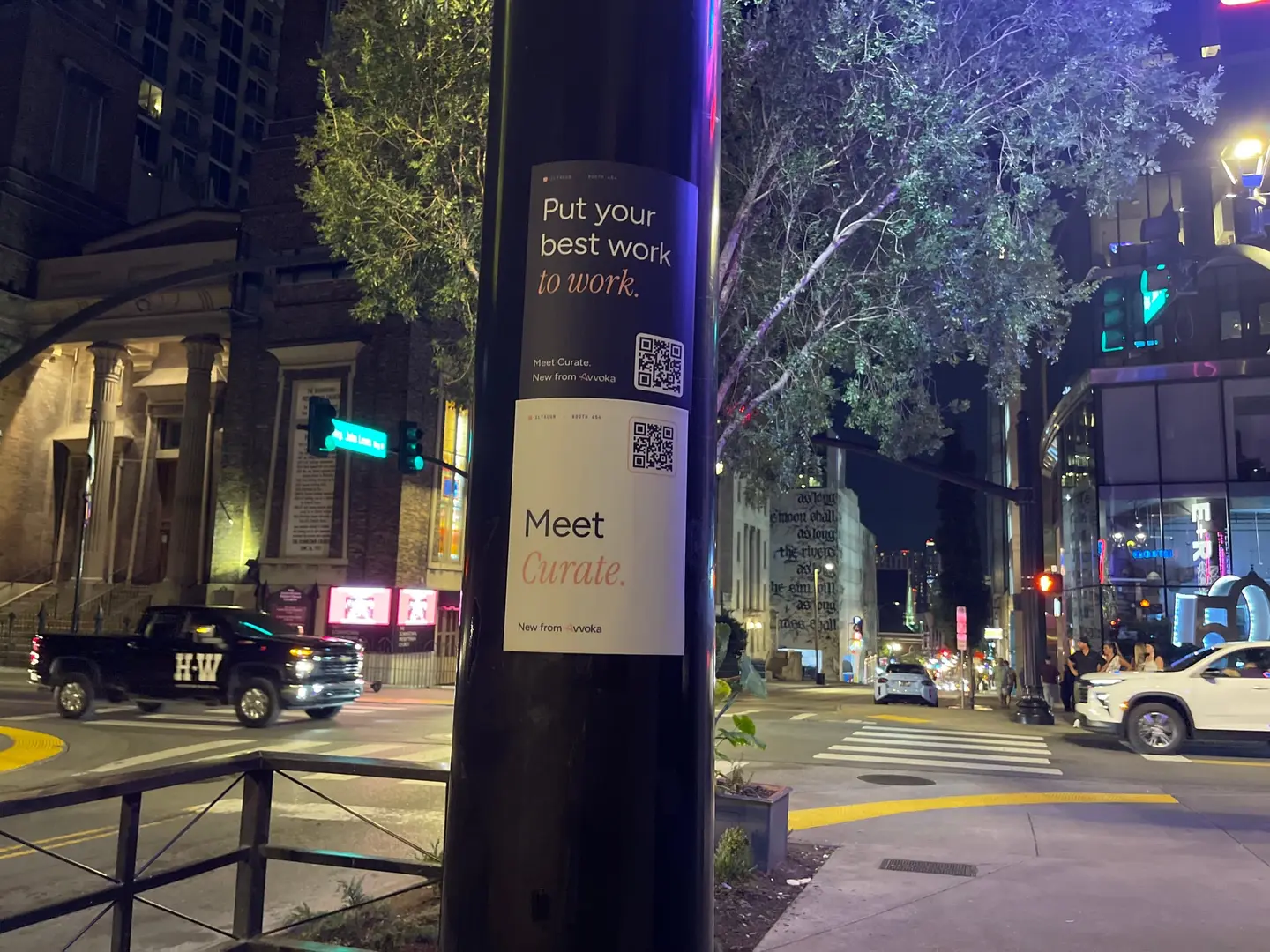
A billboard buys reach on a road. The formats below buy proximity on a block, usually for less money and always with a different kind of receipt attached. Out of home is a large category to shop inside of, with the OAAA reporting a record $9.46 billion in US revenue for 2025, up 3.6 percent year over year, and billboards are one line in it. The comparison starts with what each format costs.
The comparison
| Format | Published floor | Where it lives | Dwell |
|---|---|---|---|
| Highway billboard | ~$1,500–$5,000 / mo small-mid market, $14,000+ large | Above the road | Longest recorded fixation ~1.3 sec |
| Sidewalk stencils | $2,500 | The pavement people walk | Read mid-stride |
| Snipe posters | $3,000 | High-density street corridors | Repeat exposure on foot |
| Wheatpaste posters | $3,500 | Private walls at eye level | Read standing still |
| Floor graphics | $4,000 | Retail and venue floors | At the point of decision |
| Pole stickers | from $3,000 | Crosswalk signals, waiting moments | The walk-signal wait |
| Interior installs | $5,000 | Storefront windows and lobbies | Inside the room |
Billboard rates swing hard by market, which is why a single national number is close to useless. Broadsign’s cost breakdown puts static boards at roughly $1,000 to $2,000 a month in rural areas, $1,500 to $5,000 in small and midsize cities, and $14,000 and up in larger markets. Vistar Media puts typical billboard CPMs at $6 to $10, rising to $15 to $25 in marquee zones like Times Square. The street-format floors above are our published rates with printing and installation included, plus a GPS-stamped photograph of every placement, and the full rate card sits on the pricing page.
The dwell column measures two different things. An FHWA in-car driving study, summarized in the OAAA’s brief on driver distraction, recorded a longest single fixation of 1.28 seconds on a standard billboard and 1.34 seconds on a digital one, and the same brief puts typical glances toward digital boards under a second. A poster at eye level gets whatever time a person waiting at a crosswalk decides to give it, which we can describe but cannot meter.
What a billboard does that street formats don’t
A board wins on reach per dollar against a drive-by audience. Nothing at street level replaces one on the right corridor, and pretending otherwise would be selling rather than advising.
Part of what a board’s rate covers is scarcity that is written into federal law. Signs along the Interstate and primary systems fall under the Highway Beautification Act of 1965, which the FHWA administers through agreements with each state that set standards for which signs may stand and require nonconforming ones to come down. Good inventory on a good corridor is a regulated, finite supply. Fleet services, fuel, insurance, regional retail hanging off a highway exit: those briefs usually belong above the road.
What street formats do that a billboard can’t
A poster on a retail block sits close enough to touch and photograph. The distance between the ad and the sidewalk is zero, and a board thirty feet above a traffic lane cannot get there at any price.
Precision is the second difference. A billboard covers a corridor; a street run covers Williamsburg without paying for Midtown, or Silver Lake without paying for the Valley. The route gets built block by block, following the corners where people are already on foot.
Then there is proof. An impressions estimate is a model. Our campaigns close with a GPS-stamped photograph of every placement and a field map you can open each pin from, which is a record of what went up and where rather than a projection of who saw it. Attribution stays with the client’s own analytics, where it belongs. The Talk to Strangers run logged 236 placements that way across six Denver-area municipalities in July 2026, each one photographed on install day.
Speed and floor close the gap. A board buy runs on availability windows and fixed rate cycles. A street run opens at $2,500 and can be live in days.
Where the legal line actually sits
Permission decides most of it, and the cities are explicit about the split. NYC311 tells residents that the Department of Sanitation removes illegal postings from public and City-owned property and will not remove postings from private property, where removal is the owner’s responsibility. That distinction is the whole model for poster work: private walls, written consent from the owner, secured before anything prints.
The other formats carry their own rules. Stencil runs use temporary chalk-based material by default, and permit class varies by city, with Houston and Miami cleaner to work in than New York. Snipe campaigns live on construction hoarding and scaffold, where local tolerance changes block by block, so that class gets scoped market by market instead of sold with a blanket promise. Across all of it we have zero municipal removals on record, and the market-by-market detail sits in is wheatpasting legal.
Picking by brief
- Product launch in a walkable city: wheatpaste for the hero walls, snipes for density around them.
- Festival, drop, or tour date: snipes and pole stickers along the venue’s approach routes.
- Retail traffic: floor graphics and window installs at the decision point, stencils on the approach.
- Regional awareness on a car corridor: price the billboard.
Deeper cost breakdowns live in the wheatpaste campaign cost guide and the guerrilla marketing guide.