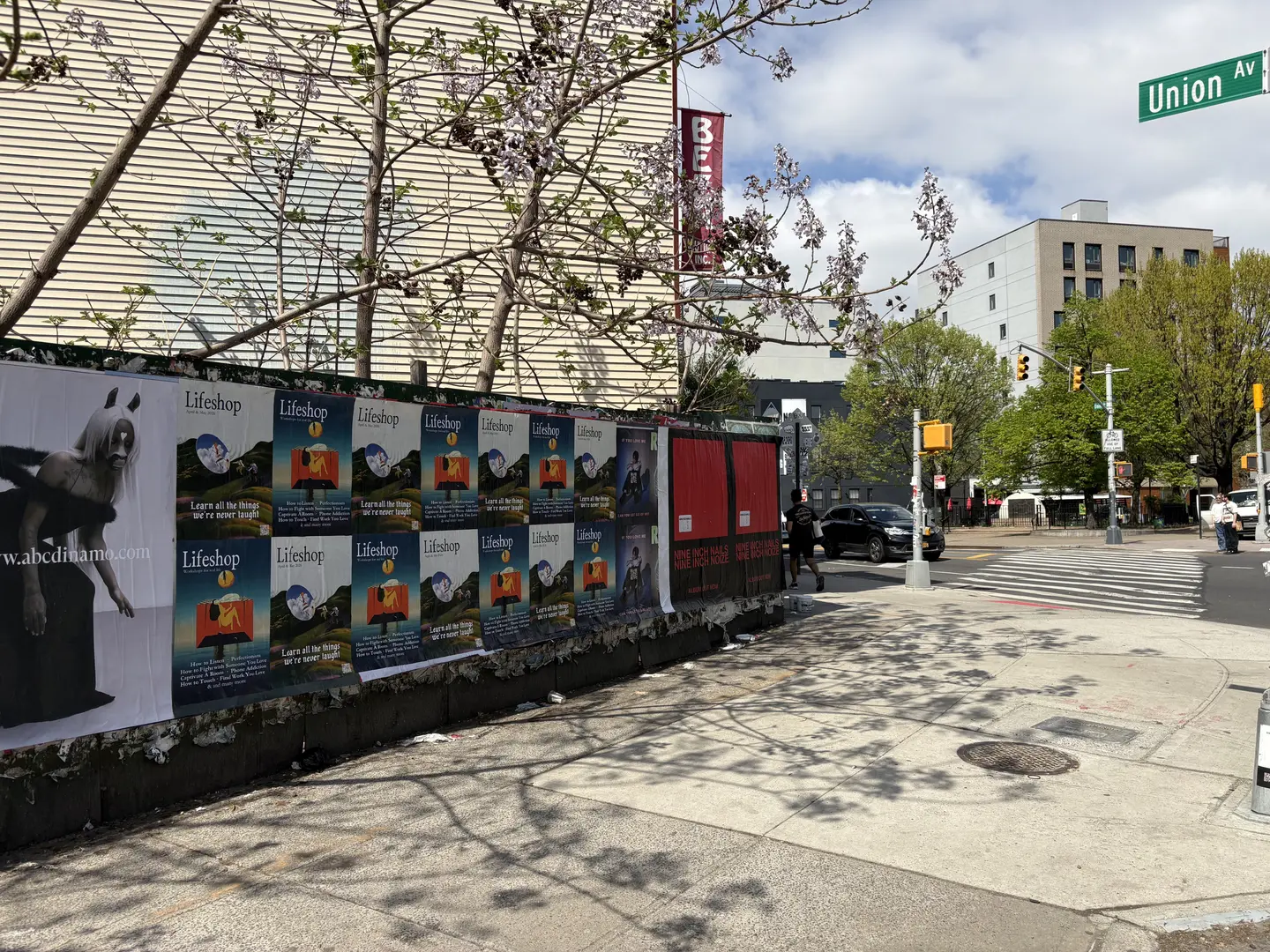
Every trade has words that get used loosely by everyone outside it. These are the seventeen that come up in briefs, defined the way the install crew actually uses them. Each definition above doubles as the short answer, and the linked service pages carry the pricing and process detail.
The formats: wheatpaste advertising · snipe posters · sidewalk stencils · reverse stencils · pole stickers · construction hoarding · scaffold wraps · custom poster installs · takeaway posters
The three words people mix up
Wheatpaste, paste-up, and flyposting describe one job from three angles. Wheatpaste names the adhesive, and the chemistry behind it is old and well documented. A 2024 study of wheat-based glues in conservation explains that flour paste draws its strength from gluten proteins, while a starch paste stays soluble because it never cross-links, so moisture swells it and lifts the sheet back off. That is the property the whole trade runs on. Paste-up names the hand-install instead of the glue. Flyposting is the British and Irish word, and it carries a legal edge in the UK: sections 43 to 47 of the Anti-social Behaviour Act 2003 let authorised council officers issue fixed penalty notices for flyposting.
“Wild posting” is the fourth word in that pile, and it behaves differently because it is a brand before it is a category. USPTO records show the mark WILD POSTING® registered to Dash Two, Inc. under U.S. Reg. No. 5432087, live since March 2018 and covering outdoor advertising services. Brands ask for it by name because vendors sell it by name. When a brief arrives asking for wild posting, we quote wheatpaste or snipes, because that is the work being described.
Where the older terms came from
Guerrilla marketing is the oldest word here and the least specific. Jay Conrad Levinson published the book that named it in 1984, and TIME later put it on its list of the 25 most influential business management books, for arguing that small companies should spend creativity where large ones spend media budget. Street postering sits inside that idea rather than defining it.
OOH is the buying category all of these formats belong to, and it is much bigger than the paper end of it. The Out of Home Advertising Association of America reported a record $9.46 billion in out-of-home advertising revenue for 2025, up 3.6 percent year over year. The figure is useful mostly as a sense of proportion. Street-level work is a small, hand-made corner of a very large channel.
The terms that are really about surfaces
Scaffold wrap and construction hoarding exist because cities are permanently under repair. When New York launched its plan to pull sheds down in July 2023, the city counted roughly 9,000 permitted sidewalk sheds spanning nearly 400 miles of sidewalk, with an average age near 500 days. That is the supply side of both formats. A wrapped shed or a hoarded fence is a flat street-level surface that somebody already owns and would rather not look at, and in our experience the owner conversation is shorter there than on a finished facade.
Pole stickers are the format most governed by local rule, and the rules are specific. San Francisco Public Works publishes its posting standards for city lamp posts and utility poles: under 11 inches tall, no higher than 12 feet, attached with twine or other non-adhesive banding, dated in the corner, removed within 70 days, and kept off traffic-signal and historic poles. Other cities write their own version, so reading the local rule is part of drawing the route.
Dwell, the term worth arguing about
Dwell time is the reason anyone buys street level instead of highway height, so it is worth having a real number attached to it. The Federal Highway Administration put eye-tracking equipment in cars and measured how long drivers look at roadside advertising. In the CEVMS driver visual behavior study, mean dwell time toward a digital billboard came out at 994 milliseconds in Reading and 1,039 milliseconds in Richmond, and fixations longer than two seconds were essentially not observed for either digital or standard billboards. A look at a billboard from behind the wheel runs about a second.
A poster on a walking block is met on foot or in a queue, so the same person can read it twice on the way to the train. What happens after that belongs to the client’s analytics. We do not measure impressions, foot traffic, or cost per acquisition, and any number of that kind attached to a paper campaign is an estimate.
What the crew can show you
The documentation is the part we control, so it is the part we put numbers on. One Denver west-metro run logged 236 GPS-stamped placements on a shared field map. Momentm’s takeaway install in Williamsburg carried 40 supplement stick packs across four posters, photographed on install and again as the strips emptied. The Father’s House SF took a street-level wall on Ocean Avenue with six jumbo 48x72 sheets printed in-house. Momentous took the construction hoarding around a Los Angeles residential development site, full perimeter, for 90 days.
Pricing is published for the same reason. Sidewalk stencils open at $2,500, snipes and pole stickers at $3,000, wheatpaste posters at $3,500, with printing and installation included. If a term in this glossary shows up in your brief, the service page for it carries the process and the floor.
Deeper reading: the complete wheatpasting guide covers technique and materials end to end; is wheatpasting legal handles the permission rule market by market; billboard alternatives puts the formats side by side on price and dwell.