The problem with a blank wall
If your building has street-level frontage that sits blank, boarded, or between tenants, you already know how this goes. Someone posts a flyer. Then someone posts over the flyer. Within a couple of weeks the wall is carrying half a dozen messages, none of them yours, and the block starts reading the whole frontage as abandoned.
The usual response is removal. Scrape it, paint it, repeat. It rarely holds, because removal treats the symptom. The reason the wall keeps getting posted on is that it looks unclaimed, and an unclaimed surface in a walkable corridor is genuinely useful to people with something to promote.
Occupancy beats enforcement
The approach that actually holds is to take the surface. Cover it with your own branding, edge to edge, and keep it maintained. Two things change at once.
The wall stops looking available. A continuous, deliberate, well-printed design reads as owned in a way that bare plywood never does, and most people will not post over something that is obviously somebody’s active frontage.
And the space starts working for you. You were going to have a wall either way. This way it carries your message instead of somebody else’s.
What that looked like in San Francisco
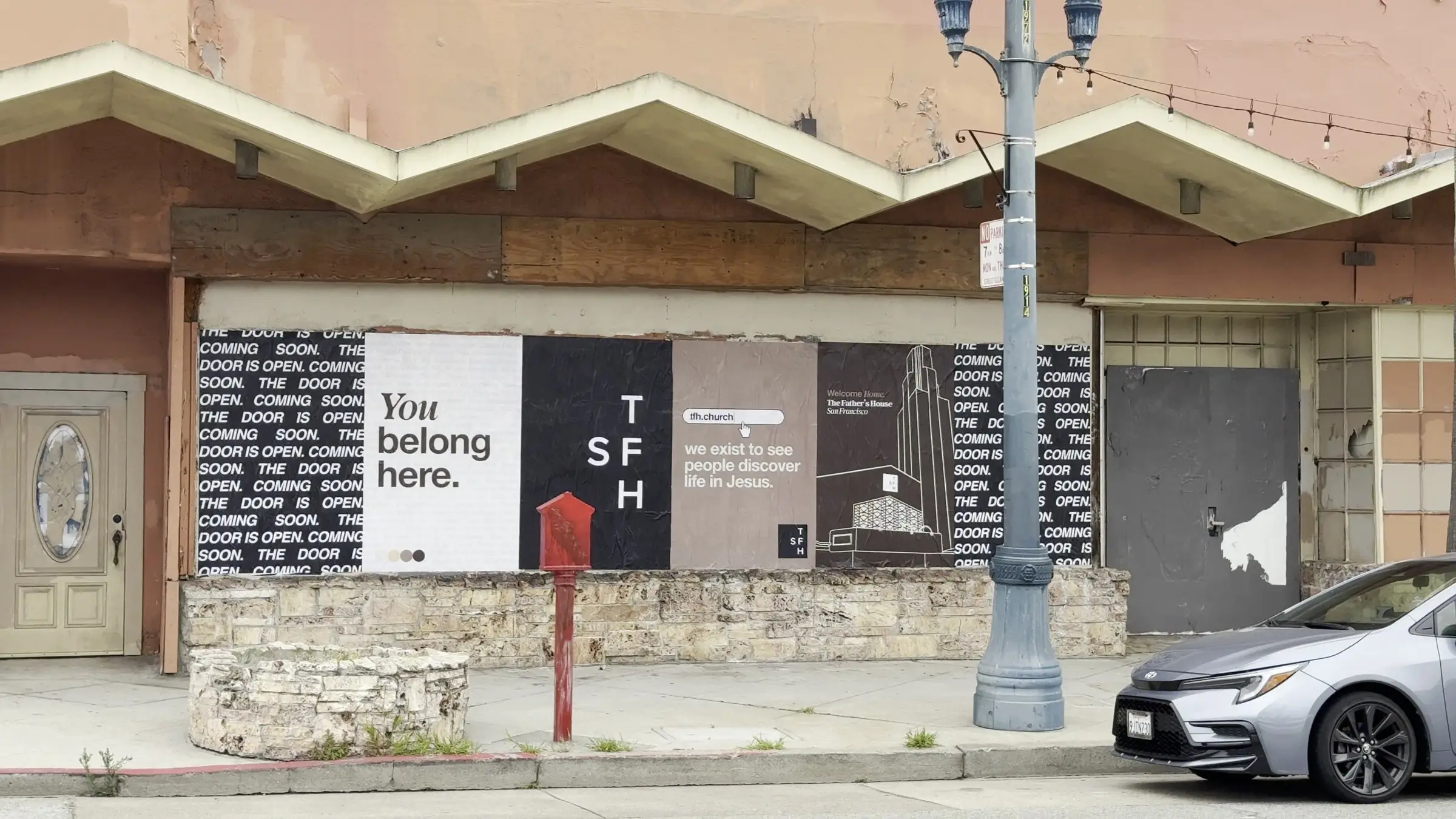
The Father’s House SF is a church on Ocean Avenue, in the historic El Rey building. Their street-level wall had become a default posting surface, and rather than fight it placement by placement, they decided to occupy it.
We recommended going big rather than wide. Six jumbo posters at 48 by 72 inches, four times the size of a standard sheet, six unique designs from the church’s own brand system, printed in-house and hand-installed as one continuous run across the frontage.
The designs did the work: a repeating “THE DOOR IS OPEN. COMING SOON.” field, a “You belong here.” panel, the church’s monogram, and a line drawing of the El Rey building itself. The building on the poster is the building the poster is pasted to.
The result is a wall that is unmistakably the church’s. It is continuous, it is maintained, and it reads as intentional. Posting on it dropped off, not because anyone is policing it, but because it is clearly taken.
Full detail, including the six designs and the install photos, is in the Father’s House SF case study.
When this applies to you
This is worth considering if you own or lease street-level frontage that is blank, boarded, under renovation, or between tenants, and especially if you are in a walkable corridor where posting is common.
It is the same logic behind construction-hoarding programs: a large temporary surface is going to communicate something to everyone who walks past, so the only real decision is whether it communicates yours.
If that is your situation, the mechanics are on our custom poster installs page, and pricing is published on the pricing page rather than gated behind an RFP. For the legal side of poster work generally, including the permission rule and what counts as consent, see is wheatpasting legal or illegal.