AI & Emerging Tech.
Wheatpaste, stencil, and pop-up campaigns for AI labs, foundation model companies, and robotics. IRL launches in SF, NYC, Cambridge, and Seattle.
Four tensions only street resolves.
- 01
AI launches now ship 5-10 per week across the same audience. The digital channels are saturated, and a press release into that flow lands as noise inside hours
- 02
Enterprise buyers (CIOs, ML platform leads, security review boards) treat brand visibility as a procurement signal. A brand they have not seen physically is a brand that has not made it to short-list
- 03
The buyer audience self-selects to specific neighborhoods (SoMa, Mission, Hayes Valley in SF; Chelsea, Flatiron, Williamsburg in NYC; Kendall Square in Cambridge). Paid digital cannot target that density without massive waste
- 04
Conference weeks (NeurIPS, ICML, CVPR, OpenAI Dev Day, AWS re:Invent, Google Cloud Next) collapse the launch window into a 5-day battle for attention with every other AI brand
Is this you?
If two or more match your roadmap, send the date.
- You're shipping a foundation model, agent platform, or robotics product and the press release disappears into the news flow within hours.
- Your enterprise buyers treat IRL visibility as a procurement signal. A brand they haven't seen in the neighborhood hasn't made the short list.
- Your target audience walks SoMa, Mission, Hayes Valley, Chelsea, and Kendall Square. Paid digital can't reach that density without massive waste.
- You have a conference window. NeurIPS, ICML, CVPR, OpenAI Dev Day. And five days to own the host city and your home market simultaneously.
- The wheatpaste photo becomes your press cycle. The screenshot founders post on X, the image The Information runs, the visual recruiting uses for the next quarter.
- You're Series A through C competing against incumbents with unlimited brand budgets.
5 disciplines, one playbook.
Wheatpaste
Wheatpasting and wheatpaste advertising campaigns from $3,500 in NYC, LA, SF + 40 US cities. Published floors, 5-7 day lead (Expedited 24-72hr), GPS-tagged photo proof on every install. From $3,500Paste-Up Posters
Paste-up poster campaigns for product launches and neighborhood saturation. From $3,500, 5-7 day lead (Expedited 24-72hr), GPS-tagged photo proof in 40 US cities. From $3,500Sidewalk Stencils
Sidewalk stencil campaigns from $2,500 in 40 US cities. Chalk-safe, removable, permitted-only. Expedited 24-72hr available. GPS-tagged photo proof. From $2,500Pole Stickers
Pole sticker advertising and street pole takeovers in 40 US cities. Legal commercial-pole campaigns with geo-tagged photo proof on every install. From $3,000Coffee Shop Posters
Coffee shop poster programs in 40 U.S. cities. Counter cards, column wraps, and wall placements in partner cafes with full photo proof on every install. From $3,000Starting floors · print, install, and GPS-stamped photo proof included in every quote. Final number varies by turnaround, size, and location count. Full rate card →
Sample creative directions.
Pre-tested format / neighborhood pairings. Pick a direction at brief intake and we route the surface set inside 24 hours.
- Foundation model launch announce Large-format wheatpaste, 16 placements SoMa 2nd-7th, Howard to Folsom
- Conference pop-up routing Chalk-safe sidewalk stencils + QR Valencia, 16th St coffee loop
- Brand corridor build Pole sticker density, conference-week window Hayes Valley, Octavia to Laguna
- Series B recruiting push Wheatpaste, Mass Ave Central to Kendall Cambridge, MIT corridor
The neighborhoods, not the metros.
We install where the audience already moves. Named corridors per market, permitted and photo-documented.
SoMa · Mission District · Castro · Hayes Valley · Tenderloin · North Beach
Chinatown · Kakaʻako · Downtown · Waikiki · Ala Moana · Kaimuki / Kapahulu
East Nashville · 12 South · The Gulch · Music Row · Downtown · Germantown
Gaslamp Quarter · East Village · North Park · Bankers Hill · Cortez Hill · Hillcrest
Put it on the wall.
We have run this for ai & emerging tech.


Proof · Printed in-house · Installed by our crew
Street campaigns for AI & Emerging Tech brands. Proof included.
Send the brief; a scoped quote for your vertical comes back inside 24 hours — formats, neighborhoods, and a GPS-stamped photo of every placement when the run wraps.
- Quote in under 24 hours
- No discovery call. The brief is the call.
- Printing & Installation under one roof
Brief us · Quote in under 24 hours
Start your ai & emerging tech campaign.
Brand-safe by default.
- Private-property walls only Written owner consent on file for every surface. No public infrastructure, transit, or right-of-way.
- GPS-stamped photos within 48 hours Wide, mid, detail per placement. The proof your team forwards internally.
- FTC + local-code compliant Disclosures and permitting handled per contract. Legal reviews clean.
- Zero municipal removals on record 500+ documented installs, none taken down by a city.
Read the full field notes
Why the Digital Launch Playbook Stopped Working for AI
Five to ten AI products ship every week. They land in the same inboxes, the same X timelines, the same TechCrunch feed, in front of the same few thousand people who decide what is real. The launch playbook every AI company runs is identical. Post the thread. Pitch The Information. Email the waitlist. Buy the LinkedIn slot. The channel is so crowded that a model release with real technical merit disappears into the scroll inside hours. The problem is saturation, not content. You cannot out-post a feed where everyone is posting the same week.
Street media breaks the loop because it is the one format the launch flood has not flooded. When a brand goes up on a wall in SoMa the morning a model drops, it is not competing in a feed. It is competing in a city, against far fewer brands, in front of an audience that cannot scroll past it. The same buyer who archives your launch email walks past your wheatpaste on the way to coffee. That is a different kind of impression. It lasts weeks, not milliseconds, and there is no auction, no bid, and no algorithm between the brand and the person.
For an AI company fighting for attention against incumbents with unlimited brand budgets, street is the rare format where a $30,000 spend visibly outranks a $3M campaign in the right neighborhood. The wall does not know who has the bigger Series. It just sits there, large, in the corridor your buyers walk every day.
The Launch-Day Wheatpaste Blitz
The center of an AI campaign is a wheatpaste blitz timed to the exact morning a model or product ships. Not the week before. Not the day after. The morning of. The work is built around the launch clock so the physical presence and the digital announce hit the audience at the same hour, reinforcing each other instead of running on separate calendars.
The mechanics matter. A foundation model launch announce runs sixteen large-format placements across a single dense corridor, installed overnight so the brand is on the wall before the first founder-and-engineer commute. The creative carries the one idea the launch is about, plus a campaign URL or QR that routes straight to the model, the waitlist, or the demo. By the time the launch thread goes live, the brand is already physically in the city, and the people posting that thread have already walked past it.
We run the entire blitz through our own presses. Wheatpaste advertising is the format, and because we print and install as a single vendor, the creative locks late and still ships on time. That single chain of custody, press to wall, is what makes a launch-day drop survivable when AI launch dates slip the way they always do.
Plan for the slip. Model dates move, often the morning of. We lock the crew, the walls, and the routes in advance and hold the creative until you call go.
Control the print clock. Because we print in-house through our poster printing operation, production is on our schedule, not a third-party shop’s. A version number or price can change the week of launch and we reprint and re-paste inside 48 hours.
Compress when the date demands it. Expedited campaigns cover the 24-to-72-hour brief-to-wall format for surprise drops and reactive launches.
Where the AI Audience Actually Walks
The AI buyer audience self-selects into a handful of neighborhoods, and the density in those corridors is why street beats geo-targeted digital on the audience-density math. Paid digital cannot reach this concentration without burning most of the spend on waste impressions. The street can, because the audience walks it daily.
San Francisco, SoMa and Mission and Hayes Valley. SoMa is the founder, engineer, and operator corridor. Wheatpaste between 2nd and 7th, Howard down to Folsom, hits the morning commute. The Mission carries the same audience on Valencia and 16th. Hayes Valley between Octavia and Laguna catches the cafe loop walk from Patricia’s Green.
New York, Flatiron and Chelsea and Williamsburg. Flatiron is the operator-and-investor walk, with pole stickers along Broadway and wheatpaste at 23rd and 6th. Chelsea holds the AI-office concentration. Williamsburg reaches the talent and recruiting audience.
Austin, East Austin and the Domain. East Austin and the Domain corridor cover the open-source and infrastructure-AI cluster, and the city turns into the center of gravity during SXSW and the rolling AI summits.
Cambridge adds the MIT and lab-spinout density along Mass Ave between Central and Kendall. Seattle adds the cloud and AI-infra audience in SoDo and Capitol Hill. Neighborhood selection drives roughly 70% of a campaign’s audience-density impact, which is why the brief always starts with the corridor, not the city.
Owning the Conference and Dev-Event Window
The AI conference calendar collapses the launch window into a five-day battle. NeurIPS, ICML, CVPR, OpenAI Dev Day, AWS re:Invent, Google Cloud Next, and the rolling enterprise-AI summits in New York and Boston each pull the entire audience into one city for one week, and every other AI brand is fighting for the same attention.
Street media wins the conference week because it owns the physical ground attendees cross between the venue, the hotel, and the after-hours dinners. We plan install windows around the conference so the brand is on the wall the morning attendees walk in, and we pre-stage the home-market install in San Francisco, New York, or Cambridge so the launch is visible in both the host city and the audience’s home neighborhoods on the same week. A developer who sees the brand at the conference and again back home in SoMa reads it as a company that is everywhere that matters. That is the impression a single sponsored slot cannot buy.
The economics favor street here too. A conference booth and a host-city sponsorship package run six figures and put the brand inside a hall everyone else also sponsored. The same budget spread across a host-city wheatpaste corridor and a synchronized home-market install puts the brand on the street where attendees actually walk, where the badge-scanning competitors cannot follow, and where the photo of the wall outlives the conference by a full quarter. We have run the Pacific-conference math for clients who chose the corridor over the carpet and watched the install carry the story long after the hall emptied.
Recruiting, Enterprise Trust, and the “Real Company” Signal
A street campaign does two jobs no digital channel does as cleanly.
It signals a real company to enterprise buyers. CIOs, ML platform leads, and security review boards treat brand visibility as a procurement signal. A brand they have walked past in the neighborhood is a brand that has made it to the short list. A brand they have only seen as a sponsored post has not. Physical presence reads as permanence, and permanence is exactly the thing an enterprise buyer is underwriting when they bet a roadmap on a young AI vendor.
It recruits. The engineers an AI company needs walk the same corridors as the buyers. A wall in SoMa or along Mass Ave is a recruiting asset that the next quarter of outreach can point to. The photo of the install becomes the image a recruiter sends, the proof that the company is building something visible enough to put on a building.
How the Street Becomes the Story
The wheatpaste photo is the deliverable that outlives the crew. The install runs five to ten days. The photo-asset lift runs for the rest of the launch quarter. A blitz timed to a model release becomes the screenshot founders post on X, the image The Information runs in its launch piece, and the visual recruiting reuses for months. Tech Twitter photographs street media because it is unexpected and physical in a world of feeds, and the brand that shows up where the audience already lives earns the kind of organic pickup that paid placement cannot manufacture.
Every placement is documented wide, mid, and detail, with the QR or URL legible, and daily install logs go to the client team. We track press, X, and LinkedIn pickup of the creative across the launch window so the brand can attribute earned media back to the install spend, and campaign URLs plus QR-tagged landing pages let the analytics stack measure street-attributed signups separately from paid digital.
Recent AI and Emerging-Tech Work
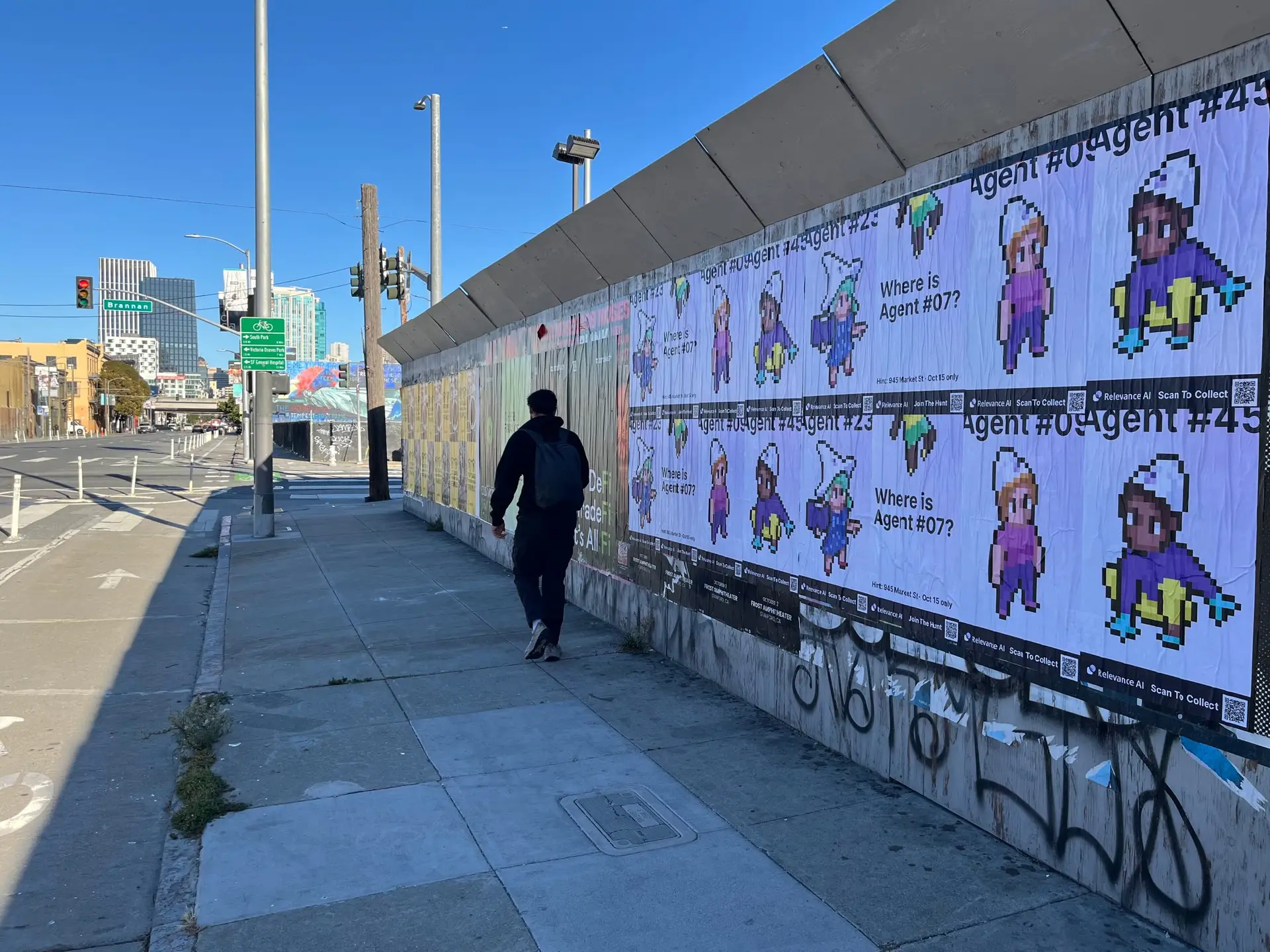
Relevance AI, SoMa blitz. Sixteen pixel-art wheatpaste placements across Howard to Folsom in San Francisco, timed to the morning founder-and-engineer commute for the agent-marketplace launch.
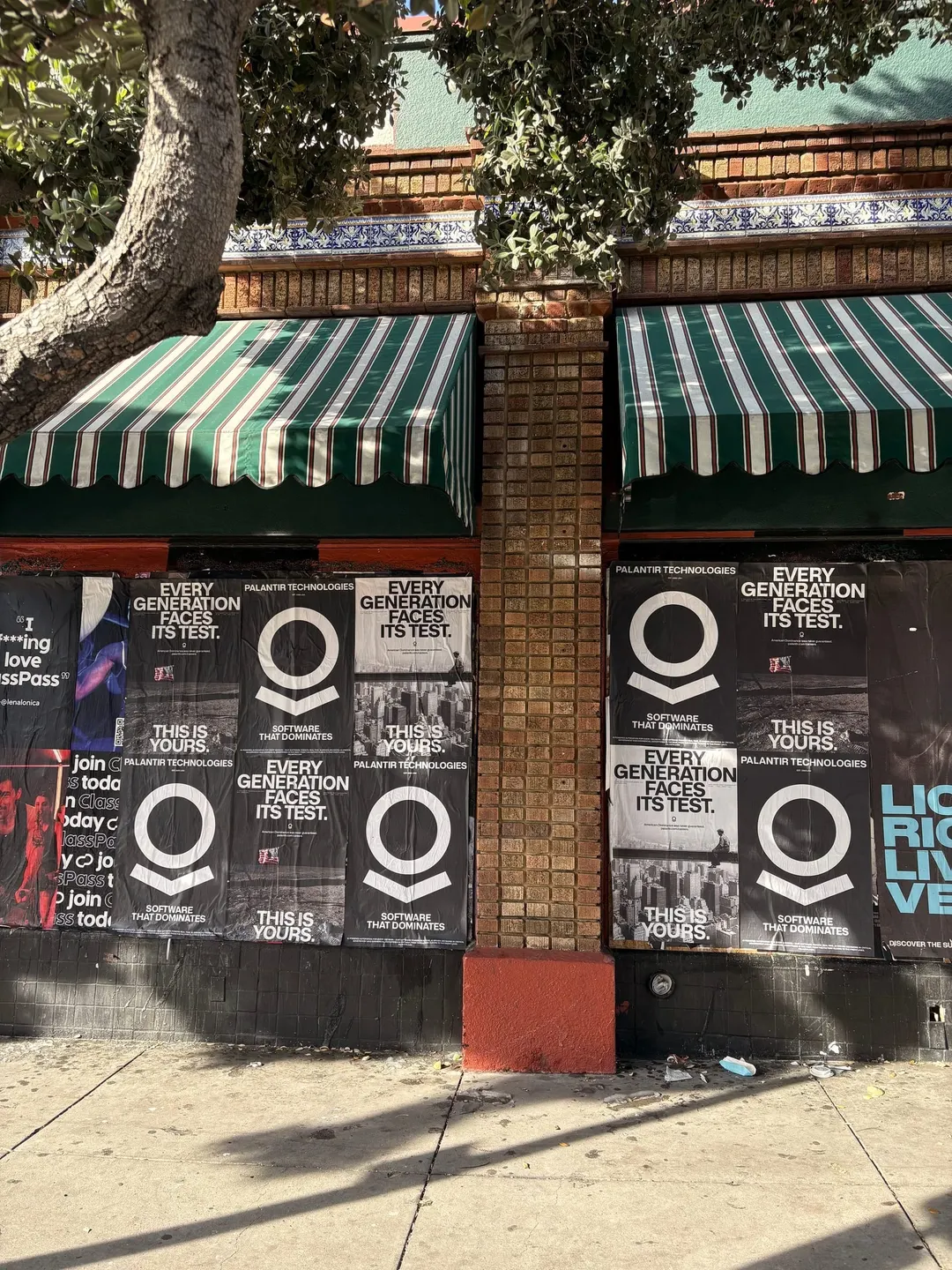
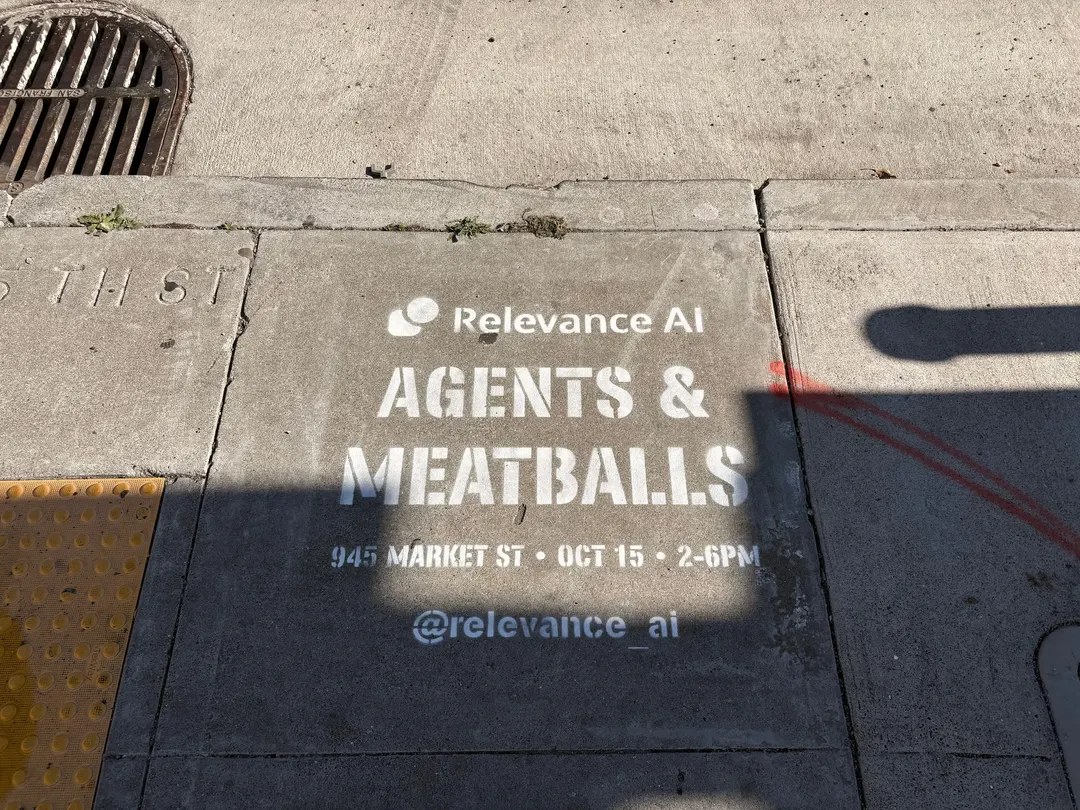
Relevance AI, Agents & Meatballs SF. Chalk-safe sidewalk stencil routing from Valencia and 16th to the 945 Market St pop-up, a multi-touch launch-week environment that turned a coffee walk into a path to the activation.
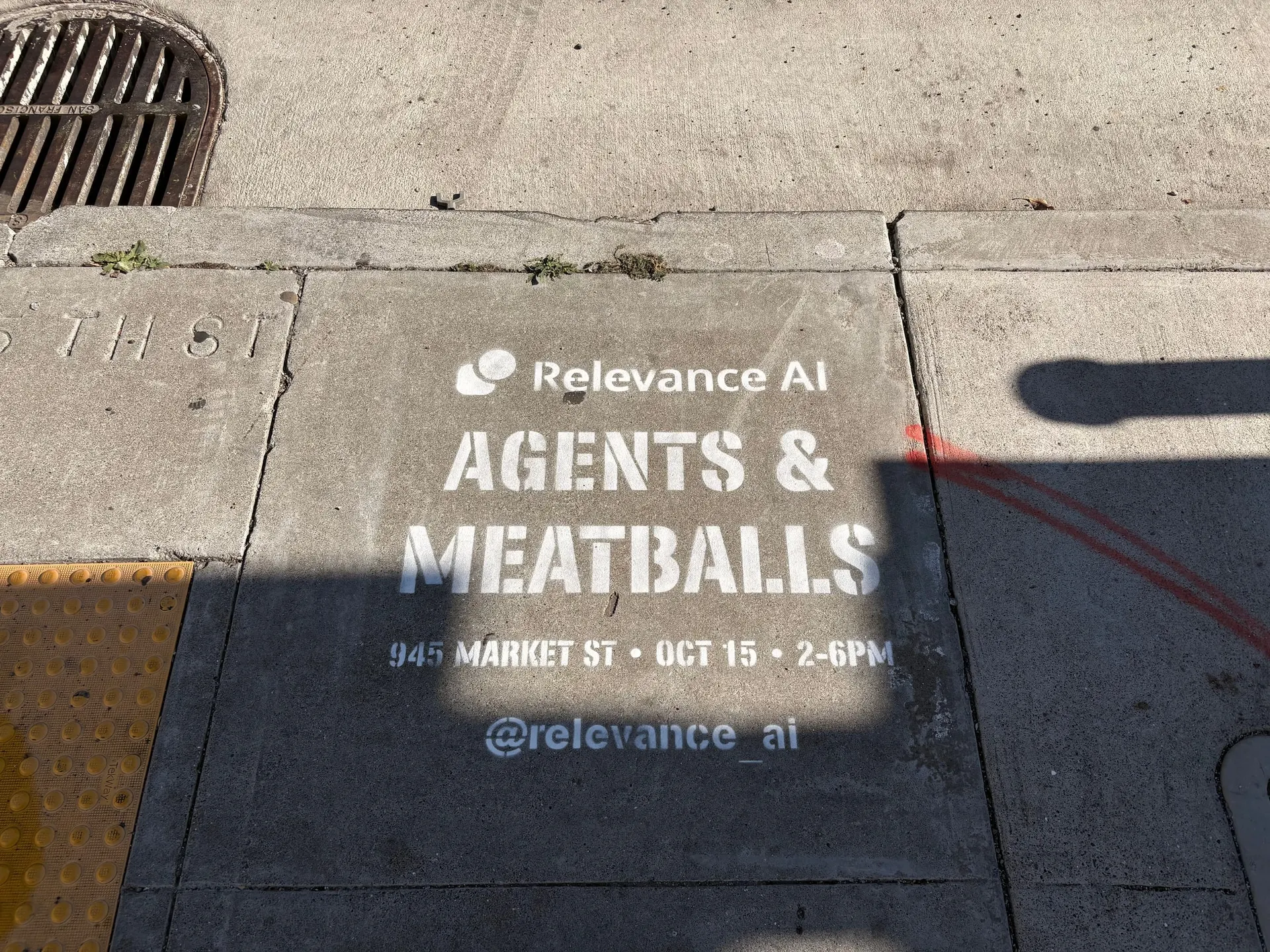
Palantir, San Diego. Twenty-nine-wall saturation in 48 hours across Gaslamp and East Village, GPS-stamped install logs on every placement.
Palantir, Honolulu. A Pacific-market wheatpaste run proving the same documented playbook works far outside the home corridor when the calendar calls for it.
Stripe, Convergence SF. Interior column wraps and on-site branding for the Stripe Convergence event, the developer-and-fintech audience reached inside the venue where they gathered, printed and installed in-house on the event clock.
Brief us with the launch date, the target corridor, and the conference window. We come back with a crew plan in 24 hours. Reach the team at info@beyondstreetmedia.com.
AI & Emerging Tech questions.
The 5 things ai & emerging tech brands ask before sending a brief. Same-day answers from the desk if yours isn't here.
Q · 01 How does street marketing actually move the needle on an AI launch?
Street media drives the photo cycle that AI launches need to break through the weekly noise. A wheatpaste blitz in SoMa the morning of a model release becomes the screenshot that founders post on X, the photo The Information runs in its launch piece, and the visual that recruiters use in the next week of outreach. The install runs five to ten days; the photo-asset lift runs for the rest of the launch quarter. For enterprise-buyer brands, the IRL presence is also a procurement signal. Buyers who have walked past your brand on Howard Street treat the inbound differently than buyers who have only seen a sponsored LinkedIn post.
Q · 02 What does an AI launch campaign actually cost?
A single-market launch blitz (wheatpaste plus pole stickers in SF or NYC, one neighborhood corridor, one week) starts at $9,000-$18,000. A multi-format multi-neighborhood push for a foundation model or product launch (SF SoMa plus Mission plus Hayes Valley, two-week window, photo-asset deliverables) runs $35,000-$95,000. Conference-week tours that pair the conference host city with the brand's home market typically run $60,000-$180,000 for the combined install. Sustained quarter-long brand programs across SF, NYC, and Cambridge scale past $250,000.
Q · 03 Do AI buyers actually walk past wheatpaste, or are they all in offices and rideshares?
The buyer audience walks. SF founders and ML engineers walk SoMa, Hayes Valley, and the Mission. NYC AI operators walk Chelsea, Flatiron, and the Williamsburg coffee corridor. Cambridge MIT and Harvard ML talent walk Massachusetts Ave between Central and Kendall daily. The walking density in these specific neighborhoods is why street media beats geo-targeted digital in the audience-density math: there is no auction, there is no bot traffic, and the impression lasts weeks instead of milliseconds.
Q · 04 Our model ship date moves. Do you print the posters, and how tight can you hold a launch-day drop?
We print in-house, so the production clock is ours, not a third-party print shop's. Hand us the artwork. We handle stock, sizing, weatherproofing for exterior wheatpaste, and the install on one timeline with one vendor. See poster printing. One chain of custody from press to wall is what lets us absorb a slipping launch date. We lock the crew, the walls, and the routes in advance, then hold the creative until you call go. A single-market SF or NYC blitz moves from approved artwork to walls in 5 to 7 business days. Expedited launch-day drops compress that further. See expedited campaigns for the 24-to-72-hour brief-to-wall format. If the date slips a week, the crew waits, the walls stay reserved, and we paste the morning the model actually ships. If a version number or price changes the week of launch, we reprint and re-paste in 48 hours without resetting the timeline.
Q · 05 How do you measure an AI launch street campaign?
Three measurement layers. First, install documentation. Every placement is photographed wide, close, and with the QR or URL visible, with daily install logs delivered to the client team. Second, photo-asset lift. We track press, X, and LinkedIn pickups of the campaign visuals during the launch window so the brand can attribute earned media back to the install spend. Third, attribution where applicable. Campaign URLs, dedicated short-domain redirects, and QR-tagged landing pages let your marketing analytics stack measure street-attributed signups, demo requests, and waitlist installs separately from paid digital.
We delivered.

















Brand partners include: FIFA World Cup 2026, Palantir, Sézane, G-Shock, Mitchell & Ness, True Religion, Huda Beauty, Yonex, Relevance AI, Momentous, RYZE Coffee, Bloom Effects, Incrediwear, Brooklyn Museum, Sweat FC, HydroJug, Frameline, Alchemy, OneRepublic, Lone Fox, Vaura Pilates.
Got a ai & emerging tech launch?
Inquire now.
Send the AI & Emerging Tech brief: markets, window, creative direction. Vertical-specific quote back in 48 hours.