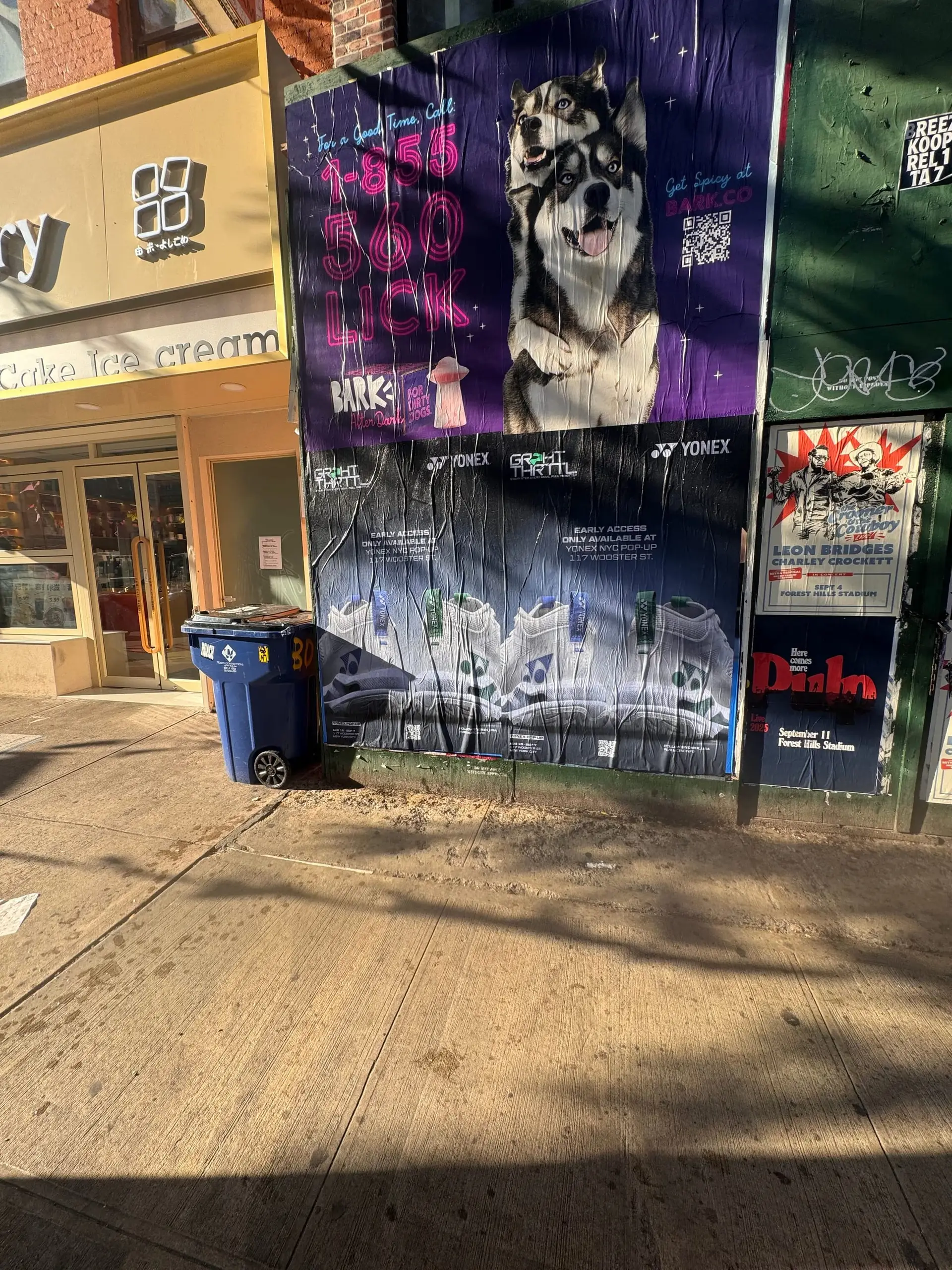
Gaming & Esports.
Wheatpaste, mural, and pop-up campaigns for game publishers and esports orgs. Launch-day saturation in LA, NYC, Austin, and tournament-host cities.
Four tensions only street resolves.
- 01
Game launch windows are locked to drop dates that cannot move. The marketing calendar is set by the publisher 18 months out. Street campaigns need to be confirmed, scheduled, and installed in a tight 4-6 week window with zero slippage
- 02
Tournament-week city sequencing (PAX rotates annually, EVO draws Vegas, Gamescom is Cologne, esports finals tour by city) requires campaigns that sync to tournament calendars, not just ad-spend calendars. A level of precision most street agencies do not provide
- 03
Twitch and YouTube ad spend for game-launch awareness has plateaued; CPM has risen 3x in three years while completion rates have fallen. Publishers are rotating budget toward IRL formats that generate organic Twitch and Discord pickup. A campaign that gets photographed and clipped is worth 10x the impression cost of a pre-roll ad
- 04
Gaming audiences are mobile and photograph everything. A wheatpaste in Echo Park or Lower East Side the week of an indie drop gets clipped on TikTok and posted in Discord servers. The social velocity of a street campaign in a gaming-cluster city often exceeds the reach of $50k in paid Twitch ads
Is this you?
If two or more match your roadmap, send the date.
- Your launch window is locked to a drop date and street media has to install in a tight 4-6 week window with zero slippage.
- You sync to tournament calendars, PAX, EVO, Gamescom, esports finals, not just ad-spend calendars.
- Your Twitch and YouTube CPMs have tripled while completion rates fall, and you're rotating budget toward IRL that gets photographed and clipped.
- Your audience photographs everything. A wheatpaste in Echo Park or the Lower East Side gets clipped on TikTok and posted in Discord.
- You operate under strict creative-faithfulness rules, no asset modification, no color shift, and missing an approval window kills the campaign.
- Your audience clusters in specific neighborhoods, Silver Lake, East Austin, SoMa, the Lower East Side, where broad targeting misses entirely.
5 disciplines, one playbook.
Wheatpaste
Wheatpasting and wheatpaste advertising campaigns from $3,500 in NYC, LA, SF + 40 US cities. Published floors, 5-7 day lead (Expedited 24-72hr), GPS-tagged photo proof on every install. From $3,500Paste-Up Posters
Paste-up poster campaigns for product launches and neighborhood saturation. From $3,500, 5-7 day lead (Expedited 24-72hr), GPS-tagged photo proof in 40 US cities. From $3,500Poster Murals
Multi-panel poster murals. Full-wall paste-up installs spanning building sides and scaffold runs. Brand-scale visibility with photo proof in 40 US cities. From $8,000Pole Stickers
Pole sticker advertising and street pole takeovers in 40 US cities. Legal commercial-pole campaigns with geo-tagged photo proof on every install. From $3,000Multi-City Tours
Multi-city guerrilla marketing tours. Coordinated wheatpaste, stencil, and interior install rollouts across 6 to 30 US cities in one sequence. From $25,000Starting floors · print, install, and GPS-stamped photo proof included in every quote. Final number varies by turnaround, size, and location count. Full rate card →
Sample creative directions.
Pre-tested format / neighborhood pairings. Pick a direction at brief intake and we route the surface set inside 24 hours.
- AAA game launch Large-format wheatpaste, 2-week window Arts District LA, SoMa SF, Williamsburg
- Tournament street activation Pole stickers + snipe posters, event week EVO Vegas, PAX West Seattle
- Indie launch saturation Wheatpaste + stencils + QR, 6 weeks pre-release Echo Park, LES, East Austin, Mission
- Gaming platform installs Column wraps + bathroom posters, 90-day cycle Gaming lounges, esports cafes
The neighborhoods, not the metros.
We install where the audience already moves. Named corridors per market, permitted and photo-documented.
SoMa · Mission District · Castro · Hayes Valley · Tenderloin · North Beach
Put it on the wall.

Proof · Printed in-house · Installed by our crew
Street campaigns for Gaming & Esports brands. Proof included.
Send the brief; a scoped quote for your vertical comes back inside 24 hours — formats, neighborhoods, and a GPS-stamped photo of every placement when the run wraps.
- Quote in under 24 hours
- No discovery call. The brief is the call.
- Printing & Installation under one roof
Brief us · Quote in under 24 hours
Start your gaming & esports campaign.
Brand-safe by default.
- Private-property walls only Written owner consent on file for every surface. No public infrastructure, transit, or right-of-way.
- GPS-stamped photos within 48 hours Wide, mid, detail per placement. The proof your team forwards internally.
- FTC + local-code compliant Disclosures and permitting handled per contract. Legal reviews clean.
- Zero municipal removals on record 500+ documented installs, none taken down by a city.
Read the full field notes
Why Street Campaigns Win for Gaming & Esports
Gaming audiences live online. Twitch, Discord, YouTube, Reddit. But the moment when a game launches or an esports tournament arrives, the audience spills into the real world. They travel to tournament host cities. They gather at launch parties. They walk to arcades and gaming lounges, and they photograph everything: a wheatpaste in Echo Park is a 10-second TikTok clip; a snipe poster outside an esports cafe is a Discord share; a mural in Lower East Side is a Reddit thread.
Street media solves a specific problem inside that landscape. AAA publishers and esports orgs have spent three years watching Twitch and YouTube CPMs rise and completion rates fall. The cost to reach a hardcore gamer on a pre-roll ad has tripled; the format is increasingly skipped. Street campaigns offer a different efficiency: they generate organic social pickup because the gaming audience documents everything, they hit the audience at exactly the moment they are mobile (launch week, tournament week, commute through a gaming-cluster neighborhood), and they create a credibility signal. “this game/tournament is real and present in my city”. That no banner ad matches.
For game publishers on a tight launch-window schedule, for esports orgs syncing campaigns to tournament calendars, and for gaming platforms launching in competitive markets, street media is the format that scales awareness without competing on auctioned channels. The operational constraint is synchronization: launch windows move 0%, tournament weeks are locked into an annual calendar, and the audience density requires neighborhood-level precision most street agencies do not provide. Beyond Street Media operates at that level.
What Gaming & Esports Brands Actually Need
Precision timing that matches the launch calendar. A game that drops on a Tuesday needs street presence in the three to five cities where the audience is densest, and that presence needs to install Sunday or Monday, not Friday. Tournament schedules are published 12-18 months out; street campaigns need to sync to the week before the tournament, not a month after. The synchronization is the entire operational contract for gaming campaigns.
Neighborhood density in gaming-cluster cities. The hardcore gaming audience is not uniformly distributed. In LA, they live in Silver Lake and Echo Park, not Bel Air. In NYC, they walk through Lower East Side and Williamsburg, not Midtown. Street campaigns that shoot for a broader audience miss entirely. Density in the neighborhood where the audience actually lives is the only targeting model that moves the needle.
Organic social velocity. A wheatpaste in a gaming neighborhood gets photographed and posted to TikTok, Discord, and Twitter automatically. The marketing team does not have to seed the content; the audience seeds it for you. This is the entire efficiency edge of street media in gaming: the reach is built into the format because the audience is biologically wired to document and share what they see in the streets. A $25k street campaign in a gaming neighborhood often generates more organic social reach than a $50k YouTube pre-roll budget for the same audience.
Creative faithfulness and zero brand slippage. Game publishers operate under creative-approval gates that are non-negotiable: no asset modification, no color shift, no logo change. The creative that ships to the street is the creative approved by the publisher’s brand ops team, period. A campaign that slips on asset approval does not delay. It cancels. Beyond Street Media treats creative faithfulness like a technical specification, not a guideline.
Synchronization across multiple approval gates. Game publishers work through multiple approval layers: internal brand ops, external ad agencies, sometimes legal if IP is complex. Street campaigns need to respect that approval rhythm. We build the timeline around your approval process, not vice versa. Creative lockdown does not happen until every approver signs off.
How Beyond Street Media Executes Gaming & Esports Campaigns
1. Campaign brief + approval mapping. We confirm launch date or tournament date, target cities, approval gates (brand ops, external agencies, legal), and any brand-safety constraints (asset faithfulness, no modifications). We also confirm attribution methodology if the campaign supports a pre-order or app-install objective (QR codes, UTM tracking, dedicated landing pages).
2. Creative production with parallel approval routing. Poster and mural design proceeds in parallel with your brand-ops approval process. We produce creative within spec, route to your approver in your preferred cadence, and hold lockdown until sign-off. For complex IP or multi-publisher campaigns, we allocate extra approval time at intake (typical game publishers need 4-5 weeks; larger studios may need 6-8).
3. Surface + venue confirmation in gaming-neighborhood density. We map placement against the gaming-cluster neighborhoods in your target cities. For LA: Silver Lake, Echo Park, Arts District (studio and streamer density). For NYC: Lower East Side, Williamsburg (indie developer cluster). For Austin: East Austin, South Congress (game companies and esports orgs). For SF: SoMa (Twitch HQ proximity), Mission (gaming talent). For Seattle: Capitol Hill, SoDo (Microsoft, Valve, Bungie). Pole sticker campaigns, stencil campaigns, and interior installs all target the same audience neighborhoods.
4. Installation synchronized to launch or tournament window. We confirm installation crew and dates to hit the launch week (or tournament week) at the front edge. Sunday or Monday for a Tuesday launch, Thursday or Friday for a Friday tournament start. The install window is typically 1-2 weeks depending on format density and city count.
5. Documentation and social-pickup tracking. Every placement is photographed (wide, close, compliance frame). Install logs go to your team daily. For campaigns with QR codes or UTM tracking, we integrate with your landing page analytics so you can read street-attributed pre-orders or app installs separately. Social-pickup velocity (clips on TikTok, Discord mentions, Reddit upvotes) is tracked through monitoring, not cost. Beyond Street Media does not own your audience’s social accounts.
Real Campaigns: Gaming & Esports Context
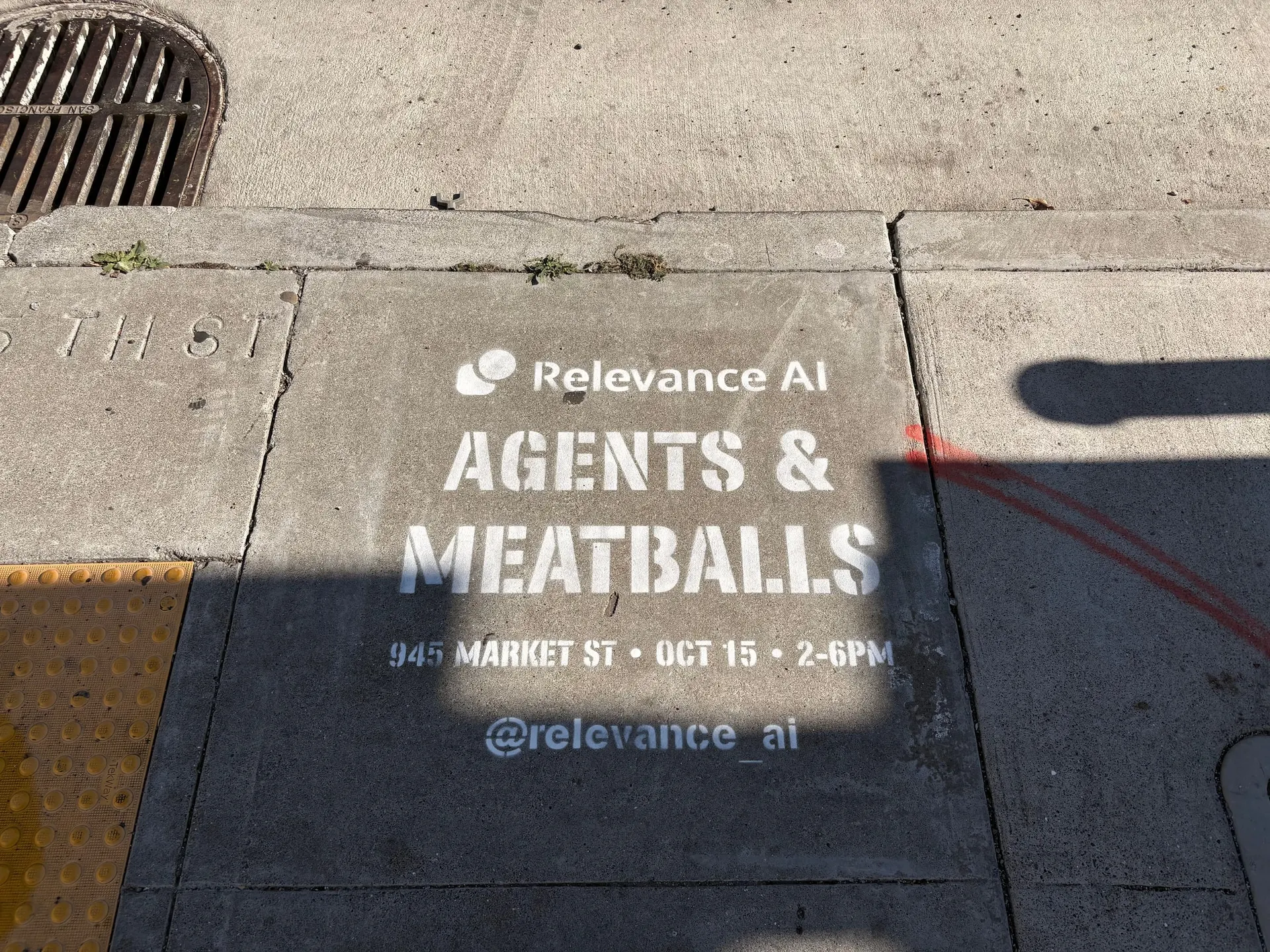
Relevance AI. San Francisco. While Relevance AI is a B2B AI company, not a game publisher, the campaign demonstrates the multi-format street execution in a gaming-adjacent neighborhood. SoMa and the Mission are where gaming-platform engineers, Twitch creators, and streaming-talent clusters work and live. A 16-placement wheatpaste campaign in that density achieves the neighborhood-saturation logic that gaming campaigns require: high foot-traffic frequency, audience concentration, and organic social documentation.
For game publishers and esports orgs, the playbook extends: wheatpaste for headline impression (hero visual, launch logo or tournament branding), pole stickers for corridor density and reminder reach, sidewalk stencils with QR codes for wayfinding and app-install tracking, and interior installs in gaming-adjacent venues (esports cafes, arcade lounges, gaming retailers) for dwell-time brand presence. Multi-city tours run the same format stack across 3-5 markets in sequential weeks, locked to the launch calendar.
Services Gaming & Esports Clients Use Most
Wheatpaste Advertising. Large-format poster campaigns for headline impression in gaming-cluster neighborhoods, locked to launch or tournament-week timing.
Paste-Up Poster Campaigns. Hand-pasted posters for neighborhood saturation and high-frequency audience touch, supporting wheatpaste headline placements.
Multi-Panel Poster Murals. Extended-format campaigns for major AAA launches, esports finals, or multi-city tour touchdowns where hero visual scale is the entire creative strategy.
Pole Sticker Advertising. Corridor-density placement between intersections in gaming neighborhoods, used for brand reinforcement and secondary message delivery.
Multi-City Guerrilla Tours. Synchronized campaign rollout across 3-5 gaming-cluster cities (LA, NYC, Austin, SF, Seattle), locked to game launch week or esports tournament schedule.
Product Launch Street Blitz. Intensive single- or two-city campaign for indie game launches, esports tournament launches, or gaming-platform debuts, concentrated over 2-4 weeks.
Neighborhood Saturation Campaigns. Multi-format programs across gaming-density neighborhoods, sustained for 4-8 weeks around launch or tournament window for share-of-voice impact against competing game or tournament buzz.
Brand-Safety, Compliance, and Operational Precision
Creative faithfulness is non-negotiable. Every asset that goes to the street is identical to the approved file. No color shift, no logo modification, no composition change. We document approval sign-off in our system and link it to every placement photograph. For multi-publisher campaigns, we maintain separate creative lockdowns per publisher so there is no cross-contamination. Installation photography includes a compliance frame showing creative legibility and asset accuracy at scale.
For esports campaigns where the tournament org or esports team owns the branding, we lock approval directly with them at intake. This prevents approval delays downstream and ensures the campaign reads as tournament-authorized (a credibility signal that matters to attendees).
For ESRB-rated game advertising, we route any rating-disclosure or content-warning copy through the publisher’s compliance team before print. Mature-rated games carry venue-side restrictions on bar bathrooms, family-coded coffee shops, and tournament floors that include minors. We surface the venue list with rating-context flags so the publisher can sign off on placement before crews go out. For convention-vicinity campaigns at PAX, EVO, or DreamHack host venues, we coordinate with the venue’s commercial team to confirm what’s permitted within the convention floor exclusion zone (typically 2-4 blocks). Tournament floors themselves are sponsor-controlled and outside the scope of street campaigns. We anchor saturation at the convention’s adjacent neighborhoods instead.
Got a Launch Window? We’ve Got the Neighborhood.
Game publishers and esports orgs are getting priced out of the digital awareness channels. Twitch and YouTube CPMs are auctioned and rising. Street media is the format that reaches the gaming audience at full density in the exact week and city where the launch or tournament is happening, and Beyond Street Media is the agency that synchronizes campaigns to your calendar, respects your approval gates, and documents creative faithfulness every step.
Gaming & Esports questions.
The 5 things gaming & esports brands ask before sending a brief. Same-day answers from the desk if yours isn't here.
Q · 01 Which cities should we target for gaming and esports campaigns?
Top gaming-audience cities for Beyond Street Media: Los Angeles (Silver Lake, Echo Park, Arts District. Game studios and streamers), New York City (Lower East Side, Williamsburg, Astoria. Indie developer cluster and esports talent), Austin (East Austin, South Congress, Domain. Game companies and esports orgs), San Francisco (SoMa, Mission, Hayes Valley. Twitch HQ, gaming platforms, streaming talent), Seattle (Capitol Hill, SoDo, Pioneer Square. Microsoft, Valve, Bungie proximity), Las Vegas (Fremont Street, Downtown Container Park. EVO tournament host), Boston (Cambridge, Allston. Gaming startups and college esports), Atlanta (East Atlanta, Midtown. Esports team bases).
Q · 02 What budget should we plan for a game launch street campaign?
A single gaming-cluster city blitz (wheatpaste plus pole stickers across two neighborhoods) runs $15,000 to $35,000 for a two-week launch window. Multi-format saturation in one major market lands at $40,000 to $80,000. A multi-city launch tour across LA, NYC, Austin, and SF over four weeks runs $90,000 to $200,000. Tournament-week activations in a single host city sit at $12,000 to $30,000. AAA launches with mural-scale hero placements scale higher. Final quote returns in 24 to 48 hours and varies by city count, format mix, and approval-gate complexity.
Q · 03 What is the lead time for a game launch street campaign?
Minimum 8 weeks from campaign brief to first installation. Publisher creative approval typically requires 4-5 weeks (internal brand ops review plus any external agency review). Surface confirmation and permit scheduling takes 2-3 weeks. Installation is 1-2 weeks depending on format and city count. For major AAA launches with multiple approval gates, lead time is 10-12 weeks. We build the approval-window rhythm into the project plan at intake.
Q · 04 What do you do with creative approval workflows?
Creative approval is part of the Beyond Street Media intake process. At brief, we flag all required approval gates: publisher brand ops, esports org marketing, legal (if any IP considerations), and external agencies if the publisher is working through one. We produce creative in parallel with your approval process, hold lockdown until green light, and do not install until the approved creative is signed and in our system. For multi-publisher campaigns or complex IP scenarios, we schedule an extra 1-2 weeks for pre-approval alignment.
Q · 05 How does tournament-week timing work for esports campaigns?
Major esports tournaments publish their host-city calendars 12-18 months out: PAX rotates (East in Boston, West in Seattle, Unplugged in Vegas); EVO is Vegas in June; Gamescom is Cologne in August; esports finals tour city-to-city. We plan street campaigns to hit tournament host cities in the week leading up to the event, targeting venue proximity, local gaming-community neighborhoods, and attendee foot traffic. Tournament sponsorships and media are locked early; street campaigns fill the immediate-context layer where brand presence reinforces sponsorship impact.
We delivered.



















Brand partners include: FIFA World Cup 2026, Palantir, Sézane, G-Shock, Mitchell & Ness, True Religion, Huda Beauty, Yonex, Relevance AI, Momentous, RYZE Coffee, Bloom Effects, Incrediwear, Brooklyn Museum, Sweat FC, HydroJug, Frameline, Alchemy, OneRepublic, Lone Fox, Vaura Pilates.
Got a gaming & esports launch?
Inquire now.
Send the Gaming & Esports brief: markets, window, creative direction. Vertical-specific quote back in 48 hours.