Beauty & Cosmetics.
Wheatpaste, bathroom clings, and pop-up window installs for beauty and cosmetics brands. Neighborhood activation during launch and influencer windows.
Four tensions only street resolves.
- 01
Beauty launch saturation is brutal. A new product or brand drops in this category every week, and the only audience-reach formats that consistently cut through are the ones happening in the buyer's actual neighborhood the same week the influencer content hits
- 02
Influencer-paid spend has plateaued in CAC across the category. Beauty brands paying $15-60k per dedicated TikTok or Instagram post are seeing diminishing return as the same creators flood the feed for every competitor in the same launch window
- 03
Retail-shelf placement at Sephora, Ulta, Bluemercury, and Credo Beauty requires brand-presence proof. Buyers ask for cultural-marketing receipts before they re-up shelf footage or expand a regional pilot national
- 04
The beauty audience photographs everything. Bathroom mirrors are organic-content gold, and a well-placed mirror cling in a SoHo or Williamsburg bar gets reshared by 18-34 women on TikTok and Instagram before the install crew has packed up
Is this you?
If two or more match your roadmap, send the date.
- You're launching into a one-drop-a-week category and need cultural placement the same week the influencer content hits.
- You're paying $15-60k per dedicated post and watching CAC plateau as the same creators flood the feed for every competitor.
- You're heading into a Sephora, Ulta, Bluemercury, or Credo buyer meeting and need cultural-marketing receipts before they re-up shelf footage.
- Your audience photographs everything and a mirror cling in a SoHo or Williamsburg bar gets reshared before the crew packs up.
- Your product claim needs IRL placement to land because pressed pigment, peptide serum, and fermented skincare don't translate in a 6-second scroll.
- You're an indie brand entering the U.S. market that needs cultural placement before retail conversations open.
5 disciplines, one playbook.
Wheatpaste
Wheatpasting and wheatpaste advertising campaigns from $3,500 in NYC, LA, SF + 40 US cities. Published floors, 5-7 day lead (Expedited 24-72hr), GPS-tagged photo proof on every install. From $3,500Paste-Up Posters
Paste-up poster campaigns for product launches and neighborhood saturation. From $3,500, 5-7 day lead (Expedited 24-72hr), GPS-tagged photo proof in 40 US cities. From $3,500Sidewalk Stencils
Sidewalk stencil campaigns from $2,500 in 40 US cities. Chalk-safe, removable, permitted-only. Expedited 24-72hr available. GPS-tagged photo proof. From $2,500Bathroom Advertising
Bar and restaurant bathroom advertising in 40 U.S. cities. Mirror clings, stall-door posters, and venue placements with full photo proof on every install. From $3,000Retail Window Installs
Retail window poster installs in 40 U.S. cities. Storefront window posters and dressing-room placements in partner retail with full photo proof on every install. From $3,000Starting floors · print, install, and GPS-stamped photo proof included in every quote. Final number varies by turnaround, size, and location count. Full rate card →
Sample creative directions.
Pre-tested format / neighborhood pairings. Pick a direction at brief intake and we route the surface set inside 24 hours.
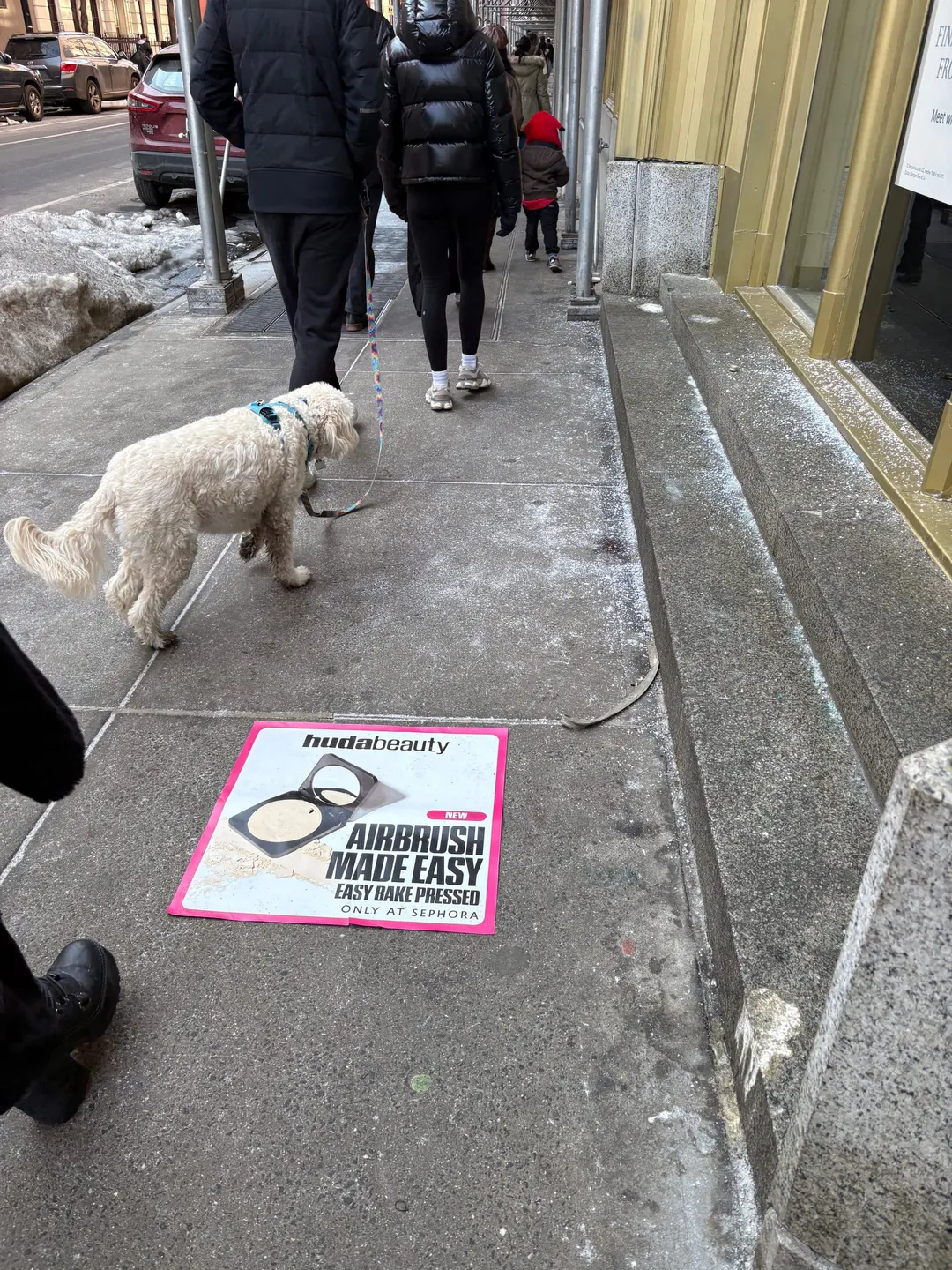
- Huda Beauty launch Sidewalk stencils, 14 placements SoHo, Lower East Side, NYC
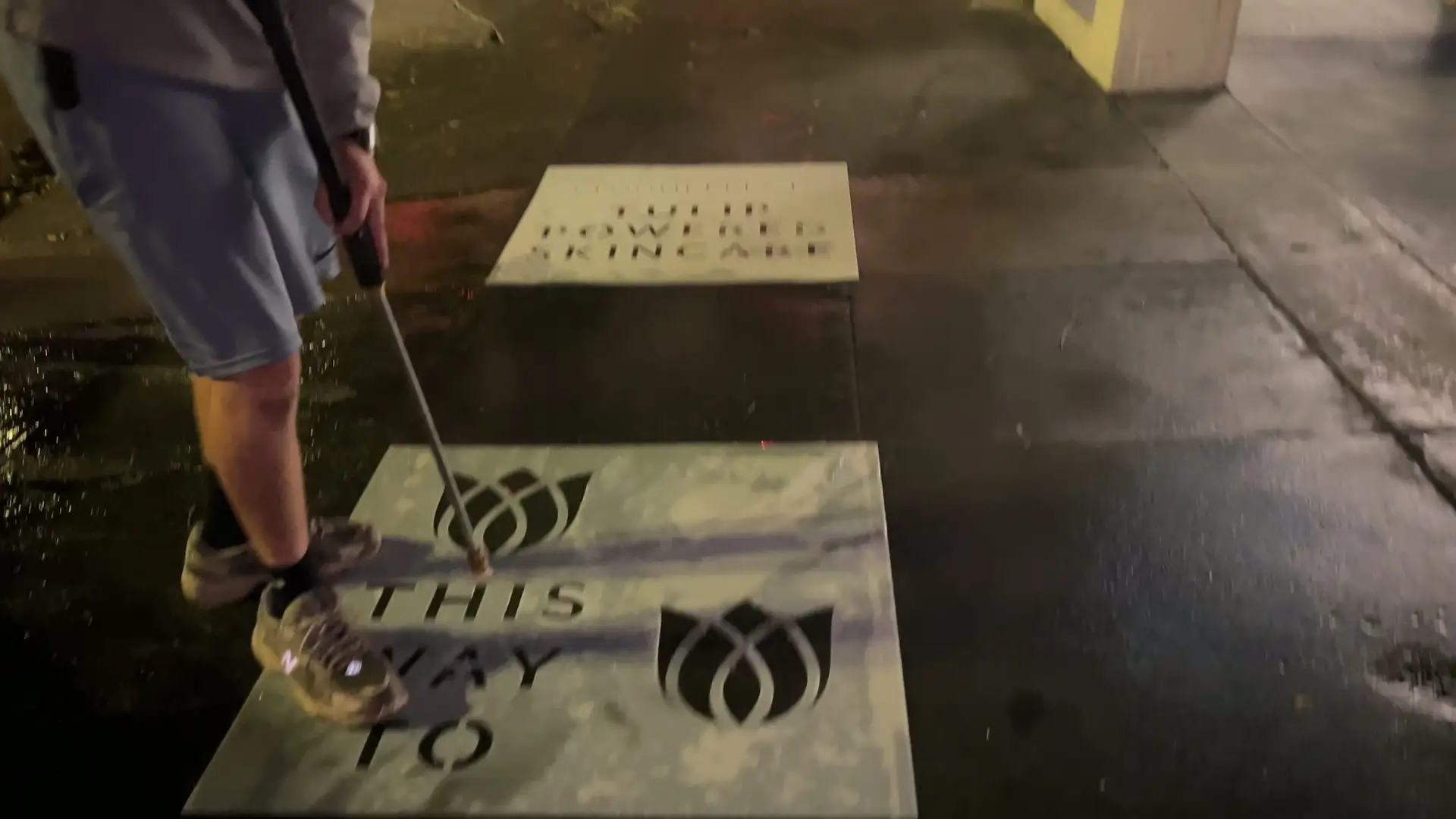
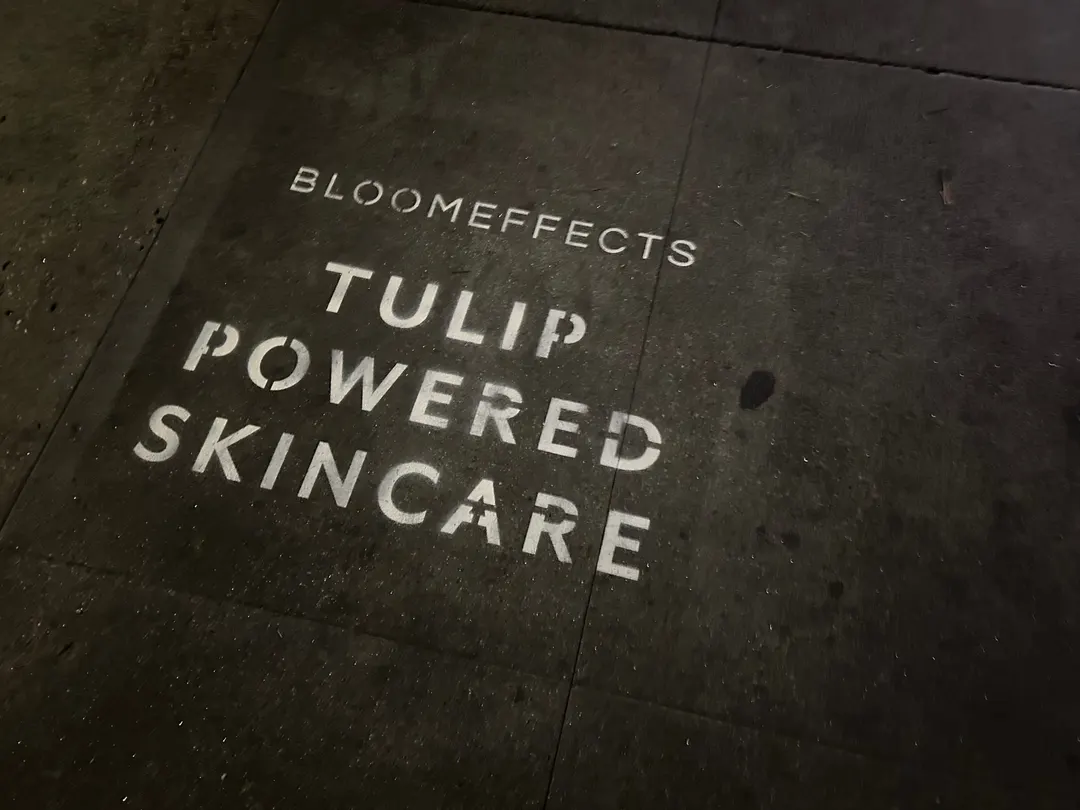
- Bloom Effects pop-up White tulip-mark stencils, 9 placements SoHo, Meatpacking, NYC
- Indie skincare U.S. launch Three-poster wheatpaste narrative Williamsburg, the Mission, Melrose
- Fragrance launch Bathroom-mirror clings, 14 venues SoHo, Williamsburg, Bushwick
- Color cosmetics pop-up Window paste-up + entrance stencil, pop-up week Hayes Valley, SF
The neighborhoods, not the metros.
We install where the audience already moves. Named corridors per market, permitted and photo-documented.
Hell's Kitchen · SoHo · Williamsburg · Bushwick · Lower East Side · Tribeca
Downtown LA · Arts District · Silver Lake · Echo Park · Venice · Santa Monica
Put it on the wall.
We have run this for beauty & cosmetics.

Proof · Printed in-house · Installed by our crew
Street campaigns for Beauty & Cosmetics brands. Proof included.
Send the brief; a scoped quote for your vertical comes back inside 24 hours — formats, neighborhoods, and a GPS-stamped photo of every placement when the run wraps.
- Quote in under 24 hours
- No discovery call. The brief is the call.
- Printing & Installation under one roof
Brief us · Quote in under 24 hours
Start your beauty & cosmetics campaign.
Brand-safe by default.
- Private-property walls only Written owner consent on file for every surface. No public infrastructure, transit, or right-of-way.
- GPS-stamped photos within 48 hours Wide, mid, detail per placement. The proof your team forwards internally.
- FTC + local-code compliant Disclosures and permitting handled per contract. Legal reviews clean.
- Zero municipal removals on record 500+ documented installs, none taken down by a city.
Read the full field notes
Your beauty launch needs SoHo bathroom mirrors, not just Meta. The category’s launch cycle has compressed to one drop a week, paid social CAC has plateaued, and the buyer. Beauty consumer 18-45. Still walks Williamsburg, Melrose, and Wynwood every weekend. The street is the campaign. Wheatpaste in the right neighborhood the same week the influencer content drops, mirror clings in the bars where the audience already photographs themselves, and window installs at the pop-up that the trade press needs to see.
Why street campaigns work for beauty brands
Beauty has the most brutal launch math in consumer media. A new color cosmetic, a serum, a skincare line, a fragrance. A launch ships every week, and the buyer’s feed is already saturated with sponsored beauty content from competitor brands fighting for the same 18-45 audience window. Cultural placement in the buyer’s actual neighborhood is the wedge that breaks the saturation. A brand running wheatpaste advertising across SoHo and Williamsburg the week of an influencer wave is the brand the audience associates with the moment, not the brand whose ad they scrolled past on TikTok 11 hours earlier. Cultural-placement reach in the right neighborhood beats incremental impression reach in a feed where every beauty brand is already buying the same audience.
The bathroom-mirror social-content effect is specific to this category and almost no other. The mirror selfie is a content reflex for the beauty audience. They pull out a phone in the venue bathroom whether or not anything is happening there. A well-placed mirror cling at eye level on a SoHo or Williamsburg bar mirror earns reshared organic content from the audience as a default behavior of the medium. We have run installs where the campaign hashtag started running on TikTok inside 48 hours without a single paid impression boosting it. No other vertical has this dynamic. For beauty, bar and restaurant bathroom advertising is not a placement format. It is an organic social-content engine.
Launch-week saturation math is the third reason. The peak street presence happens the same 7-14 day window the influencer content publishes, the press push lands, and the retail anchor opens. Inside that window the campaign hits the audience as cultural backdrop, the influencer wave amplifies awareness of the IRL placement, and the press read on the activation feeds back into the trade conversation that buyers at Sephora, Ulta, Bluemercury, and Credo are already having with the brand. Street is the only format where the install date can be locked tight enough to compress all three vectors into the same week.
What we run for beauty and cosmetics brands
Wheatpaste advertising. Large-format hand-pasted posters on construction barricades and exterior walls in beauty-density neighborhoods, the headline format for launch-week brand presence at scale.
Paste-up poster campaigns. Multi-poster narrative installs in retail-corridor density, used for product-story sequencing where a single poster cannot carry the brand or product context.
Sidewalk stencil advertising. Chalk-safe stencils outside pop-up retail anchors, host venues, and high-foot-traffic intersections in the buyer’s neighborhood. The Huda Beauty Airbrush Made Easy launch ran on this format across SoHo.
Bar and restaurant bathroom advertising. Mirror clings, stall door posters, and sink-side placements in beauty-density host venues. The format that earns organic social capture from the audience as a baseline behavior of the medium.
Retail window poster installs. Paste-up and static-cling installs on host venues and pop-up facades, the format the trade press and retail buyers see when they walk past the activation.
Interior installs. Column wraps, table-top placements, and wall-mounted poster runs inside coffee shops, beauty-adjacent boutiques, and lifestyle retail in the same neighborhood as the brand’s anchor placement.
Product launch street blitz. Multi-format programs that combine wheatpaste, sidewalk stencils, bathroom clings, and window installs across 1-4 cities for a coordinated launch-week saturation in the buyer’s neighborhood.
Compliance + brand-safety notes
Skincare and color-cosmetics performance claims trigger FDA cosmetic-labeling rules and FTC advertising-substantiation standards. Anti-aging, hydration percentage, dermatologist-tested, transfer-proof, long-wear hours, fragrance longevity. Every one needs substantiation that holds up if the FTC or a competitor challenges the creative. We route claim-heavy creative through your in-house regulatory team or external counsel before production starts. Required disclosures, asterisk citations, and substantiation footnotes get type-set at the legibility specification the print scale demands. Usually 6-8pt at the print scale, which translates to a much larger read at the poster scale. Compliance review adds 3-5 days to the production timeline; we build it into the schedule at the brief stage.
Venue-side approval is the second layer. Bathroom-mirror clings, stall door posters, and interior installs require host-venue sign-off. Bar managers, restaurant operators, coffee-shop owners. We hold the venue relationships and confirm placement permission at intake, so the brand never ends up with creative that was installed without the host’s blessing. For pop-up wraparounds and retail window installs we confirm exclusivity terms with the host venue and the brand’s retail partner in writing. The buyer-meeting read on a properly papered wraparound is materially different than one without.
Past beauty work
The strongest anchor pieces in the Beyond Street Media beauty portfolio are the Huda Beauty Airbrush Made Easy launch in NYC and the Bloom Effects Tulip Powered Skincare pop-up program in SoHo and the Meatpacking District. Both ran on sidewalk stencils, both timed install windows to product moments and retail anchors, and both delivered the campaign photography the brand teams used in their own organic and trade-press handoffs.
- Huda Beauty. Airbrush Made Easy / Easy Bake Pressed launch, NYC. Sidewalk stencil program across SoHo and the Lower East Side, 14 placements in the launch window.
- Bloom Effects. Tulip Powered Skincare pop-up, NYC. Sidewalk stencil install across SoHo and the Meatpacking District supporting the pop-up retail activation.
- Sézane. Tribeca scaffold paste-up, NYC. French fashion brand wheatpaste on Chambers Street scaffolding, the playbook for a U.S.-market beauty-adjacent campaign in the same buyer-overlap neighborhood.
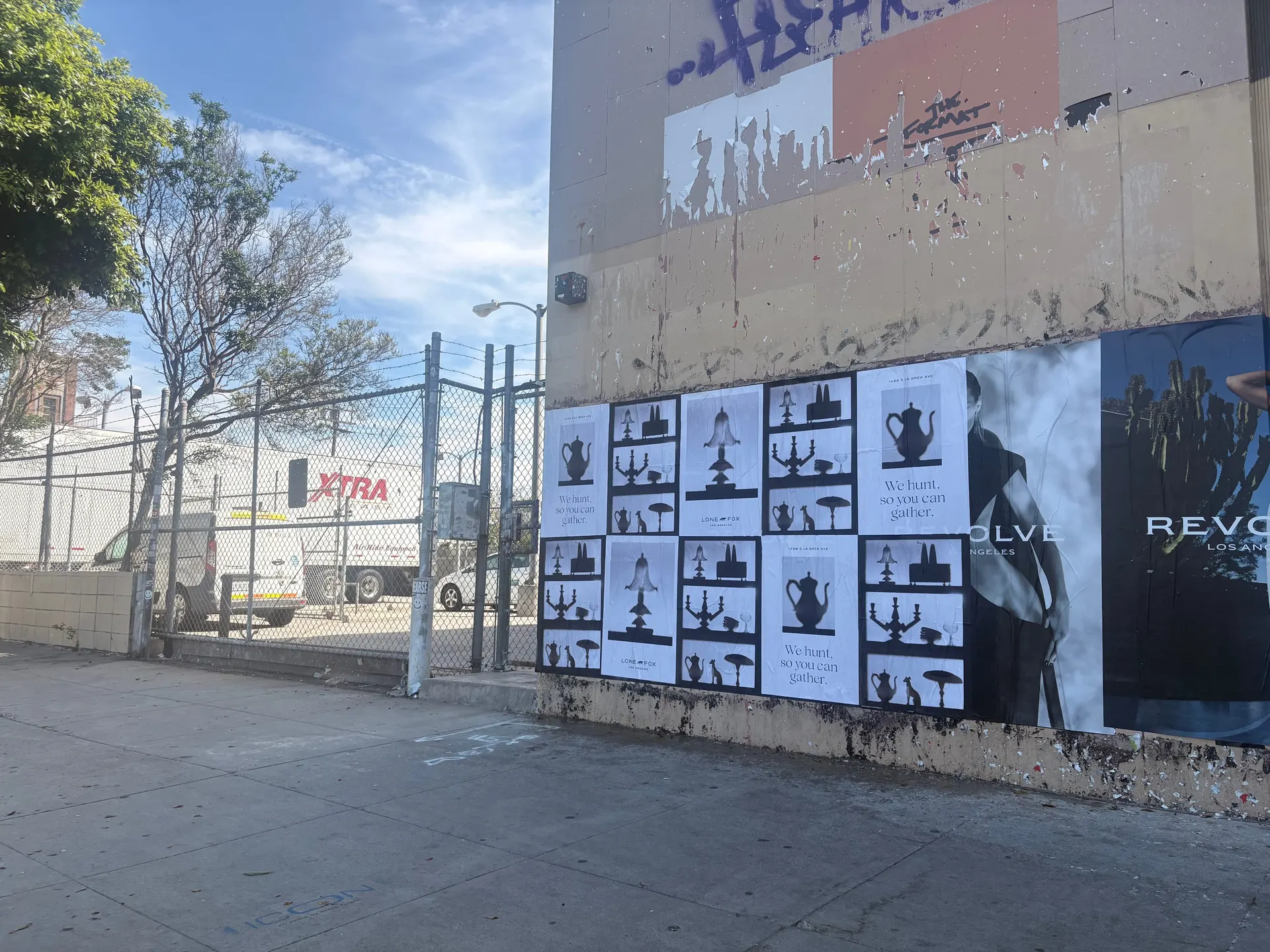
- Lone Fox. Lifestyle brand wheatpaste, LA. Multi-poster wheatpaste run across the LA lifestyle corridor that the beauty-adjacent audience walks daily.
Cities we activate for beauty brand campaigns
The U.S. Beauty-density market lives in a tight set of neighborhoods inside a tight set of cities. NYC is the anchor. SoHo, Williamsburg, the Meatpacking District, Tribeca, and Bushwick form the core map for any launch needing East Coast presence. LA is second. Melrose, Fairfax, Beverly Hills, and the Arts District cover the West Coast beauty-buyer footprint. Miami’s Wynwood, Brickell, and the Design District handle the Latin-market and the Art Basel-window press cycle. San Francisco’s Hayes Valley and the Mission cover the indie-beauty audience that buys at Bluemercury and Credo. Atlanta’s Old Fourth Ward and Ponce City Market handle the Southern beauty-corridor reach. Austin’s East Austin and South Congress fit the indie-clean-beauty audience. Boston’s Newbury Street and Seaport cover the New England retail-buyer presence.
- guerrilla marketing in New York City. SoHo, Williamsburg, Meatpacking, Tribeca, Bushwick
- Los Angeles. Melrose, Fairfax, Beverly Hills, Arts District
- guerrilla marketing in Miami. Wynwood, Brickell, Design District
- Brooklyn. Williamsburg, Bushwick, Bed-Stuy
- San Francisco. Hayes Valley, the Mission, SoMa
- Atlanta. Old Fourth Ward, Ponce City Market
- Austin. East Austin, South Congress
- Boston. Newbury Street, Seaport
Got a launch? We’ve got the SoHo wall, the Williamsburg mirror, and the Hayes Valley window.
Beauty & Cosmetics questions.
The 5 things beauty & cosmetics brands ask before sending a brief. Same-day answers from the desk if yours isn't here.
Q · 01 How does FDA and FTC creative substantiation work for skincare and color-cosmetics claims?
Performance claims on skincare (anti-aging, hydration percentage, dermatologist-tested), color cosmetics (long-wear hours, transfer-proof, pigment load), and fragrance (longevity hours) all need substantiation that holds up to FDA cosmetic-labeling rules and FTC advertising-claim standards. We route claim-heavy creative through your in-house regulatory or external counsel before any production starts, and we type-set required disclosures and asterisk citations at the legibility specification the print scale demands. The compliance read is part of the creative-production stage, not an afterthought.
Q · 02 What is the typical playbook for a beauty-launch street saturation?
Most beauty launches buy a 7-14 day street window timed to the influencer-content drop. Inside that window the standard kit is wheatpaste in 2-4 beauty-density neighborhoods (SoHo, Williamsburg, Melrose, Wynwood, Hayes Valley), bathroom-mirror clings across 10-20 host venues in those same neighborhoods, and sidewalk stencils outside the brand's pop-up or retail anchor. The install crew goes up the day before influencer content publishes so the cultural placement and the digital wave hit the audience the same week.
Q · 03 Which cities cover the U.S. Beauty-density market?
The beauty-cluster cities Beyond Street Media activates most often: New York City (SoHo, Williamsburg, the Meatpacking District, Tribeca, Bushwick), Los Angeles (Melrose, Fairfax, Beverly Hills, Arts District), Miami (Wynwood, Brickell, Design District), San Francisco (Hayes Valley, the Mission), Brooklyn (Williamsburg, Bushwick, Bed-Stuy), Atlanta (Old Fourth Ward, Ponce City Market), Austin (East Austin, South Congress), and Boston (Newbury Street, Seaport). For a national launch the standard tier-1 set is NYC, LA, Miami, and SF, with a tier-2 add of Brooklyn, Atlanta, or Austin depending on the brand-audience overlap.
Q · 04 Can you support a single-city indie beauty launch under a small budget?
Yes. A single-city activation in NYC or LA starts around $7,500-$12,000 for a focused beauty-density wheatpaste run with a bathroom-cling rotation in 6-8 venues. That budget covers production, install crew, photo documentation, and a wrap deck. Indie beauty brands entering the U.S. Market often start here to generate retail-buyer-meeting receipts before scaling to a multi-city program.
Q · 05 Do you print the posters and clings, or do we supply them?
We print in-house. Beauty creative is color-critical, a pressed-pigment tone or a foundation shade has to read true on the wall, so we control the print step rather than hand it to a third party. We proof against your brand swatches before the run, then print posters, clings, and window paste-ups at poster-printing. In-house printing also means a fast reprint if an influencer drop moves, which happens often in a one-launch-a-week category.
We delivered.













Brand partners include: FIFA World Cup 2026, Palantir, Sézane, G-Shock, Mitchell & Ness, True Religion, Huda Beauty, Yonex, Relevance AI, Momentous, RYZE Coffee, Bloom Effects, Incrediwear, Brooklyn Museum, Sweat FC, HydroJug, Frameline, Alchemy, OneRepublic, Lone Fox, Vaura Pilates.
Got a beauty & cosmetics launch?
Inquire now.
Send the Beauty & Cosmetics brief: markets, window, creative direction. Vertical-specific quote back in 48 hours.