Different formats answer different briefs. Wheatpaste is not better than door hangers; they buy different things, on different streets, for different money. What follows is what each format costs, how long it survives, and who it is for.
The criteria worth ranking on
ROI in street advertising depends on what you’re optimizing for. Pick one:
- Cost per placement. Spend divided by installs. A fact, and the one we quote.
- Time on wall. How long the format survives weather and the street. Observed from our own re-visit photography.
- Deployment speed. How fast the format goes from brief to installed.
- Surface and geography. Residential doors, commercial corridors, pavement, poles. This is usually the deciding variable.
- Photographability. Whether the format is the kind of thing people stop and shoot.
You will notice what is missing: cost per impression, social pickup rate, and CAC. Those get quoted constantly in this industry and none of them are measured. Nobody counts the pedestrians who looked up at a wall. Attach a campaign-only code or short domain and your own analytics will produce a real acquisition cost. Anything we handed you would be arithmetic dressed as evidence.
The formats, cheapest floor first
Tier 1: Ultra-Low Cost-Per-Placement, Low Conversion Intent
Door Hangers
- Time on wall: 1-2 days (discarded at end of day or trash pickup next morning)
- Best for: Hyper-localized zip codes, restaurant/retail grand openings with high foot traffic nearby, neighborhood saturation when brand presence matters more than conversion
- Service page: Door hanger distribution
Door hangers win on cost-per-placement and work when distribution is concentrated around a conversion point (retail store opening, pop-up venue). Residential delivery means you’re paying for placement, not traffic. Most door hangers end in recycling or trash. But in a 3-block radius around a new store opening, that placement matters because the recipient is already predisposed to visit.
Yard Signs (from $2,800)
- Time on wall: 14-45 days
- Best for: Election campaigns, event promotion (concerts, festivals), real estate listings, local service advertising (plumbing, HVAC)
- Service page: Yard sign placement
Yard signs sit on residential properties at five to ten feet, read by car traffic and pedestrians on that block. They hold 21 to 45 days, so the same spend keeps working far longer than a door hanger does. They are rarely photographed unless the message is political or novel. The audience is narrower than door-to-door coverage, which is the point: homeowners on chosen streets rather than every door in the zip.
Tier 2: Low Cost-Per-Impression, Moderate Conversion Intent
Snipe Posters (from $3,000)
- Time on wall: 10-30 days (weather-dependent, lower adhesion than wheatpaste)
- Best for: Local retail awareness, restaurant/bar promotion, music/comedy venue advertising, service-industry targeting
- Service page: Snipe poster campaigns
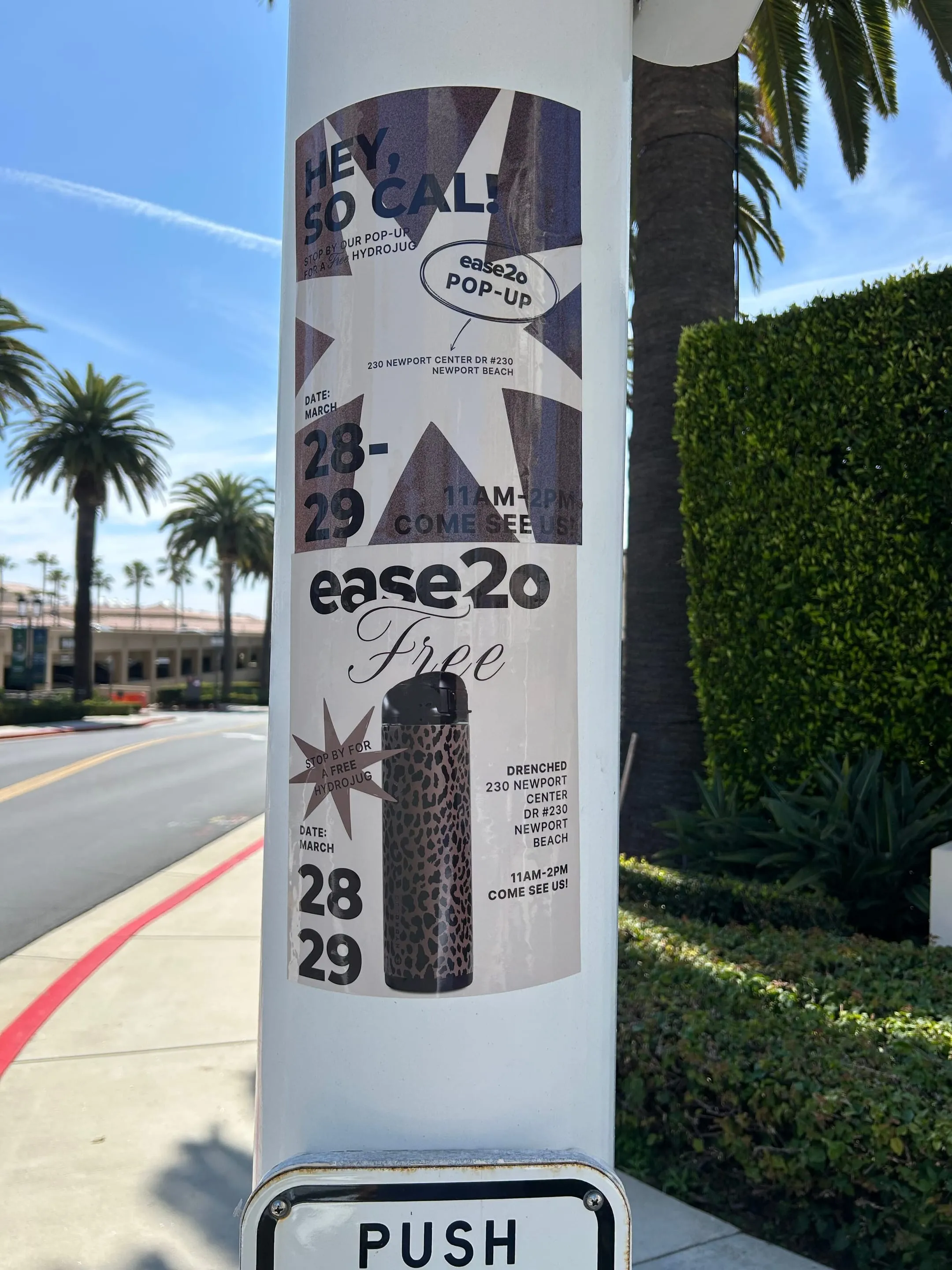
Snipe posters are smaller (11×14” to 18×24”) than wheatpaste and less durable in weather. But placement is faster and cheaper per-poster, which makes them ideal for service-heavy verticals (plumbing, cleaning, tutoring, fitness) and local events. Street furniture is not a free posting surface. New York City’s Administrative Code Section 10-119 makes it unlawful to affix a poster to a lamppost, a utility pole, a public garbage bin, a bus shelter or a traffic sign, and other cities carry their own version of that list. The surfaces that hold up are the ones where somebody can actually grant permission: community and notice boards, kiosks, and private hoarding or frontage with the owner’s written consent. Organic social pickup is low unless the creative is exceptionally sharp.
Take-One Flyers
- Time on wall: 3-7 days (stands emptied or weather-damaged after a week)
- Best for: Local events, workshops, classes, fitness group signups, DTC brand sampling, pop-up location promotion
- Service page: Take-one flyer displays
Take-ones have the lowest absolute cost-per-placement but require active stand deployment and replenishment. They work best in high-intent locations (yoga studio, record store, coffee shop) where people already expect promotional materials. Effectiveness depends entirely on stand location; a stand in Times Square generates more impressions than a stand on a residential side street. Organic pickup is minimal unless the event is locally notable.
Tier 3: Moderate Cost-Per-Impression, High Conversion Intent
Pole Stickers (from $3,000)
- Time on wall: 14-90 days (outdoor vinyl durability, clean removal)
- Best for: Rapid deployment multi-corridor campaigns, product launches, tour announcements, event promotion, fitness and beverage brands
- Service page: Pole sticker advertising
Pole stickers scale. A 300-sticker campaign across 10 corridors is deployable in 3-5 days. Street-pole foot traffic is predictable (commuters, pedestrians, delivery drivers all read poles). Vinyl holds 90 days or more in most climates, and correct spacing turns a corridor into a rhythm rather than a scatter. The audience is a commuter scanning a route they walk every day, which is a different kind of attention than a poster gets once.
Tier 4: Moderate-to-High Cost-Per-Impression, Very High Conversion Intent
Sidewalk Stencils (from $2,500)
- Time on wall: 7-21 days (chalk-based, weather-dependent, ephemeral by design)
- Best for: Product launches with strong design heritage, fashion/beauty brand activation, neighborhood saturation campaigns, “Instagram moment” marketing
- Service page: Sidewalk stencil advertising
Stencils get photographed because they’re art-adjacent and photographer-friendly. They’re deployed quickly (chalk spray or paint through a stencil), they’re inherently temporary, and they hit ground-eye level where pedestrians naturally look. The format is ideal for design-literate audiences (fashion, beauty, tech) and neighborhoods with strong creative communities (SoHo, Silver Lake, Mission District). Durability is short at 7 to 21 days, which is the trade for the format being cheap to deploy and impossible to ignore underfoot.
Tier 5: High Cost-Per-Impression, Exceptional Conversion Intent & Social Amplification
Wheatpaste Advertising (from $3,500)
- Time on wall: 14-60 days (durable adhesive, intentional removal only)
- Best for: Major brand awareness, product launches, retail foot-traffic generation, multi-city campaigns, recruitment (tech), cultural moments
- Service page: Wheatpaste advertising
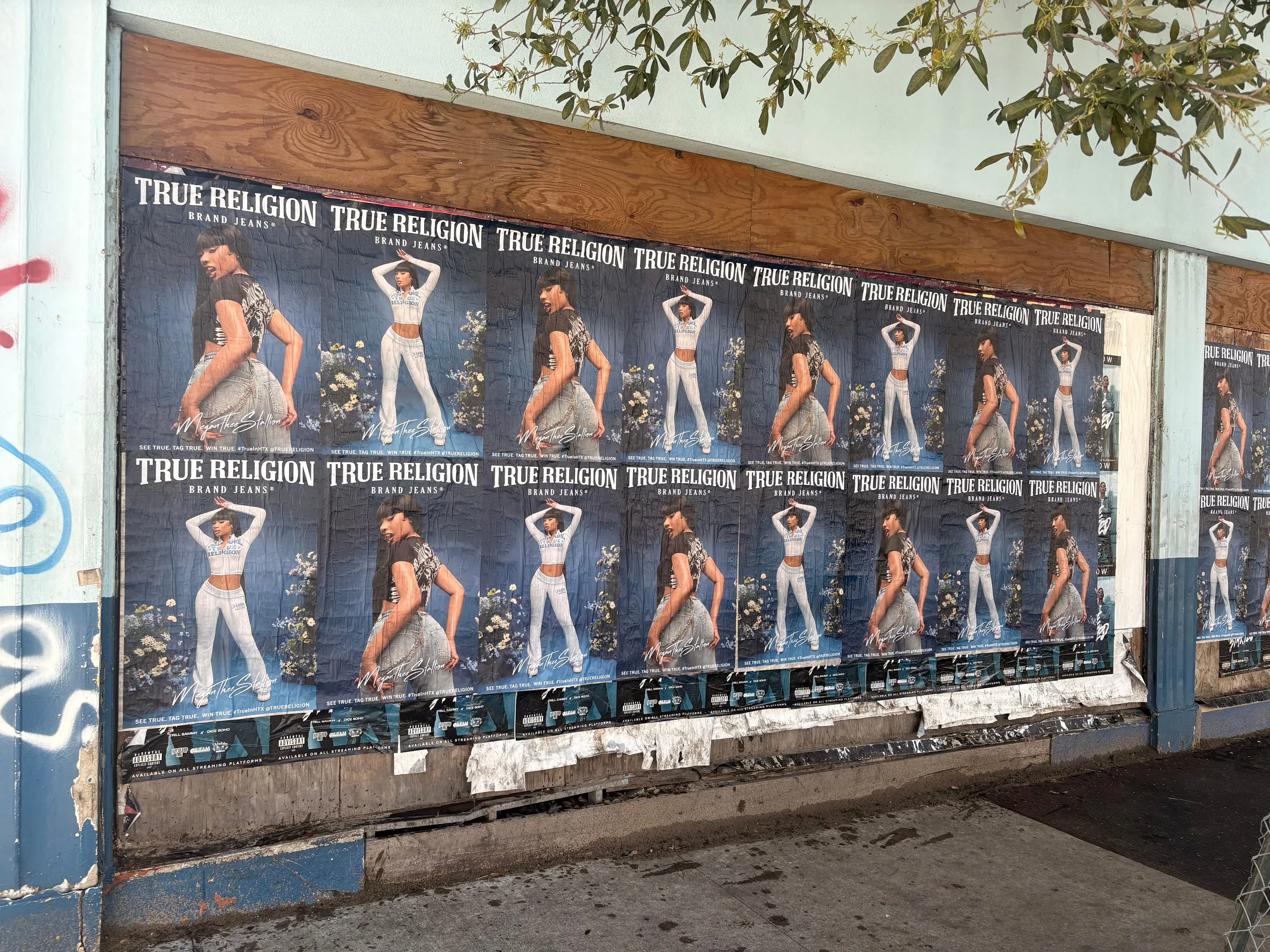
Wheatpaste carries the highest floor and holds the longest. Construction hoarding, retail frontage, and scaffolding put large-format paper at the scale of the building rather than the sign, and it stays there for weeks rather than days. It is the format people photograph, and the one that reads as a brand having shown up rather than having bought an ad. Campaigns start at $3,500 and scale into multi-city runs.
The honest trade: you pay the most per placement, and you get the longest dwell and the best-looking surface. Whether that converts better than a cheaper format depends on your product and your geography, and your analytics will tell you that before we can.
Format-to-Objective Matrix: Pick by What You’re Optimizing For
| Objective | Best Format | Second Best | Why |
|---|---|---|---|
| Lowest entry floor | Door hangers | Yard signs (from $2,800) | Lowest floor wins. Conversion quality is low. |
| Lowest cost per placement | Door hangers | Yard signs (from $2,800) | Sheer volume per dollar. Dwell is the trade. |
| Longest visibility | Wheatpaste (30-60 days) | Pole stickers (30-90 days) | Premium placement + durable adhesive. |
| Fastest deployment | Pole stickers (3-5 days) | Door hangers (2 days) | Stickers scale quickly. Hangers are simple but low intent. |
| Most photographed | Sidewalk stencils | Wheatpaste | Ground-level colour and building-scale paper. |
| Retail foot-traffic focus | Wheatpaste (from $3,500) | Sidewalk stencils (from $2,500) | Dense commercial corridors, ground and building scale. |
| Residential reach focus | Door hangers | Yard signs (from $2,800) | Volume over dwell; cheapest way to cover doors. |
| Events and pop-ups | Pole stickers (from $3,000) | Wheatpaste (from $3,500) | Fast turnaround, corridor saturation. |
| B2B and tech recruiting | Wheatpaste (from $3,500) | Pole stickers (from $3,000) | Premium surfaces near the offices you are hiring from. |
Which format each vertical tends to pick
Fashion & Beauty (high social intent):
- Primary: Wheatpaste (premium placement, design audiences photograph)
- Secondary: Sidewalk stencils (colorful, Instagram-optimized)
- Tertiary: Pole stickers (rapid deployment in multi-city)
Huda Beauty ran 60 printed sidewalk decals across Manhattan and Brooklyn over 35 days. Sézane took 15 wheatpaste placements across NYC and LA over 35 days. Bloom Effects ran nine sidewalk stencils across SoHo, the Lower East Side, and Williamsburg over 28 days.
Food & Beverage (moderate social intent, local focus):
- Primary: Wheatpaste (neighborhood density, foot-traffic conversion)
- Secondary: Pole stickers (rapid deployment across corridors)
- Tertiary: Take-ones (sampling, event promotion)
RYZE Coffee ran 500 wheatpaste posters at 24x36 across Brooklyn and Manhattan over 21 days. Tighter budgets in residential zones push toward door hangers instead.
Tech & Recruitment (premium positioning, limited geography):
- Primary: Wheatpaste (premium walls, design credibility)
- Secondary: Pole stickers (corridor saturation, rapid deployment)
- Tertiary: Yard signs (event promotion, campus proximity)
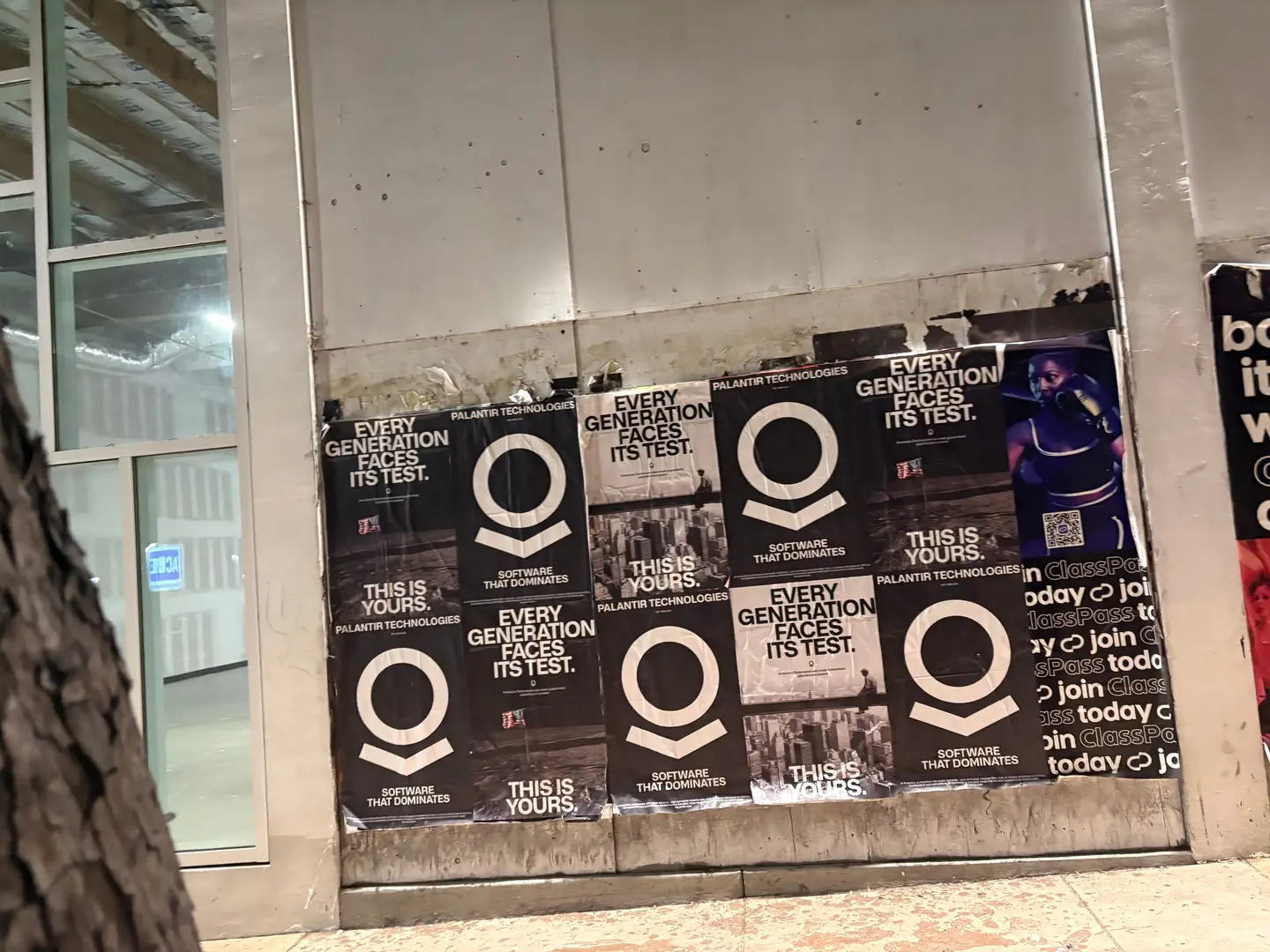
Palantir ran 300 wheatpaste posters across San Diego and Honolulu in a five-day window. Multi-city tech launches tend to pair wheatpaste with pole stickers, one for impact and one for speed.
Local Services (cost-sensitive, residential focus):
- Primary: Door hangers (lowest entry floor)
- Secondary: Yard signs (longer visibility, still low floor)
- Tertiary: Snipe posters (commercial zone spillover)
Plumbing, HVAC, and tutoring services favour door hangers because the job value is low and the catchment is a few residential streets.
Events & Promotions (speed > cost):
- Primary: Pole stickers (3-5 day turnaround, scalable)
- Secondary: Take-ones (venue-specific, high intent)
- Tertiary: Wheatpaste (if timeline permits, premium look)
Music venue, festival, workshop promotion favor fast deployment. Pole stickers win.
The Pricing Breakdown: Floors by Service
Every campaign is priced as one number that folds in design, print, install labor, materials, travel, and documentation. Floors by discipline:
- Door Hangers: lowest entry floor (talk to us for scope)
- Yard Signs: from $2,800
- Take-One Flyers: scoped per stand network (talk to us)
- Snipe Posters: from $3,000
- Pole Stickers: from $3,000
- Sidewalk Stencils: from $2,500
- Wheatpaste Advertising: from $3,500
Range varies by turnaround, size, location count, and combined service mix. Final quote returns inside 24 to 48 hours.
Getting Started: ROI Planning Framework
- Define your primary KPI. One metric, and one you can actually measure in your own stack.
- Map your target neighborhoods. Where does your audience walk, shop, work, congregate?
- Set your acceptable acquisition cost. What a conversion is worth to you decides what the campaign can cost.
- Match service to KPI. Use the matrix above.
- Run one market first. Attach a campaign-only code or short domain, and baseline your metric for two to three weeks before install.
- Read it, then scale. Compare the campaign window against your baseline in that geography, then roll out to the markets that justified it.
See pricing for the published floors by service and city, and wheatpaste advertising for the documented campaigns behind the format. Send us your neighborhoods and your KPI and we will recommend the mix, including the cases where the answer is a cheaper format than the one you asked about.