Higher Education.
College and university campaigns for student recruitment, back-to-school launches, and brand-ambassador programs. Off-campus street activation.
Four tensions only street resolves.
- 01
Back-to-school and welcome-week timing is fixed; most brands have a 2-3 week window before campus-life rhythm locks in, and that window does not move
- 02
Campus administrative restrictions on on-campus advertising mean the real reach happens off-campus in college-town adjacent neighborhoods (Cambridge for Harvard, Westwood for UCLA, Berkeley proper for UC Berkeley, Morningside Heights for Columbia)
- 03
Student audiences are hyper-localized by neighborhood. They live in specific dorm zones and off-campus blocks, and that density cannot be reached via broadcast media or performance-ad targeting
- 04
Brand-ambassador program execution requires installation at scale in the neighborhoods where ambassadors live and recruit, not in the student center or the dorm quad
Is this you?
If two or more match your roadmap, send the date.
- Your back-to-school window is fixed at 2-3 weeks before campus-life rhythm locks in, and it does not move.
- Campus admin won't allow on-campus advertising, so the real reach is in college-town adjacent neighborhoods like Cambridge, Westwood, Morningside Heights.
- Your student audience is hyper-localized by dorm zone and off-campus block, density broadcast and performance ads can't reach.
- You're running a brand-ambassador program that needs installation at scale where ambassadors live and recruit, not in the dorm quad.
- You're recruiting high-school seniors and parents at neighborhood scale in secondary markets, not just on the campus itself.
- You need the 18-24 demographic at street scale, cheaper than digital CPM and more credible than influencer marketing or dorm flyers.
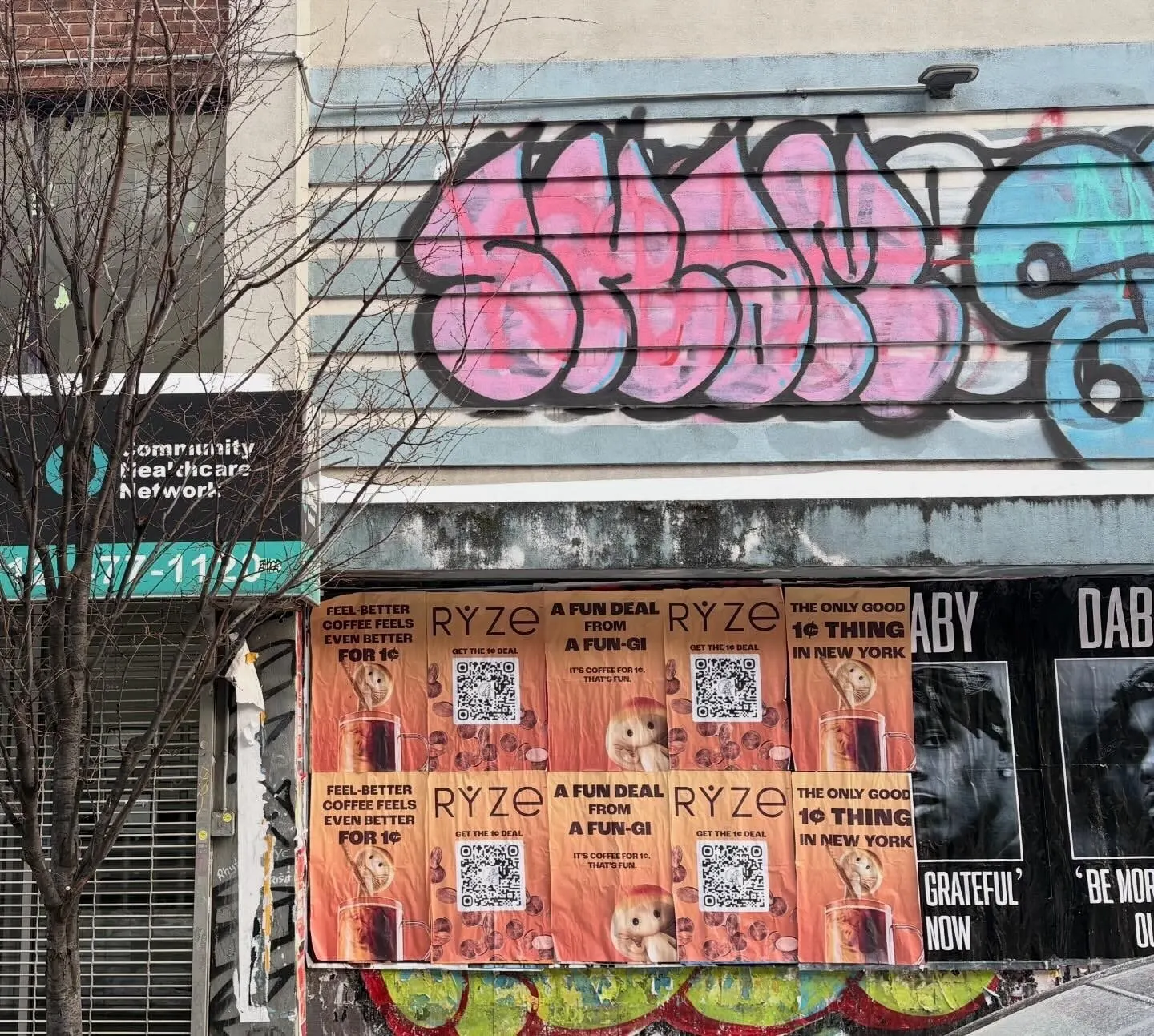
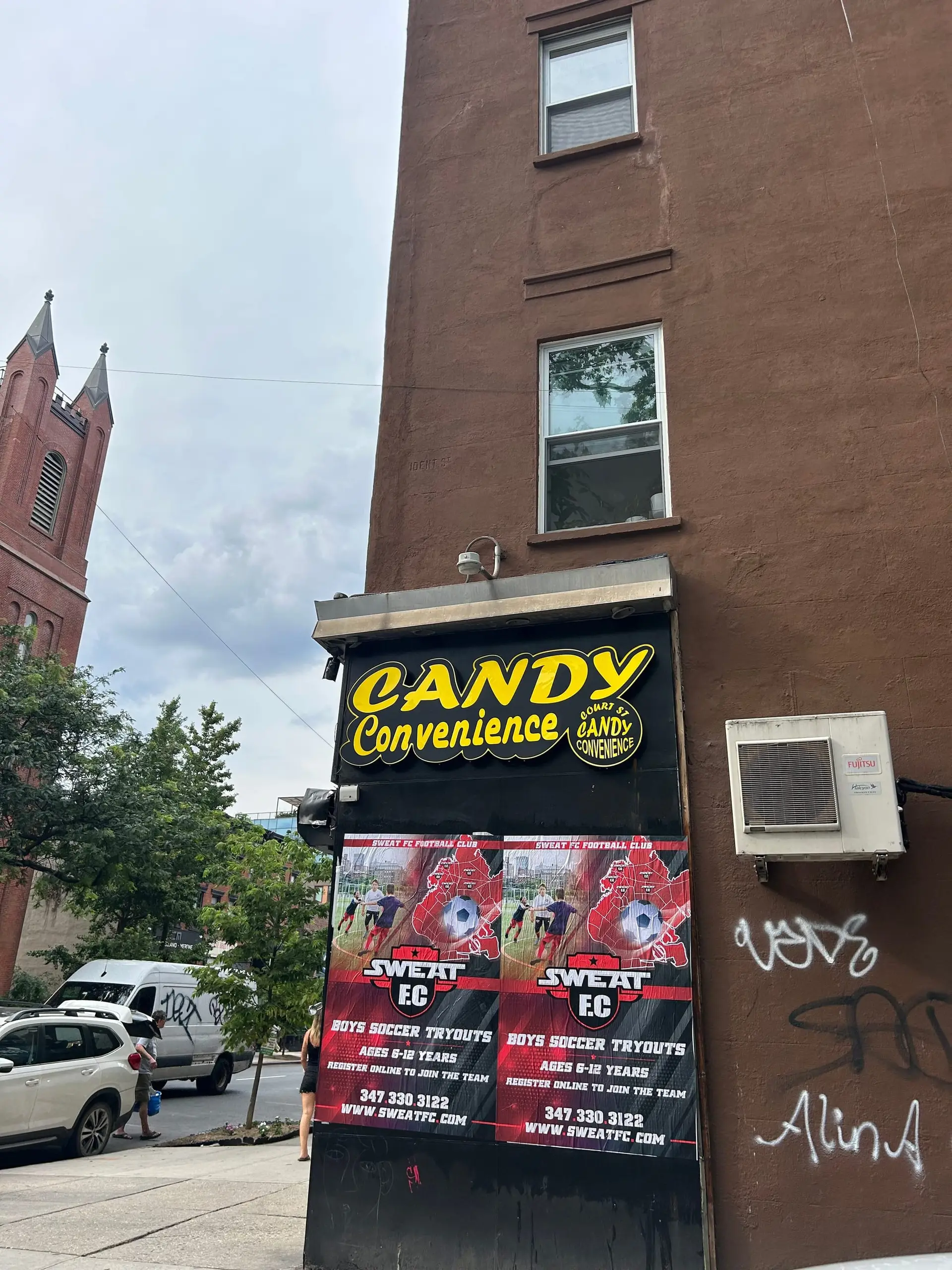
5 disciplines, one playbook.
Wheatpaste
Wheatpasting and wheatpaste advertising campaigns from $3,500 in NYC, LA, SF + 40 US cities. Published floors, 5-7 day lead (Expedited 24-72hr), GPS-tagged photo proof on every install. From $3,500Paste-Up Posters
Paste-up poster campaigns for product launches and neighborhood saturation. From $3,500, 5-7 day lead (Expedited 24-72hr), GPS-tagged photo proof in 40 US cities. From $3,500Pole Stickers
Pole sticker advertising and street pole takeovers in 40 US cities. Legal commercial-pole campaigns with geo-tagged photo proof on every install. From $3,000Sidewalk Stencils
Sidewalk stencil campaigns from $2,500 in 40 US cities. Chalk-safe, removable, permitted-only. Expedited 24-72hr available. GPS-tagged photo proof. From $2,500Coffee Shop Posters
Coffee shop poster programs in 40 U.S. cities. Counter cards, column wraps, and wall placements in partner cafes with full photo proof on every install. From $3,000Starting floors · print, install, and GPS-stamped photo proof included in every quote. Final number varies by turnaround, size, and location count. Full rate card →
Sample creative directions.
Pre-tested format / neighborhood pairings. Pick a direction at brief intake and we route the surface set inside 24 hours.
- Back-to-school CPG blitz Wheatpaste, 12 placements, 3-week window Cambridge, Allston
- Bank-app onboarding presence Sidewalk stencils + pole stickers, 8 weeks Westwood Village, UCLA corridors
- College-town saturation Pole stickers, 40+ placements Madison, Chapel Hill, Ann Arbor
- Brand-ambassador program Interior installs, 6 gyms, quarterly rotation Berkeley, Palo Alto, Princeton, Hyde Park
- Fintech student launch Wheatpaste poster series Williamsburg, Bushwick, Astoria
Put it on the wall.

Proof · Printed in-house · Installed by our crew
Street campaigns for Higher Education brands. Proof included.
Send the brief; a scoped quote for your vertical comes back inside 24 hours — formats, neighborhoods, and a GPS-stamped photo of every placement when the run wraps.
- Quote in under 24 hours
- No discovery call. The brief is the call.
- Printing & Installation under one roof
Brief us · Quote in under 24 hours
Start your higher education campaign.
Brand-safe by default.
- Private-property walls only Written owner consent on file for every surface. No public infrastructure, transit, or right-of-way.
- GPS-stamped photos within 48 hours Wide, mid, detail per placement. The proof your team forwards internally.
- FTC + local-code compliant Disclosures and permitting handled per contract. Legal reviews clean.
- Zero municipal removals on record 500+ documented installs, none taken down by a city.
Read the full field notes
Why College Audiences Are Built for Street Media
College brands face a specific constraint: timing is fixed. Back-to-school happens once a year. Welcome Week is one week. The student arrival cohort onboards fast. By week four of the semester, the student population has already established routines, chosen hangout spots, and locked in brand habits. That window does not move. It does not compress. And it does not reopen until the next cohort arrives twelve months later.
For any brand reaching the 18-24 demographic. CPG launches, fintech apps, fitness platforms, quick-service restaurants, apparel brands, and universities themselves. Street media is the format that captures that narrow cohort at the exact moment they are establishing new routines in a new city. Digital performance marketing can target by age and interest, but it cannot capture the moment the student walks off the bus into Cambridge or Westwood and opens their phone for the first time in a new city. Street media captures that moment with a physical, unmissable impression in the exact neighborhood where they will live.
Beyond Street Media runs college campaigns in the college-town adjacent neighborhoods where students actually live and walk. Not the campus quad. Campus admin will not allow it. But the off-campus density neighborhoods that are where the student life actually happens. For Harvard, that’s Cambridge and Allston. For UCLA, it’s Westwood. For UC Berkeley, it’s the neighborhoods immediately adjacent to campus, not the campus proper. The strategy is to own the student neighborhood at sufficient density that the brand reads as credible, present, and worth the freshman’s attention in the first critical weeks of the semester.
What College Brands and Student Audiences Actually Need
Timing lock. Back-to-school campaigns must install two weeks before student arrival. Miss that window and the campaign is noise among brands that already captured the onboarding moment. Street media can move fast. A 60-placement college-town campaign can install in 4-5 days. But production and approval must happen in advance. Brands that lock timing 8-12 weeks ahead win.
Neighborhood-density reach. Students are hyper-localized. They live in specific housing blocks, study in specific coffee shops, work out at specific gyms, eat at specific restaurants. Performance marketing tries to approximate that with geo-fencing and neighborhood targeting. Street media owns it physically. A brand with 40 placements across the core student-walking corridors reads as ubiquitous and credible. It is not a banner ad that can be scrolled past; it is a physical environmental presence that the student interacts with daily.
Off-campus adjacency. Campus restrictions are real. Most universities do not allow third-party advertising on campus proper. The campaign happens off-campus. That is actually a stronger strategic position. The neighborhoods where students live are more valuable than the campus itself because that is where they make personal-choice purchasing decisions.
Brand-ambassador program amplification. Ambassador programs execute at scale when the street media creates a physical anchor that ambassadors can reference and activate around. An interior poster install in a student gym is a placement. But when an ambassador who works at that gym promotes it to their member network, the placement becomes a neighborhood signal.
Student recruitment for universities. Universities use street media to reach high-school students in target recruitment corridors. A state school reaching in-state secondary markets runs a lower-frequency campaign than a college-town presence campaign, but the targeting is sharper and the impression is more credible than email or social ads.
How Beyond Street Media Works With College Audiences
1. Brief intake. Campaign objective (brand awareness, app install, ambassador program support, university recruitment), target cohort profile, target college towns, timing (typically back-to-school window), creative messaging, and attribution method (QR, URL, app tracking, ambassador report-back).
2. College-town neighborhood mapping. We identify the off-campus student-density neighborhoods for each target college. Harvard-area students walk Cambridge and Allston. UCLA students walk Westwood and adjacent neighborhoods. We map installation against the neighborhoods, not the campus proper. High-foot-traffic coffee shops, student housing blocks, and student-oriented bars become the placement corridors.
3. Creative production and brand-ambassador coordination. For campaigns with ambassador programs, creative is produced in coordination with your ambassador team. They see early concepts. They help shape messaging around the neighborhoods where they operate. The installation timeline is locked so ambassadors can plan social amplification around the media install date.
4. Install within the timing window. Most college campaigns install in a compressed 3-5 day window to maximize the effect of novelty and density. Back-to-school installations lock in late August. Semester-start campaigns lock in early January. The window is fixed; installation coordinates into that window.
5. Attribution and ambassador integration. For brand-awareness campaigns, we track placement density by neighborhood and measure social pickup. For app-install campaigns, QR codes and UTM-tagged URLs route through tracked landing pages. For ambassador programs, the ambassadors execute amplification around the physical install. Posting about the placements they see, activating in neighborhoods where install is concentrated, and driving direct signups through their personal networks.
Real Campaigns: College Audiences in Action
Energy Drink Brand. Back-to-School Launch. A major CPG brand running a 3-week back-to-school blitz across Cambridge MA (Harvard/MIT student housing), Allston MA (BC/BU neighborhoods), Boston MA (Northeastern), and Providence RI (Brown University neighborhoods). The campaign combined wheatpaste headline posters with 120+ pole-sticker placements across student-walking corridors, with QR redirects to a free-sample landing page. Installation locked the first week of August to catch the student arrival window. The campaign generated 8,000+ sample claims and ranked as the brand’s highest-ROI student activation that year.
Financial Services App. Multi-City Student Launch. A fintech brand targeting college-age early adopters across six college towns: Boston (Allston/Cambridge/Back Bay), New York (Columbia area), Los Angeles (Westwood), San Francisco (Berkeley), Chapel Hill (Franklin Street), and Madison (downtown UW corridor). Sidewalk stencils and pole stickers dominated, with a heavy QR-to-signup routing. Installation coordinated with a student-influencer ambassador program: 12 local micro-influencers at each college town received early creative access and drove amplification around their neighborhood-based placements. Signup attribution showed 23% of new users reported first-seeing-the-brand via street-media placements.
University Recruitment. In-State Secondary Markets. A large state university ran recruitment campaigns in secondary metro markets within the state to drive high-school student inquiries. The campaigns used low-density pole-sticker and interior-poster placement in coffee shops, tutoring centers, and college-prep high schools. Each market ran for 8 weeks (September through November, the peak college-application window). Inquiry attribution showed applicants from street-media neighborhoods converted at 18% higher rates than baseline, suggesting stronger brand-awareness metrics in neighborhoods with physical presence.
Services College Campaigns Use Most
Wheatpaste Advertising. Large-format poster campaigns in core student-neighborhood corridors for headline impressions during back-to-school and welcome-week windows.
Pole Sticker Advertising. Corridor density placement across student walking routes, coffee-shop blocks, and study-hall neighborhoods for brand reinforcement and app-install QR campaigns.
Sidewalk Stencil Advertising. Ground-level wayfinding outside coffee shops, student bars, and high-foot-traffic college-town venues for daily brand presence.
Coffee Shop Poster Programs. Dwell-time placements in student-favorite coffee shops across college towns, with quarterly creative rotation for semester-long presence.
Bar & Restaurant Bathroom Advertising. Interior placements in student bars and college-town restaurants where captured-audience messaging performs.
Multi-City Guerrilla Tours. Coordinated back-to-school and semester-start campaigns across 4-8 college towns with unified messaging and timing lock for brand-ambassador integration.
The College-Town Neighborhood List
Beyond Street Media runs college campaigns in these core college-town markets with proven student-audience density:
- Boston, MA. Cambridge (Harvard/MIT student housing), Allston (BC/BU/Northeastern corridor), Back Bay (Northeastern and grad schools), Seaport (newer student housing)
- New York, NY. Morningside Heights (Columbia), Washington Square (NYU), Williamsburg & Bushwick (NYU housing sprawl)
- Los Angeles, CA. Westwood (UCLA), Palo Alto (Stanford), East LA and surrounding areas for Cal State LA
- San Francisco Bay Area, CA. Berkeley proper (UC Berkeley), Palo Alto (Stanford), Mountain View (internship and graduate density)
- College Park, MD. Campus perimeter neighborhoods for University of Maryland
- Ann Arbor, MI. South University corridor and student housing blocks for University of Michigan
- Madison, WI. Downtown and campus-adjacent corridors for University of Wisconsin
- Chapel Hill, NC. Franklin Street and student housing neighborhoods for University of North Carolina
- Austin, TX. East Austin and South Congress for University of Texas
- Princeton, NJ. Downtown Nassau Street and student housing for Princeton University
- Evanston, IL. Northwestern University campus-adjacent neighborhoods
- Hyde Park, IL. University of Chicago student neighborhoods
College Campaigns Win on Speed and Density
College audiences are built for campaigns that move fast and land at density. The window is 2-3 weeks. The installation is compressed. The frequency is high. By the time the student walks off the bus, they have already seen the brand five times in their new neighborhood. That is credibility. That is the street-media advantage in the college market.
Higher Education questions.
The 5 things higher education brands ask before sending a brief. Same-day answers from the desk if yours isn't here.
Q · 01 Can we advertise on the actual campus?
Most universities restrict third-party advertising on campus. Rules vary widely by institution, but typically require institutional affiliation, student-life office approval, or restrictive placement rules. The real strategic opportunity is the college-town adjacent neighborhoods where students live, study, eat, and socialize. For Harvard, that's Cambridge and Allston. For UCLA, it's Westwood. For UC Berkeley, it's the neighborhoods immediately adjacent to campus. Off-campus reach at student-density scale is where the impressions land.
Q · 02 What is typical pricing for a college-town campaign?
Entry-level back-to-school campaigns start at $6,000-$10,000 for a single college town (60-80 wheatpaste and pole placements across core student-housing corridors). Multi-format programs across a full semester run $25,000-$60,000 (wheatpaste, pole stickers, sidewalk stencils, interior installs in 3-5 college towns). Major brand ambassador program executions with quarterly creative rotation scale to $80,000-$150,000+ per semester for sustained multi-city presence with ambassador integration.
Q · 03 What is the best timing for college campaigns?
Back-to-school (late August through September) is the unmovable window. New students arrive, establish routines, and lock in habits within 2-3 weeks. Welcome Week (first full week of classes) is peak foot traffic. Semester-start (January) is secondary. Graduation season (May) for admissions and recruitment targeting. The window is fixed; the brands that win are the ones that book 8-12 weeks in advance so installation can coordinate with the student arrival timeline.
Q · 04 What college towns work best for these campaigns?
Top college-town markets for Beyond Street Media: Boston MA (Cambridge for Harvard/MIT, Allston for BC/BU, back bay for northeastern), Los Angeles CA (Westwood for UCLA, Palo Alto for Stanford), San Francisco Bay Area (Berkeley proper for UC Berkeley, Palo Alto for Stanford, Mountain View for Google internship density), College Park MD (UMD immediate neighborhood), Ann Arbor MI (South University corridor and student housing), Madison WI (UW-Madison core neighborhoods), Chapel Hill NC (Franklin Street and adjacent student housing), Austin TX (UT campus-adjacent East Austin and South Congress), New York NY (Washington Square area for NYU, Morningside Heights for Columbia, Brooklyn neighborhoods for NYU satellite housing), Princeton NJ (downtown Nassau Street and student housing), and Chicago IL (Hyde Park for UChicago, Evanston for Northwestern).
Q · 05 Can you hit the back-to-school window if we lock late?
Sometimes, and in-house printing is the reason. We print posters in-house at poster-printing, so a 60-placement college-town run can install in 4 to 5 days once creative is final. But the window is fixed. Posters need to be on walls in Cambridge or Westwood two weeks before students arrive. A late lock compresses the production buffer and limits creative iteration. We will tell you at intake whether your date is still hittable and what compresses to make it.
We delivered.


















Brand partners include: FIFA World Cup 2026, Palantir, Sézane, G-Shock, Mitchell & Ness, True Religion, Huda Beauty, Yonex, Relevance AI, Momentous, RYZE Coffee, Bloom Effects, Incrediwear, Brooklyn Museum, Sweat FC, HydroJug, Frameline, Alchemy, OneRepublic, Lone Fox, Vaura Pilates.
Got a higher education launch?
Inquire now.
Send the Higher Education brief: markets, window, creative direction. Vertical-specific quote back in 48 hours.