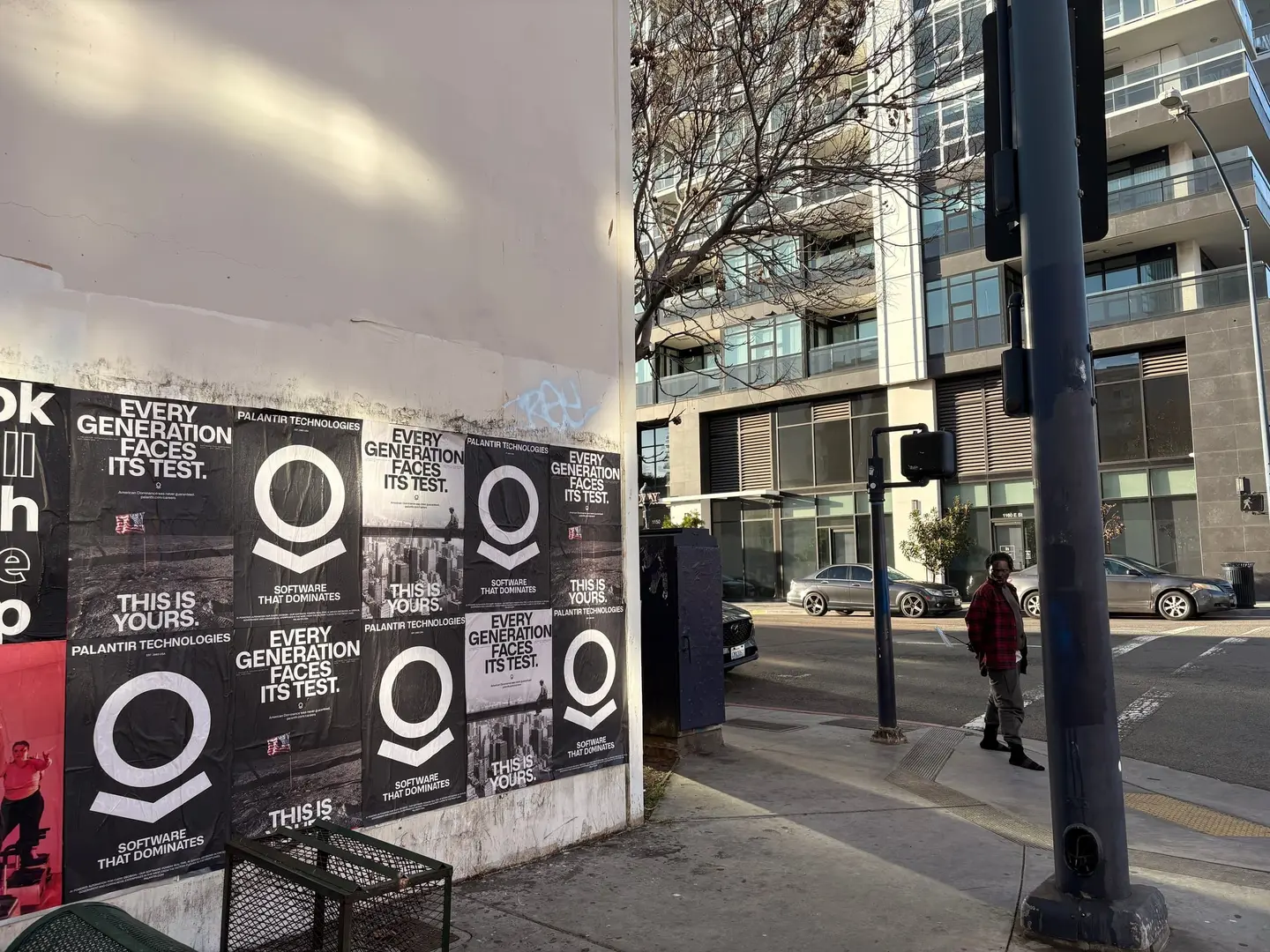
Palantir Technologies ran one recruitment message across two Pacific markets: “Every Generation Faces Its Test. This Is Yours.” The creative stayed locked in both cities while the tempo and the geography changed. San Diego took 29 wall positions across four neighborhoods inside a 48-hour push. Honolulu took 6 positions across two downtown clusters over 72 hours. Pasted as repeated grids, those 35 positions carried the run’s 300 posters, 250 on the mainland and 50 on the island.
What follows is the routing logic behind each tempo and a plain account of what the documentation proves.
The Brief: Palantir’s Recruiting Challenge
The ask was narrow. Place the poster in high-dwell commercial zones, hit neighborhood-scale saturation, GPS-tag every wall on the day of install, and run both cities without phased rollouts.
The creative arrived locked: large-format typographic, black and white, roughly 100pt sans-serif, with palantir.com/join as the only call to action. No QR code and no fine print. A poster like that has one job, which is to be legible from 30 feet on brick or hoarding, in daylight, without softening.
The company’s own job board lists open roles in both San Diego and Honolulu, and that is the first filter on any recruitment street buy. A poster only works as a hiring instrument in a city where the company can seat the person who reads it.
City Selection Logic: Why These Two Markets
The default recruiting move is to buy the largest talent pools and optimize for reach. Palantir bought two mid-size markets and spent the budget on repetition inside them.
San Diego sits on an overlap that few metros have. The San Diego Regional EDC attributes about 20 percent of the region’s gross regional product to defense-related spending and counts more than 3,100 software establishments locally. UC San Diego runs a dedicated bioinformatics and systems biology program that sits upstream of the Torrey Pines research corridor. For a company hiring against that profile, a downtown grid reaches a workforce already concentrated inside a few square miles, and specialists in a small field tend to know each other, so visible work travels by conversation as well as by sightline.
Honolulu presents the reverse problem. The island technology market is small and geographically isolated, and plenty of national employers recruit into it from the mainland without ever showing up. A poster grid in the downtown core and along Ala Moana is a claim of physical presence, made in a market where we see very little national street-level media.
Geographic specificity is the whole thesis. Concentrate the budget where the target already clusters and where competitors are thin on the ground.
Surface Strategy: Matching Walls to Walking Routes
Surfaces matter less for what they are than for where they sit relative to how the target moves.
In San Diego, Gaslamp Quarter carried the anchor placements: historic brick, 12 to 18 feet, sitting on the spine between residential blocks and the downtown office towers, with morning commute and evening retail hours stacking on the same walls. Gaslamp also carries an extra layer of regulation. The city administers it as a planned district with its own design guidelines and sign regulations layered on top of the downtown community plan, so wall access there is a property-owner conversation inside a framework the city already wrote. We scope Gaslamp knowing that.
East Village took newer construction hoarding with retail frontage, where the pedestrian peak falls at lunch and again at end of business. Bankers Hill is office-park density with light retail, which makes it a morning-commute placement rather than an all-day one. Little Italy carried the secondary zone of art-forward storefronts.
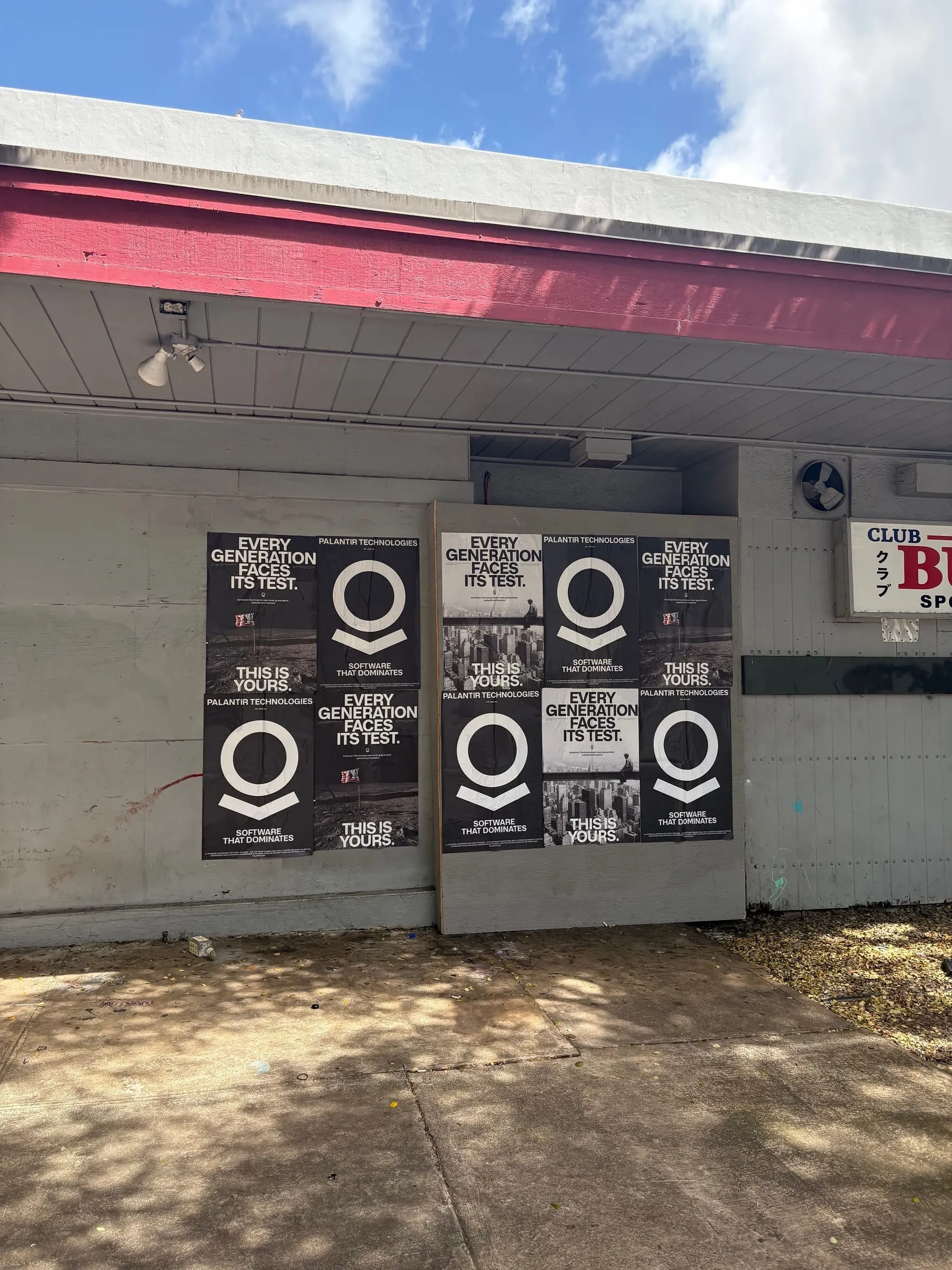
In Honolulu, the downtown core covers office towers and state government buildings, where the same workers walk the same two or three blocks five days a week. Ala Moana covers the retail and office mixed-use corridor. The City and County of Honolulu’s transit-oriented development plan describes it as a continuing regional retail destination and a model for walking, biking and transit use, which is the pedestrian profile a poster grid needs.
Brick and hoarding both read fine from street distance once the paste is flat and the paper is heavy enough. The strategic question is whether a given wall sits on a route the target actually walks.
Frequency Over Footprint: The Routing Logic
Repeat exposure carries most of the published measurement in out-of-home. Clear Channel Outdoor’s CMO, writing for the OAAA, reported a credit union study where people who saw the ad across nine unique billboard locations were nearly three times as likely to visit the credit union’s website as people who saw it across three. Clear Channel reads that as a case for covering a market broadly. We read the same number from the other end: what moved was how many times one person met the message, and on a recruitment budget the cheapest way to raise that count is to put the unique locations on a corridor the target already repeats. The study measured consumer web response to billboards rather than hiring response to paste-ups, so treat it as directional.
Recruiting suits that shape better than most categories, because the audience walks predictable routes at predictable hours. A downtown worker who takes the same corridor to transit and to lunch passes a clustered grid repeatedly across a week instead of glancing at one wall once.
That is why San Diego got 29 positions concentrated in four neighborhoods rather than spread across seven, and why Honolulu got 6 positions inside two clusters rather than scattered between Waikiki and Pearl City. Fifty posters spread across Oahu would read as sparse. Fifty inside two corridors reads as coverage.
The Install Timeline: 48 Hours vs. 72 Hours
San Diego ran the compressed version.
Two crews started Thursday at 7am, one anchoring Gaslamp and Little Italy, the other on East Village and Bankers Hill. Early start gives full daylight for surface inspection, prep and photography. The Gaslamp crew closed out by 2pm, East Village by 4pm. Both returned Friday morning for reinforcement paste on the highest-traffic surfaces. By Friday close of business all 29 positions were pasted, curing and photographed.
The case for that tempo is synchronization. Property agreements were pre-cleared, the crew knows the surfaces, and May gave us dry walls and mild temperatures, so the whole footprint could go live inside one window. Coverage appears everywhere at once rather than trickling in, and if a single property owner changes their mind, the rest of the campaign is already up.
Honolulu ran the longer arc.
Friday covered property walkthroughs and surface checks for salt corrosion and mold. Saturday ran the primary install, downtown from 9am and Ala Moana from late afternoon, which put the retail-corridor grid up while the corridor was still full. Sunday covered reinforcement paste on the four highest-traffic surfaces, then documentation and GPS logging.
Tropical conditions drive that choice. Our Honolulu crew logs 60 to 75 percent relative humidity at 75 to 80 degrees on install days, and a standard mainland paste mix slumps or drags out past two days to cure in that air. The island crew mixes thicker for the climate, and the three-day window leaves room to watch the cure and fix what needs fixing. The cost is real: the first walls have been up two days before the last ones go live, so simultaneous saturation is gone.
Same goal in both cities, on a tempo set by what each market and each climate allows.
Creative: One Poster, Four Reads
The simplicity of the poster is doing strategic work. Complicated imagery dies at street distance, and a headline plus a URL survives brick texture and a walking glance.
Abstraction is the other half. “Every Generation Faces Its Test” names no role and no seniority band, which lets it sit differently by context. Our read from the field: in Gaslamp and downtown Honolulu, both older business districts, it lands as an institutional claim aimed at senior people. In East Village and along Ala Moana, both younger and more mixed-use, it lands closer to a direct pitch. One line, no variants, carried by context instead of by rewriting.
For B2B street work with a wide target, that is usually the right call. Copy specific enough to name one job title excludes everyone else on the block.
Documentation: What GPS Proof Covers
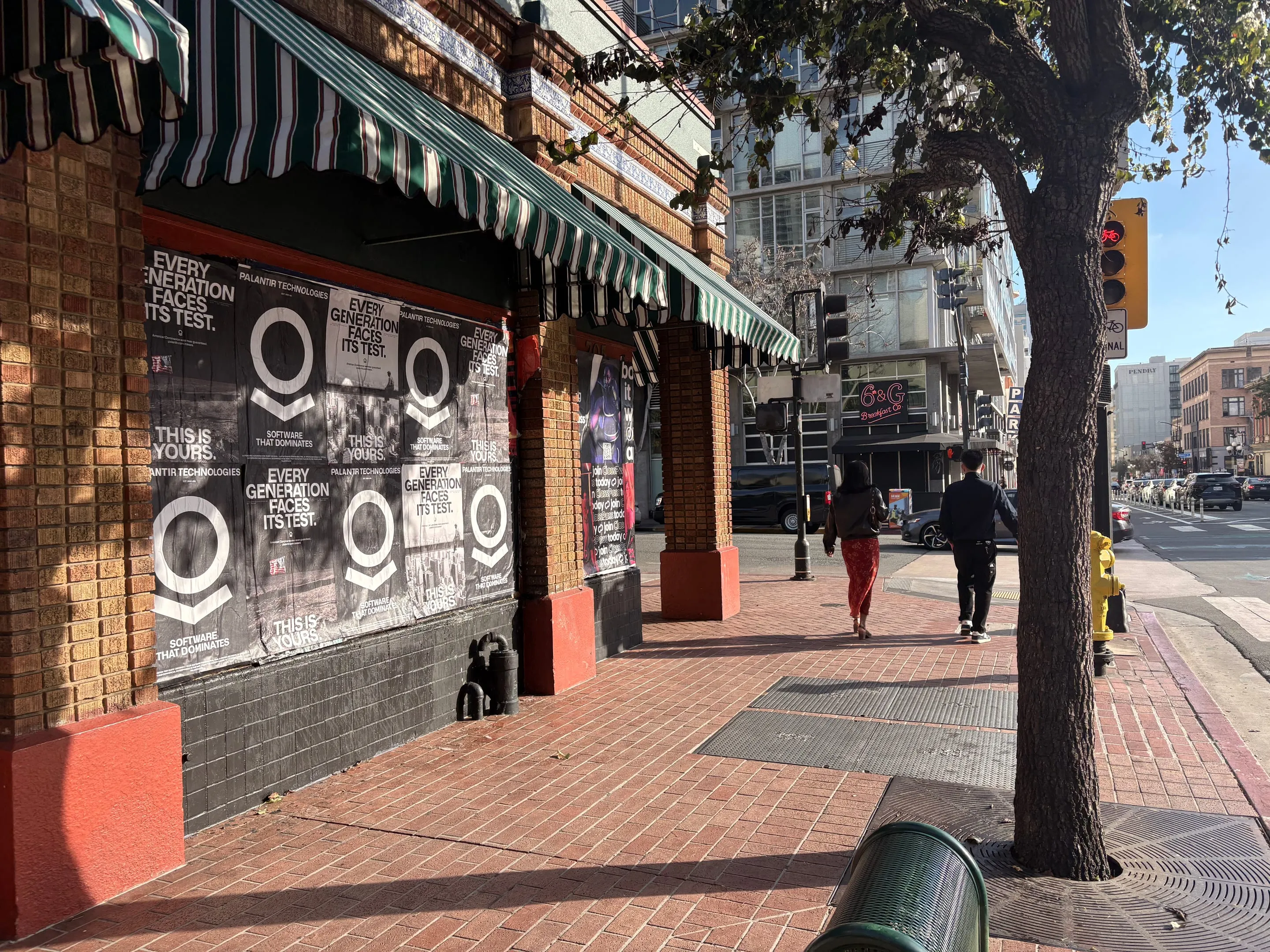
All 35 positions were documented the day they went up. Each wall carries GPS coordinates, timestamp, surface type, neighborhood zone, crew member ID, install date and daylight photography, one wide frame for context and one close for adhesive detail.
Install logs ran alongside the install rather than after it. San Diego closed by Friday, Honolulu by Sunday, and both city manifests reached the client Monday morning: latitude and longitude for every wall, an elevation estimate, and the wall-by-wall photo set.
That record does one thing well. It proves the campaign ran where and when it was scoped to run, down to the coordinate, which is the question a finance team asks about street media and the question most vendors answer with a modeled reach figure instead.
It does not measure impressions, foot traffic or applications. BSM photographs placements and does not claim to count the people who walked past them. Any read on recruiting response lives in the client’s own analytics, where campaign dates and placement coordinates can be lined up against geo-filtered traffic and applicant source questions. Set that up before install, because street media cannot be retrofitted with tracking after the paste is dry.
Lessons for B2B Brands Running Street Campaigns
Geographic concentration beats national reach
If you are hiring or selling into a specific professional cohort in specific cities, repetition inside those cities does more than one thin pass across the country. Palantir ran 300 posters in two markets rather than 300 across twenty.
Walking routes matter more than raw foot traffic
A wall on a commute spine reaches the same person several times a week. A wall in a tourist district reaches a different person every time. Map how your audience actually moves before choosing zones.
B2B messaging can stay high-level
The Palantir line never says what roles are open. That abstraction is what lets it work on a senior engineer and a junior one walking the same block. Street advertising signals seriousness and location; the landing page does the qualifying.
Documentation is the proof, and its limits are part of the proof
“Thirty-five documented wall positions in San Diego and Honolulu, photographed and GPS-stamped” is a verifiable claim. “Estimated reach of two million” is a model. Recruiters can run their own attribution against the first one and cannot do much with the second.
Tempo is a market decision
A 48-hour blitz suits a market with embedded crew and pre-cleared surfaces. A 72-hour arc suits slower property cycles and slower cure conditions. Forcing one tempo everywhere costs you either quality or coverage.
Our Palantir case study carries the full photographic documentation from both cities. The wheatpaste advertising page covers how multi-city runs get scoped and priced, with printing and installation both inside the published $3,500 floor, and the San Diego coverage page covers what we run locally.
One message can hold across two markets. The routing and the tempo are what change underneath it.