The DTC beauty problem
Paid social keeps getting more expensive to buy attention on. Meta closed 2025 with a record holiday quarter, and Marketing Dive reported that ad impressions rose 18% year over year while the average price per ad still rose 6%. More inventory, and it cost more per unit anyway. A beauty brand whose entire acquisition model sits inside that auction is bidding against every other launch for the same scroll.
The brands that get out of the pattern build physical presence in the neighborhoods where their customer already walks. They stop being a brand somebody saw in a feed and become the brand on the corner in Nolita. That signal builds slowly, and it does not switch off the day the media budget does.
Why beauty wins on the street
Beauty creative survives the jump to large format better than most categories. A hero product shot with high-contrast type is already built to land at a glance, so the file that compresses to a 1080x1080 square reads cleanly at 36”x48” on brick with almost none of the redesign work most categories need.
The audience also repeats the route. A poster near the Spring Street subway sits on a corridor people use constantly: the MTA’s published subway ridership data records roughly 586,000 entries across the two Spring Street stations in May 2025 alone. That volume arrives on a schedule rather than through an auction, and it arrives on foot, at walking pace, with nothing to scroll past.
Pickup is the third piece. In a 2022 OAAA and Morning Consult survey, 88% of adults said they notice out-of-home ads, and about one in seven of those viewers had photographed an ad and shared it on social. Nielsen’s poster research for the OAAA found that poster ads stand out more than ads in newspapers, online, on mobile, or on radio. Those are industry findings about the format, and we will not turn them into a forecast for your campaign. We photograph what goes up and where; whether a placement produced a repost or a sale shows in your own analytics, not ours.
The neighborhood mix
Concentration is the whole strategy. A budget split across twenty markets puts one poster on each of twenty unrelated routes. The same budget folded into two neighborhoods puts a dozen on one route, which is what turns a placement into something a person recognizes.
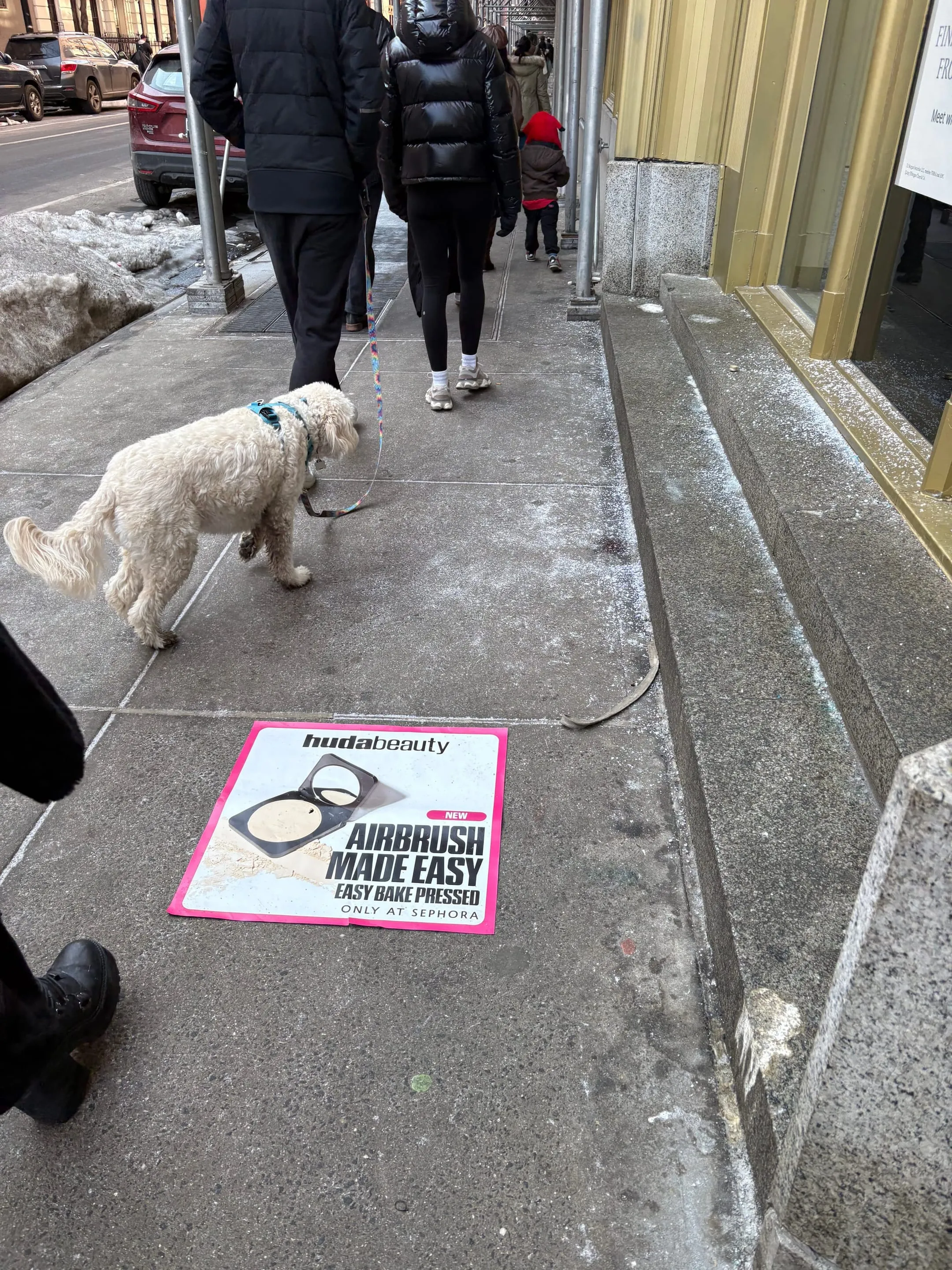
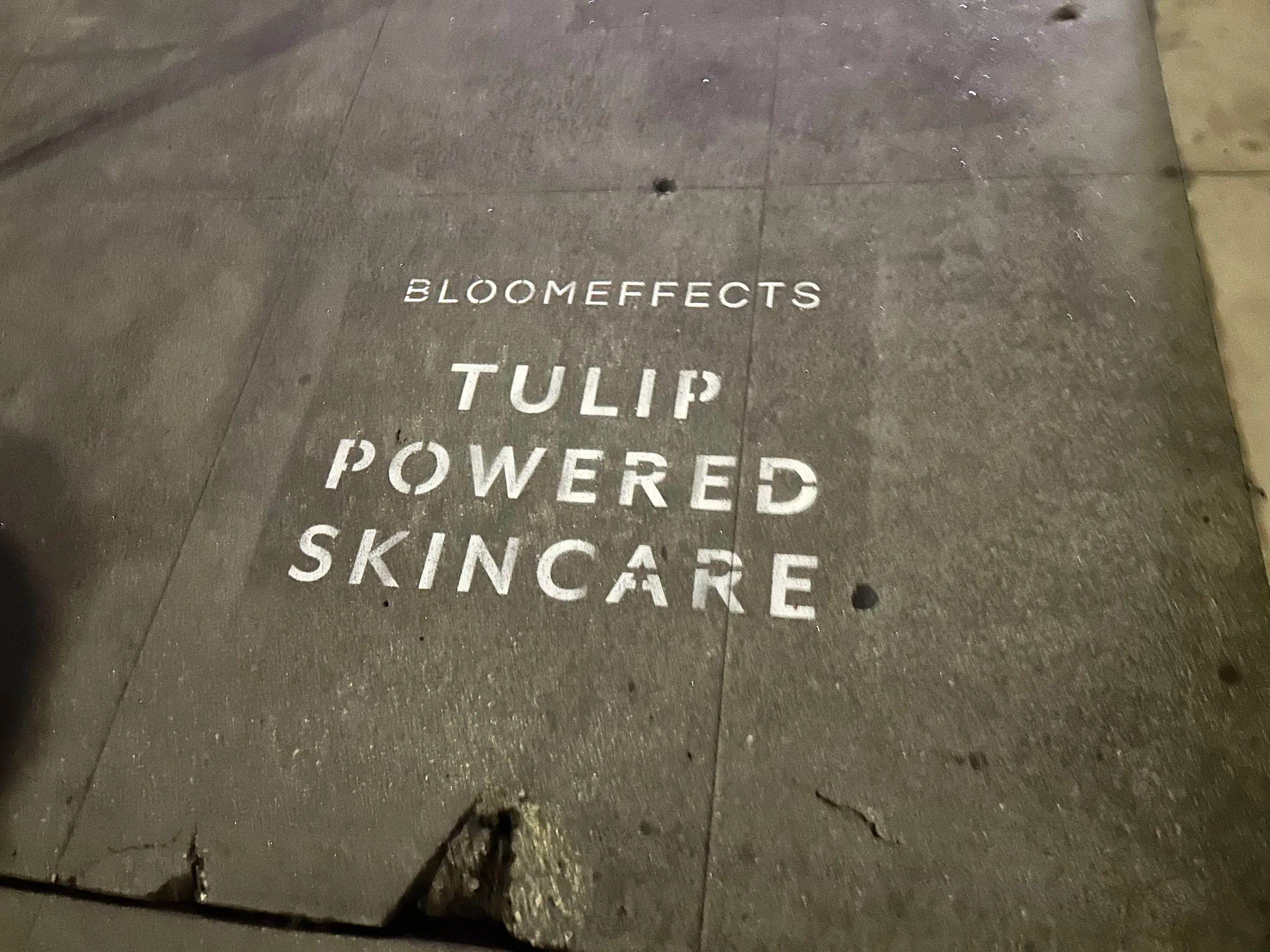
New York carries most of our beauty record, and it clusters in Nolita, SoHo, and the blocks south of Houston. The Huda Beauty run placed 60 printed sidewalk decals, 24” square, across the SoHo-to-Tribeca beauty cluster and Williamsburg, held for 35 days. Bloom Effects took a quieter route: 7 sidewalk stencils across SoHo, the Lower East Side, and Williamsburg over 28 days, one of them a reverse-stencil clean tag pressure-washed into the pavement rather than printed onto it. Picking the block is worth doing with data. NYC DOT publishes bi-annual pedestrian counts for commercial corridors across the five boroughs, and the spread between corridors is wide enough to change a media plan.
Los Angeles works differently. Silver Lake, Echo Park, and the Sunset corridor have natural light and wall stock that holds longer creative than a New York scaffold panel will. Sézane’s bicoastal run put nine of its fifteen placements on Sunset Boulevard between West Hollywood and Silver Lake, alongside Tribeca scaffolding in New York, over 35 days on one creative system.
Hayes Valley in San Francisco is a smaller catchment that skews premium. It earns its place as the third stop on a coastal tour more often than as a standalone market.
Wynwood in Miami is art-adjacent on purpose. The Wynwood BID runs the district under a revitalization plan written to preserve its artistic and industrial character and to keep the streets pedestrian-focused. A poster there sits inside a visual context the neighborhood actively protects, which reads differently from the same poster on a commuter road.
Skip Times Square and Hollywood Boulevard. Those are billboard environments built for traffic moving at speed, and this format wants somebody on foot, ten feet away, on a block she walks most weeks.
Creative rules for beauty wheatpaste
Commit to one image. Pick the single hero, the frame you would commission for an editorial spread, and run it across 15 to 20 walls. A first guerrilla buy has no accumulated recognition to spend on variety, and repetition across a corridor is what builds the recognition that later campaigns can play with.
Set type at human scale. The brand mark should read from five feet, a tagline from two or three. On QR codes we split it by format: we put them on sidewalk stencils routinely, because somebody looking down at pavement is already standing still with a phone in hand. On a wall poster read from across a street, a code is mostly decoration.
Lean on contrast. Wheatpaste lands on brick, scaffold board, and weathered masonry, and those surfaces eat pastels and white space. Ink-and-pop palettes hold: black grounds with bright product photography, or saturated color fields with white type.
Sizes do specific jobs. 36”x48” is the workhorse and should carry most of a buy. 24”x36” reads more editorial at close range. 42”x60” is the destination panel, the one somebody stops in front of, so it belongs where foot traffic already slows and it works better kept to a handful.
What a typical DTC beauty launch looks like
A single-brand neighborhood saturation looks roughly like this:
- 15 to 25 wheatpaste placements in one primary neighborhood, plus 5 to 8 in an adjacent corridor
- Sidewalk stencils at retail-adjacent intersections, with the medium picked against the window: washable chalk holds 2 to 7 days, biodegradable spray 10 to 30
- Optional reverse-stencil clean tags at pedestrian chokepoints such as a subway exit, which hold 2 to 6 weeks and fade as the surface re-soils
- Published floors: wheatpaste from $3,500, sidewalk stencils from $2,500, printing and installation included. Placement count and corridor count move the number, and the full rate card is on the pricing page
- Timing: paste pulls flat and reaches full cure by the next morning in good conditions, and on the Sézane LA run in March weather cure ran 36 to 48 hours. Our documented beauty campaigns held 28 and 35 days in the field
- Documentation: a GPS-stamped photograph of every placement, a field map, and property-owner consent records
What is not on that list is an impressions figure. We do not measure foot traffic, reach, or social pickup, and any agency quoting you a multiplier for those is modeling, not counting. What we can put in writing is what went up, where it went up, when, and that it came down clean. We have zero municipal removals on record.
What we’d ask in the brief
Send the hero image, the launch date, and the primary neighborhood. From there we map the corridor, secure wall inventory, produce the property-owner paperwork, schedule the crew around the install windows that actually work on those blocks, and deliver the documentation set within 72 hours of campaign close.
The point of the whole exercise is narrow. For four or five weeks, in the ten blocks your customer walks every day, you are the new thing on the wall.