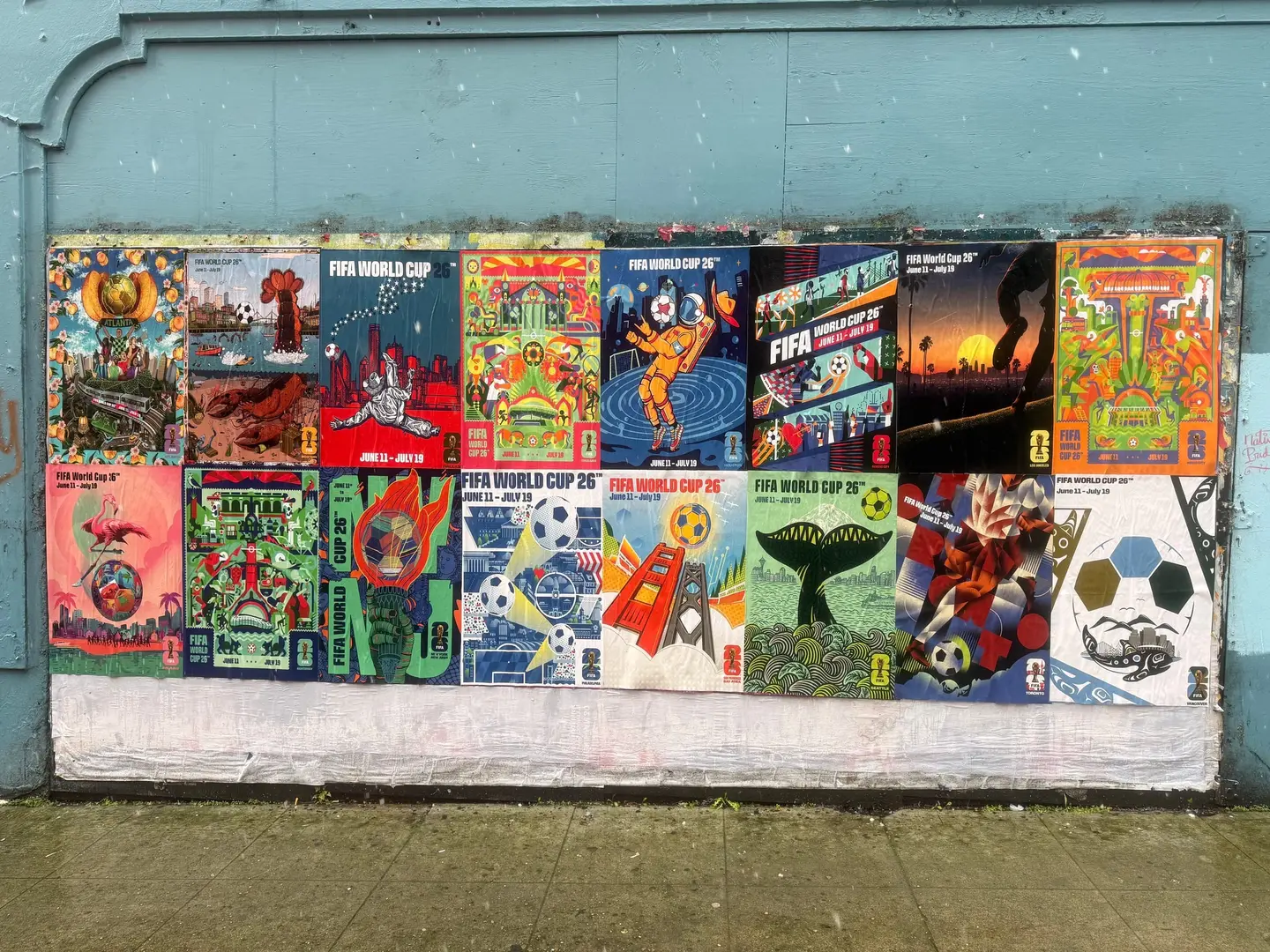
FIFA World Cup 26 runs across 16 host cities in three countries, which pulls international crowds through a small set of walkable corridors for about five weeks. Every brand with a stake in the tournament wants to be on those corridors. Most of them also have an ESG report to answer to afterward.
FIFA publishes its own Sustainability and Human Rights Strategy for the tournament, built on social, environmental, economic, and governance pillars. That document covers how FIFA runs the event. It does not set a standard for a brand’s street-level advertising, so the standard a brand has to clear comes from elsewhere: whatever it already reports to investors, and whatever the host city allows on its sidewalks.
A campaign that goes up for two weeks and washes off, photographed at the same coordinates before and after, is checkable by both. That is the operational argument for a low-impact format here, and it holds up better than a sustainability adjective in a press release.
This playbook covers the formulations, the documentation protocol, and the timelines these formats actually hold to.
Three Eco-Friendly Material Tiers
Three material tiers cover low-impact street advertising. Each carries a different cost, visibility profile, and lifespan.
Tier 1: Chalk-Mix Stencil (Highest Visibility, Weather-Dependent Wash-Off)
A chalk stencil is a water-soluble chalk medium applied through a template cut to the artwork. No solvent, and nothing that needs a chemical to come back off.
Application:
- Sprayed or brushed through a stencil mask cut in-house to the approved file.
- Dries matte in 2 to 4 hours on concrete, brick, and painted wall.
- Legible at street distance, roughly 40 to 60 feet.
- Shrugs off light drizzle for the first day or so, then gives way to real rain.
Lifespan:
Chalk lives as long as the weather lets it. Our published range for sidewalk chalk work is 3 to 14 days in most markets, and the chalk-safe paint on the Toronto World Cup sidewalks held 10 to 21 days. Before booking an install window we read NOAA’s U.S. Climate Normals for the market, then the local ten-day forecast, and we schedule into the longest dry stretch available. A pressure washer takes it off immediately if a client needs the surface clear early.
Residue:
Chalk leaves the surface as it found it. That is why the post-wash frame is shot from the same coordinate as the baseline, so the two images can be put side by side instead of described.
Cost:
- Sidewalk and chalk stencil campaigns start at $2,500, printing and installation included.
- Turnaround, size, placement count, and format mix move the number. A scoped quote returns inside 24 to 48 hours.
Visibility:
The mark is crisp, and brand logos read clearly from across a two-lane street. It holds that sharpness through the first week in most weather, which covers the core visibility window for an event-tied run.
This is the format we recommend first for host-city work.
Tier 2: Reverse-Stencil Clean-Tag (Lower Visibility, 4-8 Week Semi-Persistence)
A reverse stencil uses a pressure washer to lift accumulated grime through a stencil mask, revealing clean surface beneath. The brand mark is a negative in the absence of dirt rather than an applied material.
Application:
- A weather-resistant mask, aluminum or plastic, is positioned on the surface.
- A pressure washer at 2,500 to 3,500 PSI works through the mask, lifting dirt and oxidation.
- The mark appears as clean, light-toned areas where the grime came off.
- Budget 10 to 20 minutes per surface for the washing itself.
Persistence:
The mark holds roughly 4 to 8 weeks as dust and oxidation rebuild, then fades on its own. Nothing has to be removed.
Residue:
No material is added, so there is nothing to come back and remove. The only change is temporary cleanliness, which the street reverses on its own.
Legality, honestly:
The material story is cleaner than the legal one. Cleaning public property is generally not prohibited, but advertising in public space generally requires a permit, and a pressure-washed logo is advertising. NBC News reported that San Francisco’s public works department asked brands running reverse-graffiti ads to come back and wash the marks away while it worked out which enforcement code applied, and the founder of one clean-advertising firm described the practice to NBC as sitting in a gray zone between legal and not. We run clean-tags on private frontage with written owner consent.
Cost:
- Reverse-stencil campaigns start at $3,500, standard turnaround 4 to 7 days.
- Material cost is near zero here. Surface scouting, crew hours, and stencil complexity drive the quote.
Visibility:
Visibility is medium. The mark is real but subtle, reading at roughly 20 to 40 feet depending on surface tone and how much grime had built up. It works best on heavily soiled surfaces, which is most of the alley wall and sidewalk inventory in a dense host city. A clean surface gives you almost no contrast to work with.
This is the second option when the brief wants the strongest zero-material story and can accept lower visual impact.
Tier 3: Soy-Based Ink on Recycled Paper (Short-Term Paste-Up)
When the brief calls for poster format, the low-impact build is soy-based ink on uncoated recycled stock, hung with wheat paste.
Worth knowing what the ink label promises. Soy ink substitutes soybean oil for part of the petroleum oil in the ink vehicle, and the American Soybean Association’s SoySeal program sets a minimum soybean-oil percentage by ink type, 20 percent for sheet-fed and 7 percent for heat-set. “Soy-based” is a content threshold, not a description of the whole formulation, and a brand putting the claim in an ESG report should know which number it is standing on.
On stock, the number that matters is post-consumer content. The EPA defines postconsumer fiber as material that has finished its life as a consumer item and been recovered from the waste stream, which excludes newsstand returns and printers’ over-runs. Ask the printer for the post-consumer percentage specifically.
The build:
- Wheat paste, flour and water, no synthetic adhesive.
- Soy-based ink, four-color.
- 80 lb uncoated recycled cover stock, no plastic backing.
In our runs the paste gives up within days and the sheet weathers off over the following weeks, faster in rain, slower on a sheltered wall. We photograph what happened rather than model it.
Cost:
- Wheatpaste campaigns, print and paste and installation, start at $3,500.
- Turnaround, size, placement count, and format mix move the number.
This tier costs more than chalk because it carries print production. Use it when the brand wants poster format specifically.
Documentation Protocol: Install and Wash-Off Proof
The documentation protocol turns a campaign from something a brand vouches for into something it can hand over.
Pre-install baseline
Date-stamped, GPS-tagged frame of every surface as found, before anyone touches it. That baseline captures any damage or staining that was already on the surface. Shoot in consistent morning light, 7 to 9 AM, so the shadows repeat when you come back.
Post-install
Same coordinate, same angle, timestamped to the install. Chalk stencils get shot 2 to 4 hours after application, once the medium has dried and the mark reads at full legibility. Reverse stencils get shot immediately after washing, while the contrast against surrounding grime is at its highest.
Post-wash and post-weathering
Same coordinate again. Chalk stencils are photographed at 7 days and 21 days. Reverse stencils at 14 days and again near the eight-week mark. The frames show the surface returning to baseline as the chalk dissolves or the grime rebuilds.
For a 30-surface chalk-stencil campaign, that is 30 baseline frames, 30 post-install frames, and 60 wash-off frames across the two check dates: 120 photographs plus the GPS log and timestamps.
What that set proves is placement and removal. It does not measure reach, foot traffic, impressions, or social pickup, and we do not report numbers we cannot stand behind. Attribution runs through the brand’s own analytics. The photographs cover the part the brand is being asked to defend, which is whether the campaign existed where it said it did and whether it came off.
The before-and-after pair works side by side. The progression reads without a caption.
Timing and Campaign Lifecycle
Stencil campaigns are short-window by design, and the calendar runs differently from a paste-up.
For a host-city activation:
Week 1: Surface scouting and property-owner consent.
Week 2: Stencil design and production. Simple vector artwork files in 2 to 3 days, and laser-cut aluminum stencils take another 3 to 5. Creative-to-ready runs about a week, which is faster than the print logistics behind a poster run.
Week 3: Install window. Figure 15 minutes per surface for chalk plus repositioning, so a 30-surface run lands in 2 to 3 days. Reverse stencils run 3 to 4 days at 20 minutes per surface. On the FIFA World Cup host-city job, Seattle and Toronto installed on parallel 24 to 48 hour schedules inside a single 14-day activation window, with crews already living in each market rather than one team flying between them.
Week 4: First wash-off documentation for chalk. Expect partial dissolution by day 7, weather depending.
Week 5: Second pass for reverse-stencil campaigns at the 14-day mark, when grime has started to rebuild.
Weeks 6-7: Final documentation. Chalk should be gone or nearly gone by day 21.
A chalk run is 4 to 6 weeks start to finish, most of it documentation rather than install. A reverse-stencil run adds a final check near the eight-week mark, once grime has rebuilt. The install itself is the short part.
World Cup 2026 Host-City Strategy
FIFA World Cup 26 is hosted by Canada, Mexico, and the United States. The eleven U.S. host cities are Atlanta, Boston, Dallas, Houston, Kansas City, Los Angeles, Miami, New York New Jersey, Philadelphia, San Francisco Bay Area, and Seattle. Canada hosts in Toronto and Vancouver, Mexico in Guadalajara, Mexico City, and Monterrey.
Before scoping a single placement, check the map. Morgan Lewis reports that FIFA’s hosting contracts require clean stadiums and clean zones, mapped areas where cities and stadiums actively remove non-sponsor branding. The same piece notes that this turns what would be a trademark fight into a contractual claim against the host city or stadium, which makes the local enforcement path much shorter than a lawsuit. A non-sponsor putting branded work on a sidewalk inside that boundary is scoping a campaign that can be pulled.
Outside the clean zones, a workable multi-city sequence opens in Seattle with chalk stencils installed 4 to 6 weeks ahead and documented through June. Pioneer Square and Capitol Hill carry the pre-match foot traffic, and Pioneer Square is where our own Seattle World Cup work ran. Toronto activates in parallel, with King West and Queen West covering the entertainment-district crowds. Los Angeles comes last, 20 to 25 surfaces across Echo Park and Silver Lake on an early-June install.
One creative system, cut per city, keeps production efficient across all three. Budget starts from the published floors:
- Seattle chalk stencils from $2,500.
- Toronto chalk stencils from $2,500.
- Los Angeles chalk stencils from $2,500.
What moves a three-city number above the sum of those floors is placement count, crew days, and whether the cities run in parallel or in sequence. A scoped quote returns inside 24 to 48 hours.
The documentation package is the same in every market: install photos with GPS, then wash-off photos at the 7 and 21-day marks alongside a closing summary of what went where and how it came off. A time-lapse of a single surface fading from day 7 to day 21 is available on request.
Messaging a Non-Sponsor Can Actually Use
A wash-off campaign has a story built into its physical behavior. It holds for the window the brand paid for, then leaves without anyone coming back for it. That is a claim the brand can make in plain language because the photographs carry it.
The trap is in the wording. Unless the brand is an official sponsor, the tournament name and FIFA’s official marks are off the table, and so is copy implying a commercial relationship that does not exist. Tie the campaign to the city and the season instead of the tournament. Your legal team should see the creative before the stencil is cut.
Example copy a non-sponsor can run:
“Our summer campaign ran across Seattle, Toronto, and Los Angeles in a washable chalk medium. Every placement was photographed at install and again after it washed off, from the same coordinates. Nothing was left on the street for anyone to clean up.”
That version survives a legal read and still lands the environmental point, because the point is a fact about the material rather than an adjective. Weather does the removal. The photo set shows it happened.
What We Have Run in Host Cities
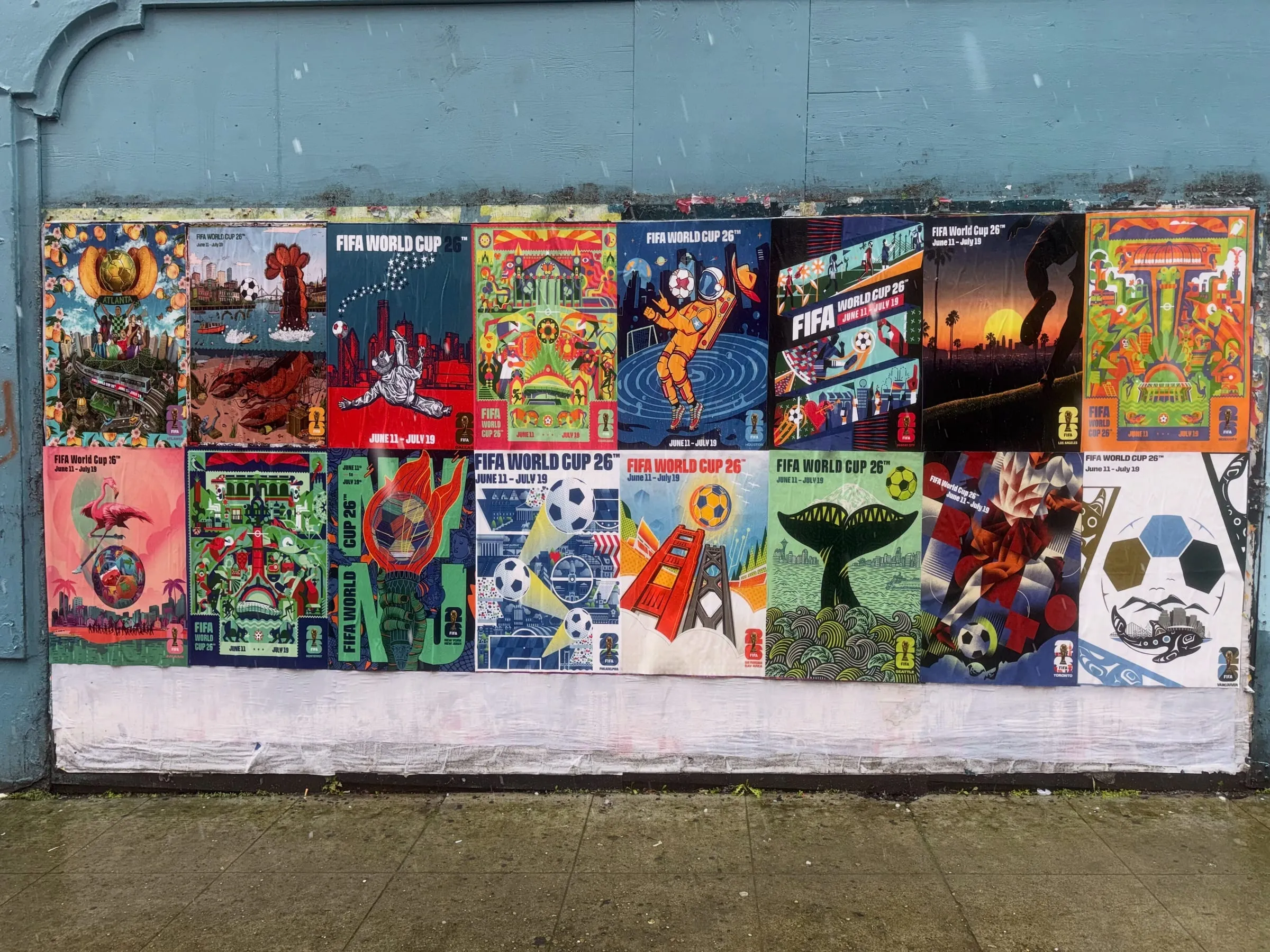
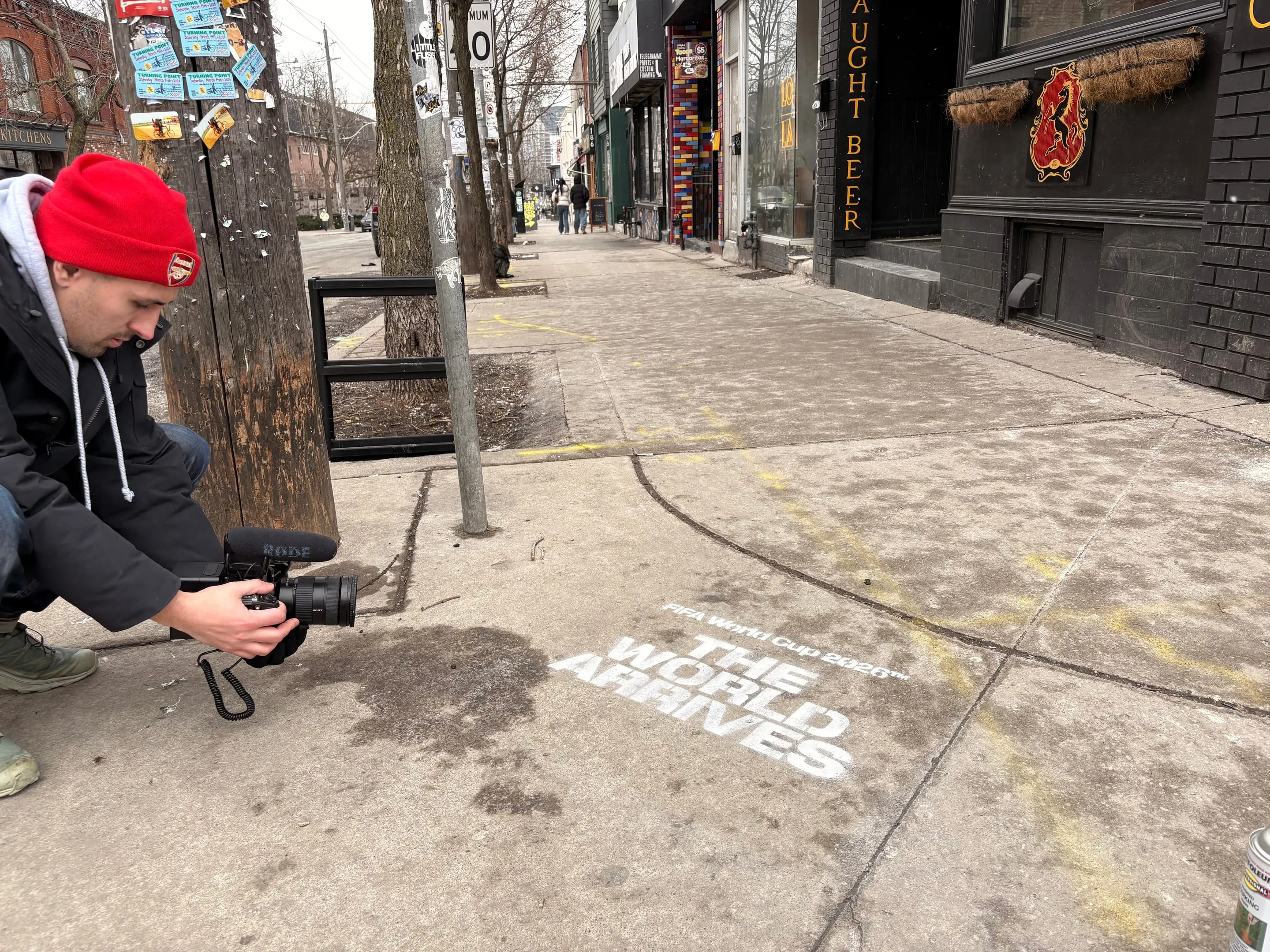
Beyond Street Media ran the FIFA World Cup 2026 host-city poster series in two markets. Seattle took 124 wheatpaste posters at 24 by 36 through Pioneer Square, six blocks from Lumen Field. Toronto took 30 sidewalk stencils through the downtown core, on the foot-traffic feeds toward BMO Field. That is 154 documented placements inside one 14-day activation window, every surface photographed and GPS-tagged on the way out. The full write-up of that run has the install detail.
Two things from that job carry into any lower-impact version of it. Crews already living in each market let both cities install on the same 24 to 48 hour schedule, which matters when a chalk campaign’s whole lifespan is two weeks. And the Toronto stencils went down in a chalk-safe paint that held 10 to 21 days, then wore off through foot traffic and weather on the tournament’s schedule rather than ours.
The reverse-stencil side has its own record. The Bloomeffects clean-tag run in New York went in at night: a pressure washer working through a stencil laid on a dirty sidewalk, the mark surfacing as clean concrete against the grime around it. Nothing was added to the surface, only grime taken off.
Across every format we run, the standing number is 500-plus documented installs with zero municipal removals on record.
Send a World Cup brief if you want a host-city activation: city, target fan district, campaign window in weeks before the match, and budget. We will come back with a chalk-stencil or reverse-stencil recommendation and a scouting plan within four business hours, and a scoped quote inside 24 to 48.