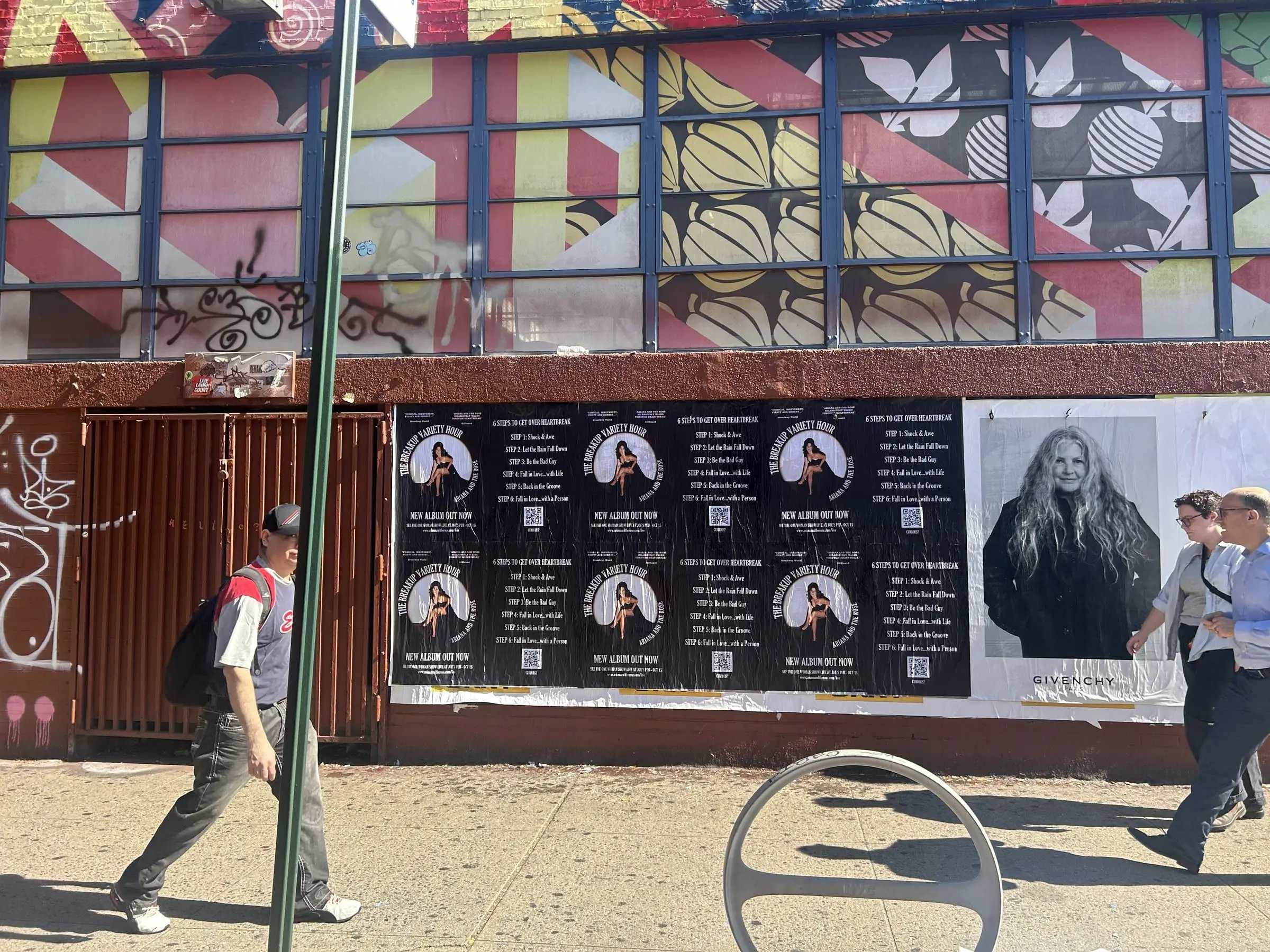
Our 50-state laws guide answers the first question every brand asks: is wheatpaste legal here. This answers the harder one that comes right after. You have a wall in mind, the clock is running on a launch, and you need to know how to actually get permission to paste it, and how fast.
The honest answer is that a clean, legal wall takes about a week from a standing start, and almost none of that week is paperwork with the city. It is finding the right surface and getting one signature. Here is the path we run.
The surface decides everything, not the poster
Wheatpaste is not illegal. Posting on the wrong surface is. The medium is paper and flour-and-water paste. What determines whether an install is legal is who owns the surface and whether they said yes in writing.
That leaves three surfaces you can legally use and one you cannot:
- A private wall, with the owner’s consent. The workhorse of every campaign.
- A construction scaffold or hoarding, with the contractor’s or developer’s sign-off. Often the fastest and largest legal surface in a city. See scaffold wrap advertising and construction hoarding posters.
- A wall inside a sanctioned program, where some Business Improvement Districts run permitted poster slots.
- Public infrastructure is off-limits everywhere: utility poles, traffic signs, transit property, government buildings, mailboxes. That is the line that turns a campaign into a sanitation ticket in every state. The statute that governs it in your state is in the laws guide.
Day 1: Identify the surface and who controls it
Pick the exact wall before you do anything else. A specific surface turns “we want to be in SoHo” into a single phone call.
Then find who controls it, which is not always the obvious party:
- A vacant or commercial wall: the building owner, or the lessee if the lease grants exterior rights.
- A construction scaffold or hoarding: the contractor or the developer, not the building owner.
- A storefront or gallery wall: the tenant, who often says yes faster than a landlord.
The fastest week starts here. Most delays are not legal. They are spent finding the right name and number.
Days 1 to 3: Get written property-owner consent
This is the document that makes the whole thing legal: a signed consent letter that names the property owner or authorized party and the address, the exact surface and approximate square footage, the install and removal dates, and the installer.
That letter is your legal cover and your proof. Keep it on file for the life of the campaign. On our installs it lives in the client portal next to the photo log, so the consent and the placement are documented together.
If you are working a multi-wall run, build a relationship book of owners and BID contacts you can call again. A standing yes from last quarter compresses the consent step from days to a phone call.
Days 2 to 4: Confirm whether a city sign permit applies
Here is the part that scares brands and rarely needs to: most private-wall paste-ups need no city permit at all. Permission from the owner is the permission that matters.
A city sign permit comes into play in specific cases:
- Large-format installs. Many cities regulate signage above a square-footage threshold, often around 32 square feet, even on private property.
- Historic and landmarked districts. Designated facades and historic overlays add a review step regardless of size.
- Scaffold and sidewalk-shed advertising. Some cities license advertising on construction sheds separately.
When one of those applies, the check is the local sign code, not a guessing game. Read it before you print.
Days 5 to 7: Print, stage, install with proof
With the surface confirmed and the consent signed, the last three days are production and install. Print to the confirmed dimensions, stage the materials, and install with documentation: three photos per wall, wide, mid, and detail, GPS-stamped and time-stamped.
That photo log is not a vanity deliverable. It is the evidence that the wall ran where the consent said it would, for the dates it said it would. One surface, one signature, one sign-code check, one documented install.
The city-by-city checklist
The process is the same in every market. What changes is the local sign code and which districts trigger extra review. The top five US markets:
- New York City. Private-wall consent is the rule. The strictest review is in landmarked and historic districts (SoHo, Tribeca, the Lower East Side) and above large-format signage thresholds. Public posting on street fixtures is ticketed per sheet. See NYC coverage.
- Los Angeles. Owner consent governs. Watch the citywide sign ordinance for large-format and the historic-preservation overlay zones. See LA coverage.
- Chicago. Owner consent governs. Landmark districts and the municipal sign code apply to large installs. See Chicago coverage.
- San Francisco. Owner consent governs. The planning code’s sign provisions and historic districts (the Mission, North Beach) add review for big formats. See San Francisco coverage.
- Miami. Owner consent governs. Miami Beach and historic districts carry their own signage rules, and Wynwood runs sanctioned wall programs that can be the fastest legal path in the city. See Miami coverage.
The 7-day checklist
- Name the exact surface you want.
- Find who controls it: owner, lessee, scaffold contractor, or BID.
- Get written consent: owner, address, surface, dates, installer.
- Check the local sign code for size, historic-district, and scaffold rules.
- Pull a sign permit only if one of those triggers applies.
- Print to the confirmed dimensions.
- Install with a GPS-stamped photo log and file it next to the consent.
When to hand it to an operator
All of the above is a week of work if you have the relationships and know which districts to watch. If you do not, it is where campaigns stall. We run the surface scouting, the consent paperwork, and the sign-code check in-house as part of wheatpaste advertising, and we keep the consent and the photo proof together in your portal.
If you have a launch window and a wall in mind, send the brief and we will come back with the path to a legal wall. The clean wall is the part nobody sees, until the one campaign that skipped it gets scraped off by Monday.