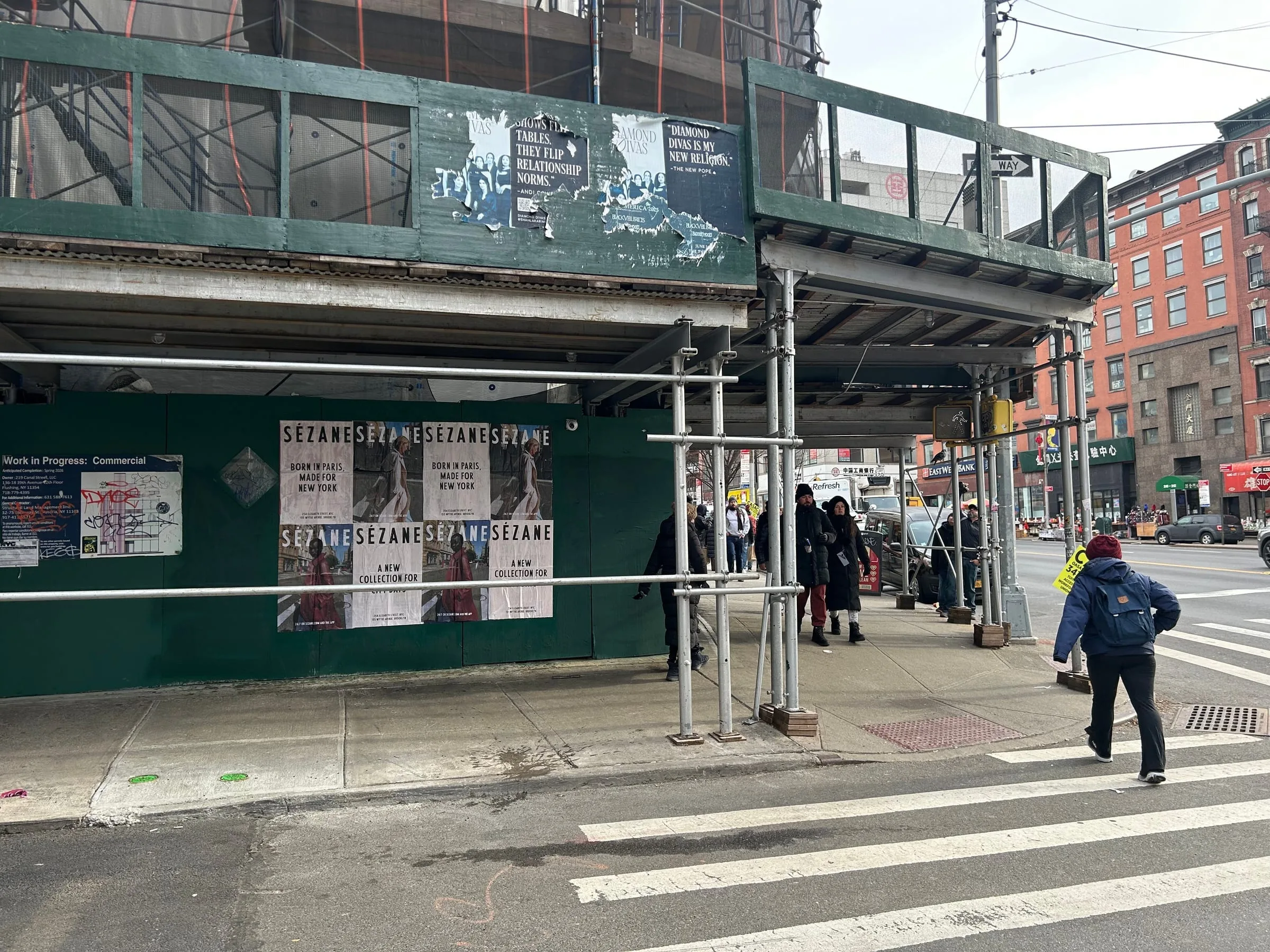
Guerrilla marketing is street-level brand activation built for foot traffic, press pickup, and word-of-mouth. It lives in high-traffic neighborhoods for 2–8 weeks, then disappears. The term originates from Jay Conrad Levinson’s 1984 book Guerrilla Marketing, which applied military strategy metaphors to marketing on minimal budgets. Today’s guerrilla is tactical: a $12,000 campaign reaches 5,000–15,000 qualified consumers in a specific city. Traditional advertising reaches millions indiscriminately and costs millions; guerrilla reaches thousands in one neighborhood for five figures.
This guide covers the six core formats, real cost ranges, the legal landscape, ROI measurement, and how to vet an agency.
What Is Guerrilla Marketing?
Guerrilla marketing is physical, location-based brand activation using unconventional media in high-foot-traffic urban spaces. Unlike billboard or TV advertising, guerrilla campaigns don’t broadcast nationally. They’re targeted to one or two neighborhoods where your audience lives, works, or spends leisure time.
Core characteristics:
- Physical: the campaign exists on a wall, a pole, a sidewalk, or inside a retail/transit space. Consumers encounter it in their daily commute.
- Ephemeral: the campaign lives 2–8 weeks, then the wall is painted over, the sticker weathers, or the creative is removed. That constraint forces designers to maximize impact in a short window.
- Location-specific: you’re buying placements in a geography, not broadcast reach. A campaign might target Brooklyn’s Williamsburg neighborhood, not “Brooklyn,” not “New York,” not “nationally.”
- Measurable by foot-stops: success is measured by how many people slowed down to read the creative, took a photo, or visited a retail location. Not CPM or broadcast impressions.
- High design intensity: because the campaign lives in a short window and competes for street-level attention, the creative has to be unusually strong. A mediocre guerrilla campaign is invisible. A strong one stops foot traffic and generates press pickup.
Guerrilla is not a replacement for national media buying. It’s an amplifier within a blended media mix. Paid social reaches your broad audience; guerrilla creates the “moment” that activates word-of-mouth and press.
A Brief History: From Levinson to Street Media
Jay Conrad Levinson published Guerrilla Marketing in 1984, positioning the approach as a strategy for small businesses with minimal budgets to compete against large-budget advertisers. The core insight: unconventional, high-impact tactics could deliver awareness and traffic at a fraction of traditional media cost.
Levinson’s early examples were tactical and low-cost: stenciled messages on sidewalks, leafleting at bus stops, guerrilla PR stunts. The philosophy was “do something unexpected where your audience already is, rather than buying expensive media to reach them.”
By the early 2000s, guerrilla had evolved. Brands began using stencils, wheat paste, and street installations as premium creative, not “budget workarounds,” but intentional brand statements. Nike, Coca-Cola, and automotive brands deployed large-scale stencil and wheatpaste campaigns across urban centers, often with permits and property owner agreements.
Today’s guerrilla (2020s) is operationalized. What was once ad-hoc is now systematic: agencies maintain networks of local installers in 20–40 cities, use GPS-tagged photo proofs for accountability, and integrate campaigns with social media marketing and press outreach. Guerrilla has become a formal media channel with transparent pricing, predictable timelines, and measurable ROI.
The shift from “Levinson’s grassroots hustle” to “branded street media” reflects a broader change: brands now see urban neighborhoods as a media ecosystem, not just a sales geography. Foot traffic, Instagram-native creative, and earned press are all valued alongside traditional conversion metrics.
The Six Core Formats
Modern guerrilla breaks into six distinct formats, each with a different cost structure, lifespan, legal profile, and foot-traffic impact.
Format 1: Wheatpaste Advertising
Wheatpaste is a full-color poster adhered to a wall or utility box using wheat-based biodegradable paste. The format dominates guerrilla marketing because it’s high-visibility, Instagram-native, and fast-turnaround.
Production: Design is a full-color 18x24 or 27x40 artwork. Print is offset or digital on 100 lb cover stock. Paste is wheat flour and water (or a proprietary wheat-based formulation, no synthetic adhesives). Lifespan is 4–8 weeks depending on weather, foot traffic, and wall exposure.
Cost: Wheatpaste campaigns start at $3,500 in major cities (NYC, LA, SF, Miami, Chicago, Seattle). That covers design refinement, print production, shipping or local print, installation labor, and any property owner fees. Range varies by turnaround, size, location count, and combined service mix. Final quote returns inside 24 to 48 hours.
Legal: Wheatpaste requires explicit property owner consent (residential or commercial property) or a city permit (rare, most cities don’t permit advertising on public infrastructure). Agencies maintain relationships with property owners who allow campaigns on their walls. The property owner signs a simple agreement (duration, removal timeline, brand guidelines).
Best for: Brand awareness, product launches, event promotion, press pickup. Wheatpaste dominates social media and press because the creative is large, bold, and designed for a 40-foot street viewing distance.
Link to wheatpaste-advertising service page
Format 2: Sidewalk Stencil Campaigns
Sidewalk stencils use a hand-cut or laser-cut stencil mask (aluminum, plastic, or mylar) to spray chalk, paint, or biodegradable ink through the mask, creating a precise image on concrete, brick, or asphalt.
Production: Design is a simplified vector artwork (2–4 colors maximum, high contrast). Stencil is laser-cut aluminum or hand-cut mylar. Spraying is done with chalk-based spray, soy-based acrylic, or biodegradable chalk mix. Lifespan is 7–21 days for chalk (dissolves in rain), 4–8 weeks for paint.
Cost: Sidewalk stencil campaigns start at $2,500, including design, stencil production or rental, spray material, and labor. Range varies by turnaround, size, location count, and combined service mix. Final quote returns inside 24 to 48 hours. Stencils run a lower floor than wheatpaste but generally need more placements to achieve saturation.
Legal: Sidewalk stencil campaigns require property owner or city permission, same as wheatpaste. Some cities (LA, NYC in certain neighborhoods, Seattle) have softer enforcement on chalk-based stencils if they’re designed to wash off quickly. Always confirm with local property owners before installing.
Best for: Direct response (QR code, promo code, event date), high-foot-traffic corridors, event promotion, environmental/low-impact messaging. Stencils force copy clarity because the format is small and high-contrast. A messy stencil is unreadable; a clean one reads from 50 feet.
Link to chalk-stencil-campaigns service page
Format 3: Pole Sticker Campaigns
Pole stickers are small vinyl or paper stickers (4–6 inches, typically) affixed to street-sign poles, light poles, parking meters, and utility poles. They’re the high-volume saturation format.
Production: Design is small (4x6, 5x7, 4x8, landscape or portrait). Print is vinyl or weatherproof paper. Application is sticker-adhesive (permanent or removable depending on city code). Lifespan is 8–12 weeks depending on weather and foot traffic, longer if the sticker is in a covered or protected area.
Cost: Pole sticker campaigns start at $3,000, including print and labor. Range varies by turnaround, size, location count, and combined service mix. Final quote returns inside 24 to 48 hours. The value is saturation, a consumer walking the same route sees the sticker on multiple poles, creating frequency and recall without the cost of a large wheatpaste.
Legal: Pole stickers on public infrastructure (city poles, utility poles) are technically illegal in all US cities under municipal code. Enforcement varies wildly: NYC has a ‘look the other way’ policy in certain neighborhoods; LA is strict; Chicago has no-sticker zones. Private poles (parking lot, retail property) require only property owner permission. Most professional campaigns use a mix of private poles and carefully-selected public poles in low-enforcement neighborhoods.
Best for: High-volume, hyper-local campaigns (concert promotion, app launches, flash sales, political campaigns). Pole stickers are the workhorse of guerrilla marketing, cheap, fast-turn, good for rapid-response campaigns.
Link to pole-sticker-advertising service page
Format 4: Snipe Campaigns
A snipe is a small poster (11x14 or 18x24) wheat-pasted directly onto utility boxes, control boxes, or transit infrastructure. Snipes are smaller and faster than full wheatpaste but operate on the same wheat-paste principle.
Production: Design is simplified (2–3 colors, high contrast, text-heavy or symbol-heavy). Print is quick-turnaround digital or offset on cheaper paper stock. Paste is wheat-based. Lifespan is 3–6 weeks depending on foot traffic and weather.
Cost: Snipe campaigns start at $3,000, including design, print, and labor. Range varies by turnaround, size, location count, and combined service mix. Final quote returns inside 24 to 48 hours. Snipes run a lower floor than wheatpaste and are faster to produce, but they’re lower-visibility, smaller format, and often placed on boxes that people walk past rather than stop and study.
Legal: Same as wheatpaste, requires property owner consent or city permit.
Best for: Rapid-response campaigns, high-turnover messaging (event dates, flash promotions), hyper-local saturation. Snipes are the guerrilla format when you need turnaround speed or when budget limits placement count.
Format 5: Mural Painting
Murals are large-scale painted installations (typically 20x40 feet or larger) on the side of a building or wall, created by a hired artist and designed to persist for months or years.
Production: Design is a large-scale illustration or vector artwork. Production involves artist procurement, property owner approval, city permits (often required for murals), scaffolding or lift rental, paint and materials, and artist labor (typically 3–7 days of work). Finish is durable paint (acrylic or specialized outdoor paint) designed to weather-proof.
Cost: Hand-painted murals start at $18,000, building-side murals from $30,000, depending on wall size, artist reputation, and city. Range varies by turnaround, size, location count, and combined service mix. Final quote returns inside 24 to 48 hours. Murals are the highest-production format and carry the longest lifespan (6 months to years).
Legal: Murals require explicit property owner permission and often city approval (zoning, building code, community review). Most cities have a simpler permit process for murals than for posters because murals are considered public art, not advertising. Some cities have dedicated mural permit programs that fast-track approval.
Best for: Heritage brands, cause-driven campaigns, landmark moments. A mural is a semi-permanent installation, it signals long-term commitment to a neighborhood and creates a location that people travel to see (Instagram tourism). Murals drive press pickup and social media because of their scale and visual impact.
Examples of BSM mural work: Hand-painted murals
Format 6: Interior Install
Interior installs place posters, stencils, or projection-based creative inside retail spaces, transit hubs, lobbies, venues, and public buildings. The format offers guaranteed foot traffic and demographic precision.
Production: Depends on format (poster, stencil, projection, or 3D object). Most interior installs are posters (8.5x11 up to 27x40) printed on paper or vinyl, mounted to walls or transit infrastructure. Lifespan depends on venue rules, some allow 2–4 week runs, others allow longer.
Cost: Interior install campaigns range based on venue and scale. Interior installs at major transit hubs (subway stations, airports, train stations) require advertising contracts with the transit authority, which sets its own media rates (often $5,000 to $15,000 per month per location). Retail pop-ups and venue takeovers typically range $5,000 to $15,000. Range varies by turnaround, size, location count, and combined service mix. Final quote returns inside 24 to 48 hours.
Legal: Interior installs require venue permission only. No city permit required (the property owner has already negotiated with the city if a permit is needed). Transit authority advertising is a formal process with rates and contracts.
Best for: Targeted demographic reach, guaranteed foot traffic, retail traffic drivers. If you know your audience frequents a specific transit hub or retail corridor, interior install delivers precision without the geographic uncertainty of street-level campaigns.
Examples of BSM interior work: Interior installs
Real Cost Ranges: Budget Planning
Guerrilla marketing cost is split between creative (design, art direction, production) and execution (installation labor, material, travel, logistics).
Single-Format Floors
Every campaign covers creative (design, art direction, production) and execution (installation labor, material, travel, logistics, documentation) inside one number. Floors by discipline:
- Wheatpaste: from $3,500
- Sidewalk stencils: from $2,500
- Pole stickers: from $3,000
- Snipes: from $3,000
- Sticker bombing: from $3,000
- Sidewalk decals / floor graphics: from $4,000
- Utility-box stickers: from $4,000
- A-frame signs: from $2,400
- Yard signs: from $2,800
- Street-furniture wraps: from $3,200
- Reverse stencil: from $3,500
- Street-pole takeover: from $8,500
- Scaffold wrap: from $12,000
- Hand-painted murals: from $18,000 (building-side from $30,000)
Range varies by turnaround, size, location count, and combined service mix. Final quote returns inside 24 to 48 hours.
Multi-City Budgets
A typical multi-city campaign spans several cities with a blended format approach (wheatpaste + stencil + pole stickers). Mid-tier multi-city campaigns typically range $15,000 to $40,000. Larger national campaigns scale from there. Per-city cost drops as design assets are reused and logistical overhead spreads across the run.
Range varies by turnaround, size, location count, and combined service mix. Final quote returns inside 24 to 48 hours.
ROI Metrics That Actually Matter
Guerrilla ROI is not measured by CPM or broadcast impressions. It lives in three dimensions: foot-stops, social media pickup, and attributed conversion.
Foot-Stops
A “foot-stop” is a documented instance of a consumer pausing, slowing, or engaging with the creative. Foot-stops are measured via:
- Photo/video evidence: field crew documents moments of engagement (person reading the stencil, taking a photo of the wheatpaste, pointing at the mural). Not scientific, but indicative of impact.
- Wall-eye dwell time: for interior installs or high-traffic walls, count how many people stop to look (not just walk past). A successful creative generates 10–20 percent foot-stop rate in high-traffic areas.
A 30-wall wheatpaste campaign might generate 200–500 documented foot-stops over a 4-week lifespan (average 7–17 per wall per day). If the location is a busy retail corridor, that number climbs.
Social Media Pickup
Organic social mentions and hashtag volume are tracked throughout the campaign.
- Hashtag volume: if the campaign includes a branded hashtag or campaign hashtag, monitor volume from launch through 4 weeks post-campaign. A successful campaign generates 500–2,000 organic mentions.
- Earned impressions: aggregate the reach of all organic mentions (users’ followers) to estimate total impressions. A consumer tags the creative, their followers see the post; that’s earned reach.
- Press pickup: count earned media mentions (news articles, blog posts, podcasts) that feature the campaign. Each press mention expands reach to hundreds of thousands.
A strong 30-wall wheatpaste campaign drives:
- 500–2,000 organic hashtag mentions
- 2–8 press mentions
- 50,000–500,000 total earned impressions (combination of social + press)
Attributed Conversion
If the campaign includes a promo code, QR link, or landing page, track redemption and traffic attribution.
- Promo code redemption: if the creative includes “STREETWALK20” or similar, measure how many customers redeemed the code. That’s direct-response attribution.
- QR link tracking: if the creative includes a QR code linking to a landing page, use UTM parameters to measure clicks and conversions (purchases, signups, retail visits).
- Location-based tracking: some brands use geofencing or foot-traffic attribution tools (PlaceIQ, Gravy Analytics) to measure retail visits that originated from people who saw the campaign in that area.
A successful campaign with a trackable endpoint (promo code or QR) might generate:
- 200–500 promo code redemptions
- 500–1,500 QR link clicks
- 50–200 attributed retail visits (depending on foot traffic and redemption window)
Calculating ROI
ROI = (Revenue - Cost) / Cost x 100
If a wheatpaste campaign costs $12,000 and drives 300 attributed store visits, each generating an average $50 in incremental revenue ($15,000 total), then:
ROI = ($15,000 - $12,000) / $12,000 x 100 = 25 percent
If the campaign also generates 5,000 social impressions and 2 press mentions (estimated value $8,000 in earned media equivalent), total attributed value is $23,000:
ROI = ($23,000 - $12,000) / $12,000 x 100 = 92 percent
ROI in guerrilla ranges from -20 percent (campaign fails to drive traffic or press) to 300+ percent (campaign goes viral, drives significant attributed traffic, and generates press pickup). Most well-executed campaigns land in the 50–150 percent range.
Format-to-Objective Matrix
Choose your format based on your primary goal:
| Objective | Best Format | Why |
|---|---|---|
| Brand awareness | Wheatpaste | High-visibility, Instagram-native, press-friendly |
| Direct response (promo code, QR) | Stencil or pole sticker | High legibility, high-frequency, clear CTA |
| High-volume saturation | Pole sticker | Cheap per unit, high frequency, neighborhood saturation |
| Event promotion | Wheatpaste + stencil | Large creative + clear event date + QR link |
| Landmark/heritage moment | Mural | Semi-permanent, scale, foot-traffic destination |
| Retail traffic driver | Interior install + geofencing | Guaranteed foot traffic, demographic precision, tracking |
| Rapid-response campaign | Snipe or pole sticker | Fast turnaround, cheap, deployed quickly |
| Cause/advocacy | Wheatpaste + mural | High visibility, shareable, press pickup |
Most successful campaigns use 2–3 formats: a large-format anchor (wheatpaste or mural) for awareness and press, a stencil or snipe for direct response, and pole stickers for saturation and frequency.
The Legal Landscape: What You Need to Know
Guerrilla marketing operates in a gray zone between legal and illegal depending on city, format, and property status.
Wheatpaste and Stencil: Consent Rules
Wheatpaste and sidewalk stencils are considered defacement under municipal code unless they have explicit property owner consent. The rule is consistent nationwide: if the wall is privately owned (residential building, storefront, office building), the property owner must agree in writing. If it’s public infrastructure (city wall, utility box, underpass), you need a city permit (rare, most cities don’t allow commercial advertising on public land).
Smart agencies maintain relationships with property owners who allow campaigns on their walls. The agreement is simple: a one-page document stating duration (e.g., “2 weeks to 8 weeks”), removal timeline (e.g., “campaign owner agrees to remove or paint over by [date]”), and brand guidelines (e.g., “no political content”). The property owner receives a small fee ($20–$100) or a donation to a local cause.
Pole Stickers: The Gray Zone
Pole stickers on public infrastructure (city poles, utility poles, light poles) are technically illegal under municipal code in all US cities. Technically. Enforcement, however, varies wildly.
- NYC: Look-the-other-way policy in certain neighborhoods (Williamsburg, Bushwick, East Village, parts of Astoria). Enforcement in Midtown and Brooklyn Heights is stricter.
- LA: Strict enforcement. Agencies scout legal private poles (parking lot posts, retail property). Public poles result in removal and fines.
- SF: Moderate enforcement. Some poles are ignored; others are monitored.
- Chicago: Designated no-sticker zones around the Loop and near transit. Other neighborhoods have softer enforcement.
- Miami, Atlanta, Philadelphia: Variable. Best practice is to use private poles only.
Professional agencies maintain city-specific pole scouting lists: which poles are public (avoid or accept removal risk), which are private (safe). They also build removal timelines into expectations: a sticker might stay up 4–12 weeks, but the client should assume removal is possible and plan messaging accordingly.
Permits: When to File
City permits are available for:
- Murals: Most cities have a mural permit process (faster and cheaper than general advertising permits).
- Interior installs: Transit advertising (subway, bus, light rail) has formal permit and contract processes managed by the transit authority.
- Large wheatpaste campaigns: Some cities (rare) allow temporary advertising permits for grassroots or cause campaigns. Check with the city zoning office.
Filing a permit costs $100–$1,000 depending on the city and project scope. Timelines vary: mural permits range from 2 weeks to 3 months. It’s worth filing if you want legal certainty, long-term duration, or protection against removal.
Liability and Insurance
Professional agencies carry liability insurance (general liability, errors & omissions) to protect the client if a campaign causes damage or a legal dispute. Policy cost is typically $1,500–$3,000 per year for an agency. That cost is built into the campaign cost.
Red flags: agencies with no insurance, agencies that won’t disclose whether they have insurance, agencies that claim they operate “under the radar” to avoid costs.
When Guerrilla Works (and When It Doesn’t)
Guerrilla Works When:
-
You have a clear geographic target. Guerrilla is place-based. If your audience lives in Brooklyn, SF, or Austin, guerrilla makes sense. If your audience is “national” or “online-only,” guerrilla is overkill.
-
Your audience lives and spends time in that geography. Your audience should be commuting through the neighborhoods where you’re installing. DTC fashion brands work in Williamsburg. B2B tech doesn’t.
-
You want high-impact, low-frequency reach. Guerrilla delivers 1–5 touchpoints per consumer per week (e.g., walking past 3 pole stickers on their commute). That’s low-frequency but high-impact if the creative is strong. Good for awareness and press pickup, not for frequency-based conversion campaigns (retargeting, email nurture).
-
You have a trackable endpoint. A retail location, an app, an event, a promo code. Something that lets you measure traffic attribution.
-
You can afford 4–8 week lead time. Scouting, permitting, design, production, installation takes time. If you need to launch a campaign in 2 weeks, use social paid or influencer instead.
-
Your budget is $10,000 or higher per city. Below that, you don’t have enough placements to achieve saturation or press pickup. You’ll spend the same on scouting and logistics as a $15,000 campaign, but with fewer placements and less impact.
-
Your brand benefits from “ground truth” or hyperlocal credibility. Guerrilla signals that you care enough about a neighborhood to show up physically. Good for local brands, cultural brands, activist campaigns, and DTC fashion. Bad for mainstream national brands that already have expensive TV and digital presence.
Guerrilla Doesn’t Work When:
-
Your audience is distributed nationally. Guerrilla reaches 1,000–5,000 people per city. If your audience is “all of America,” you’re buying 50+ cities at $200,000+ total budget. That’s a blended media buy, and you’d be better served by national digital platforms.
-
Your product is invisible or non-consumer. B2B SaaS, financial services, managed services. Guerrilla is visual and foot-traffic dependent. If your buyer is a CFO sitting in an office tower, they’re not seeing the pole sticker on their commute.
-
You need rapid response (sub-2 week turnaround). Scouting, design, permits, print, installation takes time. If you need to react to breaking news or a viral moment, use social paid or influencer outreach instead.
-
Your budget is under $5,000 total. You don’t have enough for meaningful execution. You’ll spend $3,000 on scouting and design, leaving only $2,000 for 4–6 placements. That’s too sparse to drive press or saturation.
-
Your target neighborhood has low foot traffic. Suburban or rural areas, low-density office parks, dead retail corridors. Guerrilla requires dense foot traffic. Place it where nobody walks and it’s invisible.
-
You’re a fast-moving category that doesn’t benefit from permanence. Fast food, seasonal promotions, flash sales. Guerrilla lives on walls for weeks; if your message is “this weekend only,” the timing doesn’t match. Better to use paid social for fast-moving offers.
-
You operate in a hostile regulatory environment. Some cities (LA, San Jose) have strict anti-graffiti enforcement and anti-advertising poles. Agencies in those cities have fewer legal options and higher permitting costs. If you need to operate in strict cities, budget more and expect lower placement counts.
How to Choose a Guerrilla Agency: 7-Step Vetting Framework
Most guerrilla agencies are small (5–15 people) and city-based. They typically cover one primary city and 2–4 secondary cities through partnerships. When evaluating an agency, assess these seven dimensions.
Step 1: Scope Clarity
Does the agency ask specific questions about your goal?
- What cities?
- What neighborhoods within those cities?
- What audience demographics?
- What foot-traffic profile (commute corridor, retail strip, entertainment district)?
- What message and creative format?
- What’s your trackable endpoint (promo code, QR, retail location)?
Good agencies ask these questions before quoting. They say, “Let’s understand your objective first, then recommend a format and budget.”
Bad agencies pitch a generic “guerrilla brand activation” without digging into specifics. They say, “We’ll do a 30-wall campaign” without asking what cities, what neighborhoods, what foot traffic, or what success looks like.
Step 2: Proof Standards
How do they document installations?
Ask: “Do you GPS-tag every install, photograph pre/post, and deliver a timestamped proof deck?”
Good agencies answer: “Yes. Every install is GPS-tagged. We photograph baseline (before), post-install (immediately after), and in-context (showing foot traffic and engagement). All timestamps are included. You get a proof deck within 48 hours of installation.”
Bad agencies say: “We take photos” or “We have crews who document” or “Estimated reach is 500,000.” Vague answers are a red flag.
Demand specificity: you want proof that every placement was installed, photographed, and is still standing on a specific wall on a specific date.
Step 3: Permit Handling
Do they file permits where required? Do they have property owner agreements in writing?
Ask: “How do you handle permits and property owner consent?”
Good agencies answer: “For wheatpaste campaigns in most cities, we maintain relationships with property owners who give us standing permission to install. For each campaign, we confirm consent in writing. For murals and high-profile locations, we file city permits. We carry liability insurance.”
Bad agencies say: “We don’t need permits” or “We work with partners who handle that” (vague) or “Permits slow things down, so we avoid them.” That’s a sign they’re not operating clean.
Step 4: Pricing Transparency
Do they publish per-unit cost and explain the total?
Ask: “What does a wheatpaste cost per wall? What’s included?”
Good agencies answer: “Wheatpaste campaigns start at $3,500 in NYC. That includes design refinement, print production, wheat paste material, installation labor, and property owner fees. Range varies by turnaround, size, location count, and combined service mix. Final quote returns inside 24 to 48 hours. Here’s the breakdown [spreadsheet or quote].”
Bad agencies say: “It depends” or “We need to submit an RFP” or “Pricing is confidential until we know more details.” That’s consultant-speak. You’re not buying a six-month engagement; you’re buying 30 poster installations. The price should be straightforward.
Step 5: Timeline Reality
What’s the real lead time?
Ask: “What’s the minimum lead time from brief to first install?”
Good agencies answer: “Design and scouting take 1 week. Print takes 3–5 days. Installation happens over 2–3 days. Total: 2–3 weeks minimum from brief to first install on the wall.”
Bad agencies say: “We can launch in 2 days” (unrealistic unless it’s a small scouted campaign they’ve already designed) or “It depends on the cities” (vague).
Step 6: Deliverables Checklist
What’s in the final wrap package?
Ask: “What deliverables do I get at the end of the campaign?”
Good agencies deliver:
- Pre-launch scouting report (neighborhood, foot-traffic notes, wall inventory)
- Timestamped proof-of-placement photos (every wall, GPS coords)
- Social media tracking report (hashtag volume, earned media links)
- Final wrap report (placement count, lifespan, foot-stops, attribution if promo code was used)
- Brand-safe creative files
Bad agencies deliver vague “a photo gallery” or “estimated reach numbers.” Demand specificity.
Step 7: Contract Terms
What does the contract say about cancellation, IP, and indemnification?
Ask: “Can I cancel mid-campaign? What’s the liability? Who owns the creative?”
Good agencies have transparent contracts with:
- Cancellation clause: “If campaign is cancelled before all placements install, client pays for scouting + design + installations completed to date. Remaining balance is refunded.”
- IP: “Client owns all creative. Agency retains the right to use completed campaign for case studies and portfolio work.”
- Indemnification: “Agency indemnifies client against defacement claims related to installations (property owner disputes, city fines). Client indemnifies agency against defamation or trademark claims related to the message.”
Bad agencies have vague or one-sided contracts. Walk away if they won’t clarify terms.
Red Flags: When to Walk Away
-
“Estimated reach of 500,000 people.” Reach is unverifiable. How do they know 500,000 people saw the wall? Demand foot-stops or social pickup instead.
-
“We can’t disclose our pricing.” Pricing secrecy is a sign of either: a) they’re overcharging and don’t want to be compared, or b) they don’t actually know the cost. Either is bad.
-
“We partner with local crews who keep their names confidential.” Crews should be named and trained. Anonymity is a sign they’re not managing quality or compliance.
-
“Permits slow things down, so we skip them.” That’s not efficiency; that’s risk. You’re liable if they get fined or sued.
-
“Our reach estimate is conservative: 250,000 impressions.” Still unverifiable. Stop asking for estimates and start asking for proof.
-
“We have 20 years of experience.” Maybe. But do they have GPS-tagged photos of current campaigns? Can they show you a 2024 wrap report? Old experience doesn’t matter if their current work is sloppy.
-
“We’ll email you updates weekly.” Updates are good, but demand photo proof and GPS coordinates, not email summaries.
-
“Cancellation is not allowed, it’s a commitment.” If they won’t let you cancel, assume they’re either confident in the work (good) or don’t want you to see how mediocre it is mid-campaign (bad). Demand a cancellation clause.
FAQs
See frontmatter for additional Q&As.
Guerrilla marketing is a channel, not a tactic. It lives in the streets where your audience lives. The work ships. The photos come back. That is the operation.
Send a brief if you want to test: neighborhood, format, budget, and success metric (foot-stops, social pickup, attributed traffic). We’ll recommend a format, deliver a scouting plan, and execute a wrap-deck within the timeline.